Published Date: December 17, 2025
Updated Date: December 17, 2025
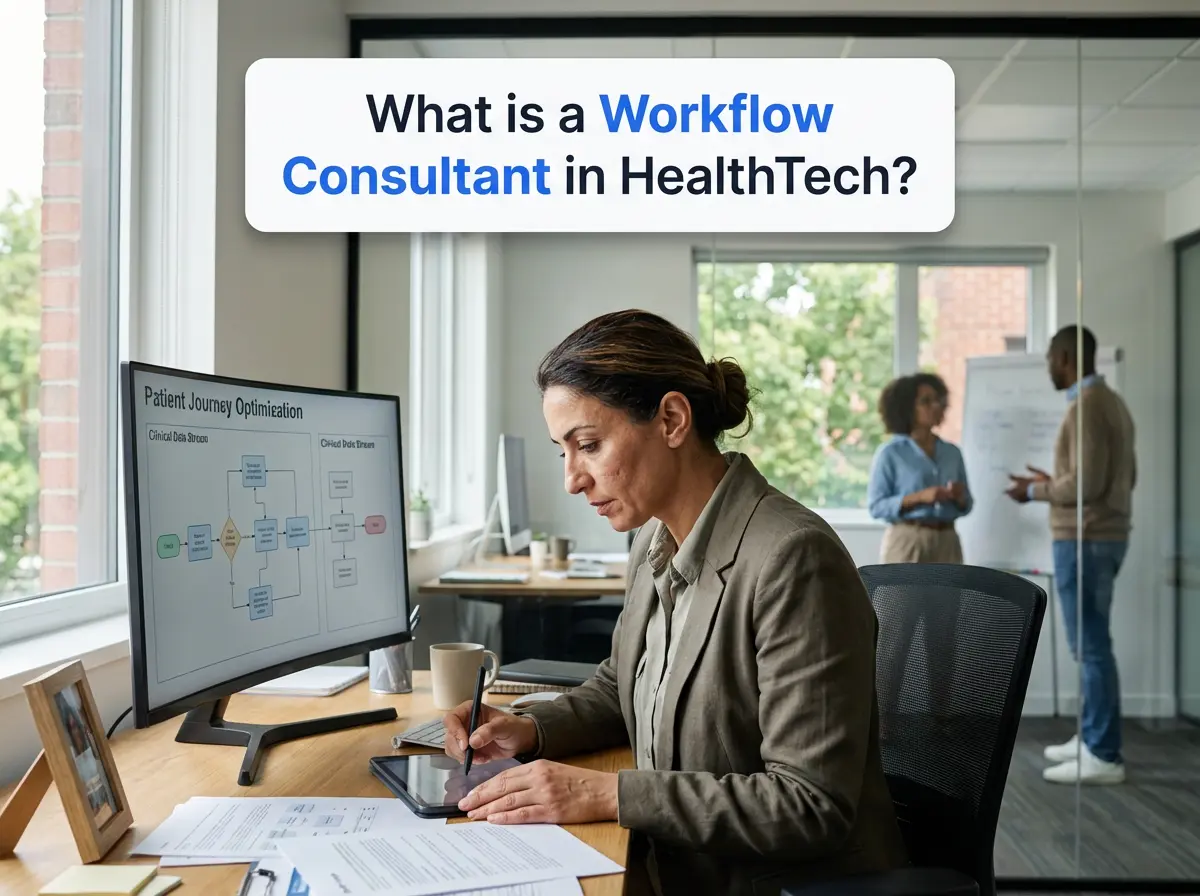
What is a Workflow Consultant in HealthTech?
A Workflow Consultant in HealthTech is a specialist who takes ownership of how work actually happens across clinical, operational, and digital systems, and is accountable for getting those workflows to a safe, measurable "works in the real world" state. They sit at the intersection of frontline teams, service leadership, and the teams building or implementing technology, and they translate messy reality into decisions that a product, platform, or programme can sustain.
This role exists because healthcare workflows are rarely "just process": they are a chain of clinical judgement, operational capacity, data capture, handovers, and safety checks, often spanning multiple teams and systems. When a HealthTech product is introduced (or an existing system is changed), the biggest risk is not the software working; it's the workflow breaking in ways that harm outcomes, slow services, or create unsafe workarounds.
A strong Workflow Consultant is therefore defined less by methods and more by ownership: they are responsible for the end-to-end integrity of a workflow as it moves from policy and intent, through configuration and training, into day-to-day use. Then they stay accountable when reality challenges the design.
🔍 How this role differs in HealthTech
In many tech industries, workflows are optimised mainly for conversion, efficiency, or customer experience within a single product boundary. In HealthTech, workflows cross organisational boundaries, professional roles, and physical environments. Decisions are constrained by service pressures, clinical risk, data sensitivity, and the non-negotiable requirement that care still happens when systems are imperfect.
That changes what "good" looks like. A workflow that's elegant in a workshop can be unsafe at 3am on a short-staffed ward, or unworkable when a clinic is running late and patients are queueing. HealthTech workflow work also tends to be more evidence and governance-heavy: changes need clearer justification, stronger stakeholder alignment, and tighter control over unintended consequences. The consultant is often operating in a setting where adoption is not simply a matter of preference. People must use the workflow correctly, consistently, and under pressure.
🎯 Core responsibilities in HealthTech
Day to day, the Workflow Consultant is accountable for understanding the current state, defining what "better" means in operational and clinical terms, and then shaping a future-state workflow that can be implemented without creating hidden risk. They spend significant time with frontline teams to observe where the work truly happens: handoffs, exceptions, interruptions, informal escalation paths. Then they make decisions about what must be standardised, what can remain flexible, and what needs explicit guardrails.
In many HealthTech contexts, they also carry responsibility for turning workflow intent into implementable requirements: what must be configured, what must be enforced, what can be guided, and what must be trained. They are expected to manage trade-offs openly (speed versus safety, data completeness versus clinician time, local variation versus standardisation) then document those decisions so that leadership can sponsor them and teams can operate with confidence.
Crucially, they do not disappear after "go-live". They own the consequences: adoption gaps, workflow drift, exception volumes, incident patterns, and the need to iterate while keeping services safe and running.
🧩 Skills and competencies for HealthTech
Core Skill | HealthTech specific requirement | Reason or Impact |
|---|---|---|
Workflow ownership | Taking responsibility for end-to-end workflow performance across people, process, and system behaviour, including failure modes and exceptions | Prevents "it worked in design" outcomes and creates a single accountable thread from intent to frontline reality |
Clinical-operational judgement | Knowing when a workflow change alters clinical risk, capacity, or patient experience, and escalating appropriately | Avoids optimising for convenience whilst inadvertently increasing harm, delays, or unsafe workarounds |
Stakeholder facilitation | Running workshops that surface real constraints (time, staffing, professional boundaries) rather than only idealised process maps | Produces implementable workflows that teams will actually use under pressure |
Requirements translation | Converting ambiguous frontline needs into testable, buildable requirements without losing safety-critical nuance | Reduces rework, misconfiguration, and "requirements theatre" where nothing lands in the system correctly |
Change control discipline | Managing workflow changes with clear approvals, impact assessment, and rollout planning, even when services want rapid fixes | Protects service continuity and reduces incident risk from uncontrolled changes |
Adoption and capability-building | Designing workflows with training, reference materials, and local ownership in mind, not as an afterthought | Increases sustained usage and reduces support burden and shadow processes |
Data and measurement mindset | Defining what "better" means using operational and safety indicators, not just anecdotal feedback | Enables evidence-based optimisation and supports leadership decisions on scaling or rollback |
💷 Salary ranges in UK HealthTech
Workflow Consultant pay is driven primarily by the scope of ownership (single pathway vs multi-site programme), the criticality of the workflows being changed (care delivery vs back office), the depth of domain knowledge required (clinical vs administrative), and whether the role carries high-pressure support expectations (go-lives, hypercare, incident response). Location matters, but so does the environment: vendor/implementation roles can pay differently to provider-side optimisation roles, and regulated constraints can increase the premium for proven judgement.
Experience level | Estimated annual salary range | What drives compensation |
Junior | London & South East: £30,000–£40,000 | Exposure to clinical/operational settings, ability to capture requirements reliably, confidence with governed documentation and change processes |
Mid-level | London & South East: £40,000–£55,000 | Owning a workflow area end-to-end, handling exceptions and stakeholder conflict, translating needs into implementable designs with minimal oversight |
Senior | London & South East: £55,000–£75,000 | Multi-workstream ownership, higher-risk pathways, leading design decisions under constraint, accountable delivery through go-live and optimisation |
Lead | London & South East: £75,000–£95,000 | Programme-level influence, governance leadership, standardisation across sites, coaching others, and shaping how workflow decisions are made and assured |
Head / Director | London & South East: £95,000–£130,000 | Org-wide accountability, strategy and operating model ownership, executive stakeholder management, delivery risk ownership, and measurable outcomes across services |
Beyond base salary, typical add-ons include performance-related bonus (more common in vendors and scale-ups), pension and benefits, and, where the work includes go-lives or operational support, enhanced pay for extended hours, travel, or time-critical incident coverage. Equity can appear in growth-stage companies, usually increasing with seniority and commercial responsibility. Total compensation varies most with the size and complexity of deployments, the expectation to travel, and whether the role is tied to revenue delivery (pre/post-sales) versus internal service optimisation.
🚀 Career pathways
Common entry points include clinical backgrounds moving into digital transformation, operational improvement professionals stepping into HealthTech implementations, or health informatics/application support specialists expanding into workflow ownership. Early progression usually comes from taking responsibility for a defined workflow slice: owning discovery, agreeing the design, supporting build and testing, and proving adoption in practice.
As responsibility expands, the role shifts from "make this workflow work" to "make workflow change safe and scalable". That includes standardising across teams, building governance that accelerates decision-making without losing control, and developing measurement that shows impact. The strongest progression is typically earned by owning the hardest parts: exceptions, trade-offs, stakeholder conflict, and the operational reality after launch, not by collecting titles.
❓ FAQ
Do I need a clinical background to be hired as a Workflow Consultant in HealthTech?
Not always, but you do need credible fluency in how care delivery and operations work day to day. Clinical experience can accelerate trust with frontline teams, whilst non-clinical candidates often succeed by demonstrating structured discovery, strong facilitation, and an ability to handle safety and governance constraints.
What will I be assessed on in interviews for workflow-focused roles?
Expect scenarios about conflicting stakeholder priorities, unsafe workarounds, and how you decide what gets standardised versus left flexible. Strong candidates show they can make and defend trade-offs, document decisions, and stay accountable through adoption and stabilisation.
Will this role involve on-call or out-of-hours work?
It depends on whether you're supporting go-lives, hypercare, or operational incident response. Some roles are standard office hours with planned travel; others require flexibility during deployment windows, including evenings or weekends, with compensation practices varying by employer.
🔎 Find your next role
Ready to step into workflow ownership in HealthTech? Search Workflow Consultant roles on Meeveem and find opportunities that match your domain, scope, and preferred environment.
You might also like