Published Date: December 12, 2025
Updated Date: December 12, 2025
What is a Clinical Data Manager in HealthTech?
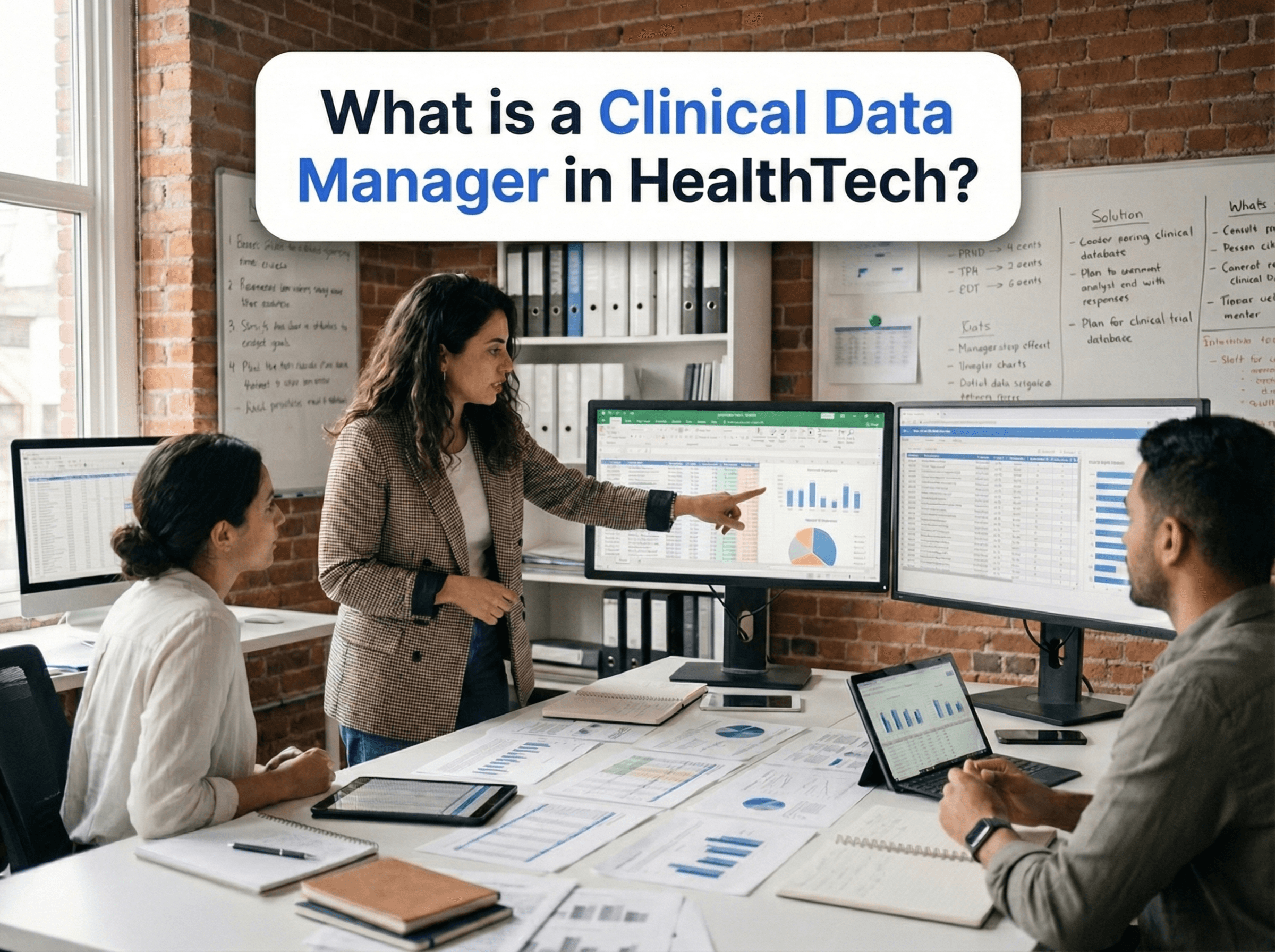
A Clinical Data Manager in HealthTech is the person accountable for turning clinical and patient-related data into a trustworthy, decision-ready asset across a product, study, or evidence programme. Their job exists because HealthTech decisions often carry clinical, regulatory, and reputational risk: if the data is wrong, incomplete, non-traceable, or handled incorrectly, you can't reliably demonstrate safety, performance, outcomes, or value.
This role is fundamentally about ownership. A Clinical Data Manager owns data integrity end to end: how data is defined, collected, validated, reconciled, locked, and handed off for analysis or reporting, so that teams can make defensible decisions and stand behind them under scrutiny. Methods (systems, checks, standards) matter, but they sit underneath the core responsibility: ensuring the organisation can trust its clinical data when it matters most.
🔍 How this role differs in HealthTech
In many tech sectors, "data management" can be optimised for speed, experimentation, or growth metrics, and errors may be reversible with limited real-world impact. In HealthTech, clinical data is closer to an evidentiary record. The tolerance for ambiguity is lower, and decisions are shaped by patient safety, privacy obligations, auditability, and the need for traceability from protocol intent to final analysis.
That changes how a Clinical Data Manager operates. They don't just "support reporting"; they protect the organisation's ability to make claims (internally and externally) without overreaching the data. They also work within constraints that are rarer in consumer or SaaS contexts: controlled data collection, strict change control, vendor and site variability, and the reality that you often can't "patch" a data mistake after the fact if it undermines interpretability or compliance.
🎯 Core responsibilities in HealthTech
Day to day, a Clinical Data Manager acts as the operational owner of data quality and readiness. They translate a protocol or evidence plan into a data strategy that is workable in the real world: what must be captured, what "good" looks like, how to prevent avoidable errors, and how to detect the rest quickly. They make judgement calls about what to standardise versus what to tailor, how strict to be with edit checks, and how to keep data clean without overburdening clinicians, sites, or product teams.
Much of the work is decision-making under constraint. Timelines rarely align perfectly with ideal data maturity, so the Clinical Data Manager orchestrates trade-offs: what can be cleaned now versus later, when a query is necessary versus noise, when a vendor deliverable is acceptable versus a risk, and how to lock a database with confidence. They typically sit at the centre of cross-functional tension: clinical operations wants speed, statisticians want analytical clarity, safety teams want reconciliation discipline, and engineering/product teams may want iterative changes. The Clinical Data Manager's accountability is to deliver an auditable, analysis-ready dataset without letting the programme drift into either "perfect but late" or "fast but indefensible."
🧩 Skills and competencies for HealthTech
Core Skill | HealthTech specific requirement | Reason or Impact |
|---|---|---|
Data integrity ownership | Ability to define what "fit for purpose" means for clinical evidence, not just "complete" | Prevents downstream rework and reduces the risk of decisions being challenged due to unclear provenance or inconsistent rules |
Protocol-to-data translation | Comfort interpreting clinical intent and turning it into precise, testable data definitions | Avoids collecting data that can't answer the question, or missing data that later proves critical to endpoints and safety interpretation |
Risk-based judgement | Knowing where strict controls are essential and where flexibility is safe | Improves timelines and site experience without compromising reliability, especially when evidence collection must scale |
Stakeholder negotiation | Ability to hold boundaries with clinical, stats, product, and vendors while staying collaborative | Protects data credibility when competing priorities would otherwise dilute standards or introduce uncontrolled changes |
Traceability mindset | Maintaining clear lineage from collection through transformations to analysis-ready outputs | Supports confidence in results, smoother review cycles, and faster response when questions arise late in a programme |
Quality and audit readiness | Operating as if the work will be inspected, even when the team is moving quickly | Reduces organisational risk by ensuring decisions and changes are explainable, documented, and reproducible |
Vendor governance | Managing CROs, labs, ePRO, imaging, and data-transfer partners with measurable expectations | Prevents "black box" data problems and ensures issues are detected early, not after a missed milestone |
Privacy and sensitivity handling | Treating clinical and patient data as high-sensitivity by default | Minimises exposure risk and reinforces a culture where access, exports, and sharing are deliberate and defensible |
💷 Salary ranges in UK HealthTech
Pay is mainly driven by the scope of accountability (single study vs multi-study programme), the criticality of the evidence (safety signals, regulatory-facing deliverables, high-visibility outcomes), and the degree of ownership (hands-on execution vs leadership and governance). Location still matters, but in HealthTech, the biggest step-changes typically come from complexity (vendors, multiple data sources, standards expectations), autonomy, and whether the role carries accountability for database locks, inspection readiness, or cross-functional sign-off.
Experience level | Estimated annual salary range | What drives compensation |
Junior | London & South East: £28,000–£36,000 | Exposure to regulated data processes, supervision level, and whether the role is focused on support activities versus owning small deliverables |
Mid-level | London & South East: £35,000–£48,000 | Independent ownership of study data cleaning and documentation, confidence handling queries/reconciliation, and cross-functional reliability |
Senior | London & South East: £45,000–£60,000 | Leading end-to-end delivery for complex studies, vendor oversight, inspection-ready documentation, and consistent delivery against milestones |
Lead | London & South East: £55,000–£75,000 | Multi-study/programme leadership, governance of standards and processes, escalation ownership, and responsibility for database lock strategy |
Head / Director | London & South East: £75,000–£110,000 | Function ownership, operating model and resourcing, vendor strategy and budget accountability, quality framework, and organisational risk management |
Beyond base salary, total compensation commonly includes an annual bonus (often tied to company and delivery performance), and in some HealthTech companies, equity or option grants, more typical where the business model is product-led or venture-backed. On-call is not universal for this function, but if the role includes time-critical support around database locks, live-study incidents, or high-stakes data deliveries, compensation may be uplifted through allowances or higher base to reflect intensity. The largest variations usually come from how regulated and inspection-exposed the work is, how many external data sources/vendors are in play, and whether the person is accountable for governance across multiple programmes rather than a single study.
🚀 Career pathways
Most Clinical Data Managers in HealthTech enter through adjacent clinical research and data routes: clinical data coordinator roles, CRO delivery roles, clinical operations roles with strong data exposure, or analytics roles that move closer to evidence generation. Some also transition from healthcare informatics or clinical systems work if they can demonstrate disciplined data handling and an understanding of clinical context.
Progression tends to follow ownership rather than titles. Early growth is about reliably managing a study's data lifecycle with minimal oversight. Mid-career expansion comes from handling more complex data ecosystems (multiple vendors, richer endpoints, and tighter timelines) while still producing consistent, audit-ready outcomes. Moving into Lead roles is usually about governance: setting standards, designing operating rhythms, mentoring, and being the person accountable when timelines, quality, and cross-functional alignment collide. Head/Director progression is then about building a scalable function: resourcing models, vendor strategy, risk frameworks, and a culture where evidence quality is designed in, not inspected in at the end.
❓ FAQ
Do I need clinical trials experience to become a Clinical Data Manager in HealthTech? It depends on the HealthTech company's evidence model. If the work involves interventional studies, regulatory-facing evidence, or structured clinical research delivery, trial experience is strongly valued. If the focus is real-world data or product evidence, you may be able to transition with strong data governance skills and credible experience in handling sensitive healthcare data.
What will I be judged on in the first 90 days? Expect to be evaluated on whether you can bring order and clarity: defining data expectations, setting realistic cleaning and delivery rhythms, and spotting risk early. Hiring managers also look for how you handle cross-functional friction (staying calm, documenting decisions, and protecting data integrity without blocking progress).
Will I be on-call as a Clinical Data Manager in HealthTech? Often no, but "time-critical" periods do happen, especially around interim analyses, database snapshots, database lock, or urgent safety-related reconciliations. In smaller teams, you may be the escalation point outside normal hours during key milestones, so it's worth clarifying expectations and compensation structures during interviews.
🔎 Find your next role
Ready to apply your data integrity and evidence-delivery skills in HealthTech? Search Clinical Data Manager roles on Meeveem.
You might also like