Published Date: December 12, 2025
Updated Date: December 12, 2025
What is a Chief Medical Officer in HealthTech?
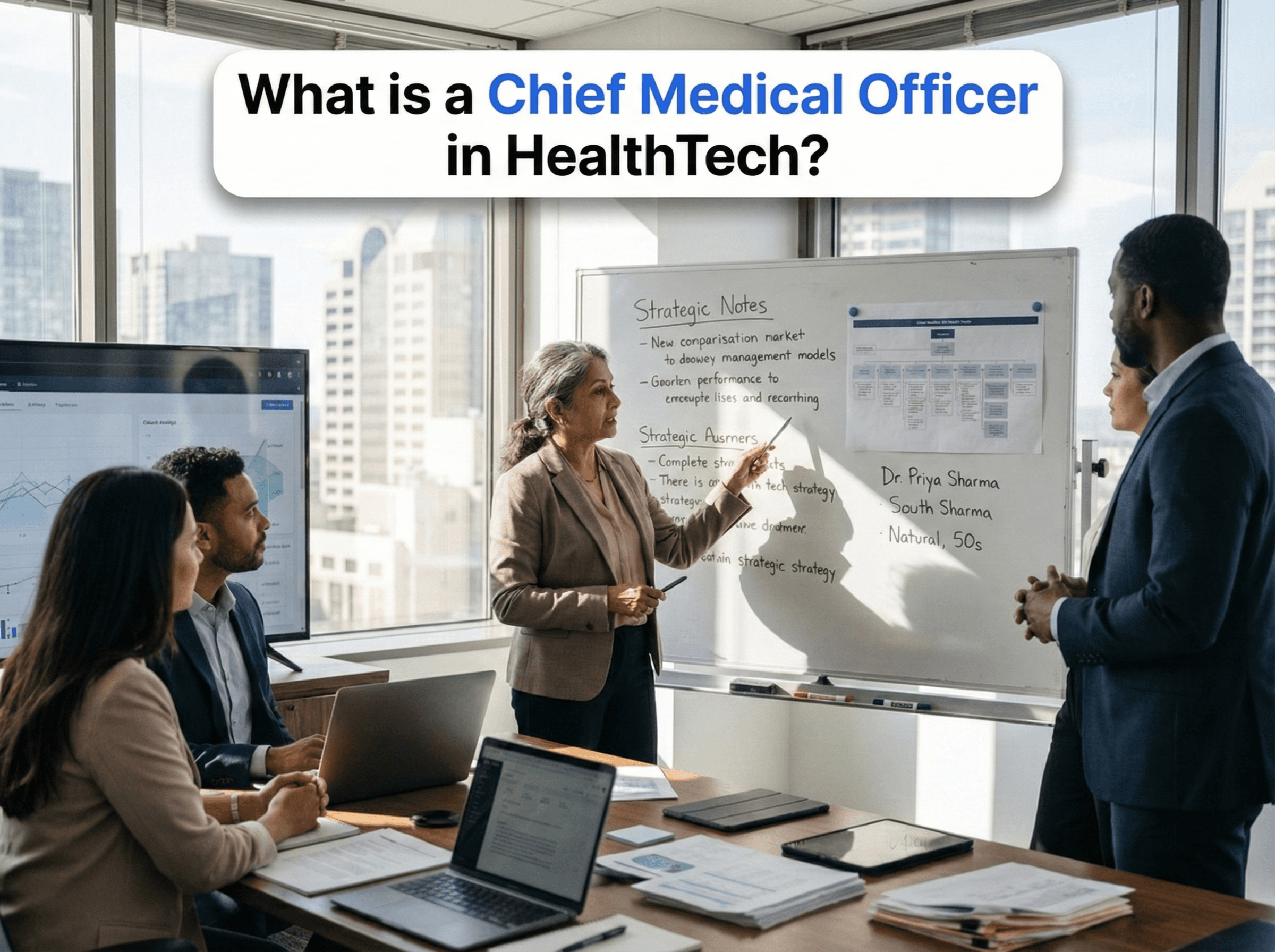
A Chief Medical Officer (CMO) in HealthTech is the executive accountable for the clinical integrity of a technology business whose product, data, or services meaningfully affect health decisions, care delivery, or patient outcomes. In practice, they are the organisation's highest clinical authority: the person who can sign off (or stop) decisions when clinical risk, patient safety, and medical credibility are on the line.
This role exists because HealthTech companies don't just ship software. They influence diagnoses, triage, treatment pathways, operational workflows, and patient behaviour at scale. That creates responsibility that cannot be "delegated to good intentions" or absorbed by product management. A CMO provides a single, accountable owner for clinical strategy, clinical risk decisions, clinical evidence posture, and the clinical legitimacy required to operate in a high-trust environment with constrained tolerance for harm.
The defining feature is ownership: the CMO is accountable for what the product means in real clinical contexts, what harms it could introduce, and how the company justifies safety, effectiveness, and appropriate use, internally, with customers, and under scrutiny.
🔍 How this role differs in HealthTech
In many tech sectors, leadership can optimise for speed, retention, or margin and accept "known issues" as a trade-off. In HealthTech, the trade space is narrower: the consequences can be clinical deterioration, delayed care, inappropriate escalation, or erosion of trust with clinicians and patients. The CMO is the executive who carries that weight and ensures the business behaves accordingly.
HealthTech also operates with unusually sensitive data and asymmetric risk. A feature that is "good enough" in consumer tech may be unsafe if it changes how a patient interprets symptoms, how a clinician prioritises a case, or how a service is operationalised across a pathway. Decisions are shaped by real-world variability (comorbidities, safeguarding, language barriers, system capacity), and the CMO's job is to keep those realities inside the company's decision-making, especially when commercial pressure pushes the other way.
Finally, credibility is not optional. HealthTech businesses rely on clinical confidence to win adoption, maintain contracts, and withstand scrutiny. The CMO often becomes the company's clinical voice externally, but that public-facing role is downstream of the core responsibility: protecting patients and the business by insisting on clinical clarity, appropriate claims, and defensible risk management.
🎯 Core responsibilities in HealthTech
A HealthTech CMO typically sits on the executive team and is expected to make hard calls where medicine, product, and commercial incentives collide. Their day-to-day work is less about "being consulted" and more about being the decision owner when the organisation must choose between shipping faster and shipping safely, between broader marketability and narrower but defensible claims, or between short-term revenue and long-term clinical trust.
They shape what the product is for (and, just as importantly, what it is not for) by defining intended use, appropriate users, clinical boundaries, and escalation routes when reality doesn't match the product assumptions. In organisations working with clinical pathways or decision support, they are accountable for ensuring the design reflects real clinical workflow constraints, not an idealised process diagram.
They also own clinical governance as a living operating system: how clinical risks are identified, documented, mitigated, monitored in the field, and acted on when incidents occur. That includes uncomfortable moments (pulling back a feature, tightening eligibility, changing messaging, or pausing expansion) because the CMO's credibility depends on being willing to slow the organisation down when patient impact is uncertain.
In mature HealthTech companies, the CMO often carries accountability for the clinical evidence posture (what you can legitimately claim, what you still need to prove), and for the clinical narrative that aligns product, outcomes, and market positioning. In earlier-stage companies, they may also be the person building the first clinical team, setting standards for external clinical partnerships, and creating the clinical "spine" that enables scale without improvisation.
🧩 Skills and competencies for HealthTech
Core Skill | HealthTech specific requirement | Reason or Impact |
|---|---|---|
Clinical judgement under uncertainty | Ability to make bounded decisions when evidence is incomplete and real-world harm is plausible | Prevents the organisation from mistaking speed for progress when patient impact is not fully understood |
Clinical risk ownership | Comfort being the named owner of safety decisions, incident response, and "stop-ship" calls | Creates clear accountability and reduces governance-by-committee that fails under pressure |
Translating medicine into product constraints | Turning clinical nuance into usable requirements, guardrails, and escalation logic | Ensures product teams build defensible behaviour rather than vague "clinically informed" features |
Credible external leadership | Communicating clinical positions to customers, partners, and stakeholders without over-claiming | Protects trust and reduces reputational and commercial risk from misaligned messaging |
Governance and standards thinking | Building repeatable clinical governance processes that scale with new markets and products | Avoids ad hoc approvals and makes safety management sustainable as complexity grows |
Evidence strategy | Setting proportionate evaluation standards (from real-world monitoring to formal studies) aligned to product claims | Keeps the business honest about what it knows, what it assumes, and what it must demonstrate |
Ethical and patient-centred reasoning | Ability to recognise second-order harms (inequity, exclusion, unintended behaviour change) | Improves outcomes and reduces the risk of "technically correct" decisions that fail patients in practice |
Cross-functional leadership | Influencing engineering, product, commercial, and operations without relying on hierarchy | Makes clinical accountability effective inside a high-velocity organisation |
💷 Salary ranges in UK HealthTech
Compensation for a Chief Medical Officer in UK HealthTech is primarily driven by the clinical risk carried by the product (and the consequences of failure), how directly the role influences go-to-market and delivery, whether the CMO is the accountable clinical authority for governance and incident response, and the breadth of scope (single product vs multi-product, UK-only vs international, advisory vs executive operator). Location still matters, but in HealthTech the biggest swings come from responsibility, regulated constraints, and how much "clinical accountability" truly sits with the individual rather than being shared across a wider medical governance structure. On-call expectations can also materially change pay where escalation is formalised.
Experience level | Estimated annual salary range | What drives compensation |
Junior | London & South East: £70,000–£95,000 | Usually a first step into company-level accountability; narrower scope, often supporting a senior clinical leader rather than owning governance |
Mid-level | London & South East: £95,000–£130,000 | Ownership of defined clinical domains (e.g., one pathway, one product line); greater influence on product decisions and customer assurance |
Senior | London & South East: £130,000–£175,000 | Clear executive accountability for clinical decisions across product and delivery; higher scrutiny, higher incident and reputational exposure |
Lead | London & South East: £175,000–£230,000 | Broad organisational scope, multi-stakeholder influence, and responsibility for clinical governance maturity; often includes investor and board-facing duties |
Head / Director | London & South East: £200,000–£300,000 | Full clinical authority across a complex business (multi-product, larger revenue base, higher-risk use cases); may include formal on-call escalation accountability and major external scrutiny |
Typical add-ons in UK HealthTech include performance bonus (often tied to delivery milestones, quality metrics, or commercial outcomes), equity or options (more common and more meaningful in earlier-stage companies), pension contribution, and private medical cover. Where the CMO is part of a defined escalation rota (particularly for patient safety incidents, clinical complaints, or high-severity operational events), an on-call allowance or equivalent compensation may apply; total compensation rises most when the role is both executive-level and operationally accountable for out-of-hours decision-making, not just advisory input.
🚀 Career pathways
Many HealthTech CMOs enter from clinical practice combined with leadership exposure, such as service redesign, digital transformation, clinical governance, quality improvement, or roles that required translating clinical reality into operational change. Others come via research, medical affairs, or clinical evaluation pathways where evidence and claims discipline are central, then move closer to product and commercial decision-making over time.
Progression tends to follow expansion of ownership rather than a linear title ladder. Early roles may involve being the clinical contributor on a product team; the next step is owning a clinical domain with the authority to set boundaries and say "no." From there, growth comes from taking responsibility for clinical governance as a system: how risk is managed, how incidents are handled, how claims are controlled, and how clinical confidence is earned and maintained.
At the most senior level, the CMO's scope becomes enterprise-wide: aligning clinical strategy with business strategy, building and mentoring clinical leadership underneath them, and becoming accountable for the organisation's clinical posture in the market. The common thread is the ability to carry responsibility under uncertainty, make defensible trade-offs, and protect patients while still enabling the company to ship and scale.
❓ FAQ
Do I need to be a practising doctor to be credible as a HealthTech CMO? Not always, but you do need unquestioned clinical credibility for the product's risk profile and customer expectations. Some organisations expect current registration and clinical recency; others prioritise governance leadership, evidence strategy, and domain depth. In interviews, expect to be tested on decision-making under ambiguity rather than credentials alone.
What will I be held personally accountable for if something goes wrong? Candidates are typically accountable for how clinical risk is governed: whether risks were identified, mitigations were proportionate, claims were appropriate, and incident response was effective. You won't be expected to guarantee perfect outcomes, but you will be expected to prove that the organisation made defensible choices and learned quickly when reality diverged from assumptions.
How should I assess on-call expectations for a HealthTech CMO role? Ask explicitly what triggers escalation, who is first-line, what "severity" looks like, and how often out-of-hours decisions occur in practice. Clarify whether on-call is informal (occasional calls) or formalised (rota, SLAs, documented escalation), and how that responsibility is compensated. Also confirm whether on-call covers clinical incidents, operational issues, customer issues, or all of the above.
You might also like