Published Date: January 2, 2026
Updated Date: January 2, 2026
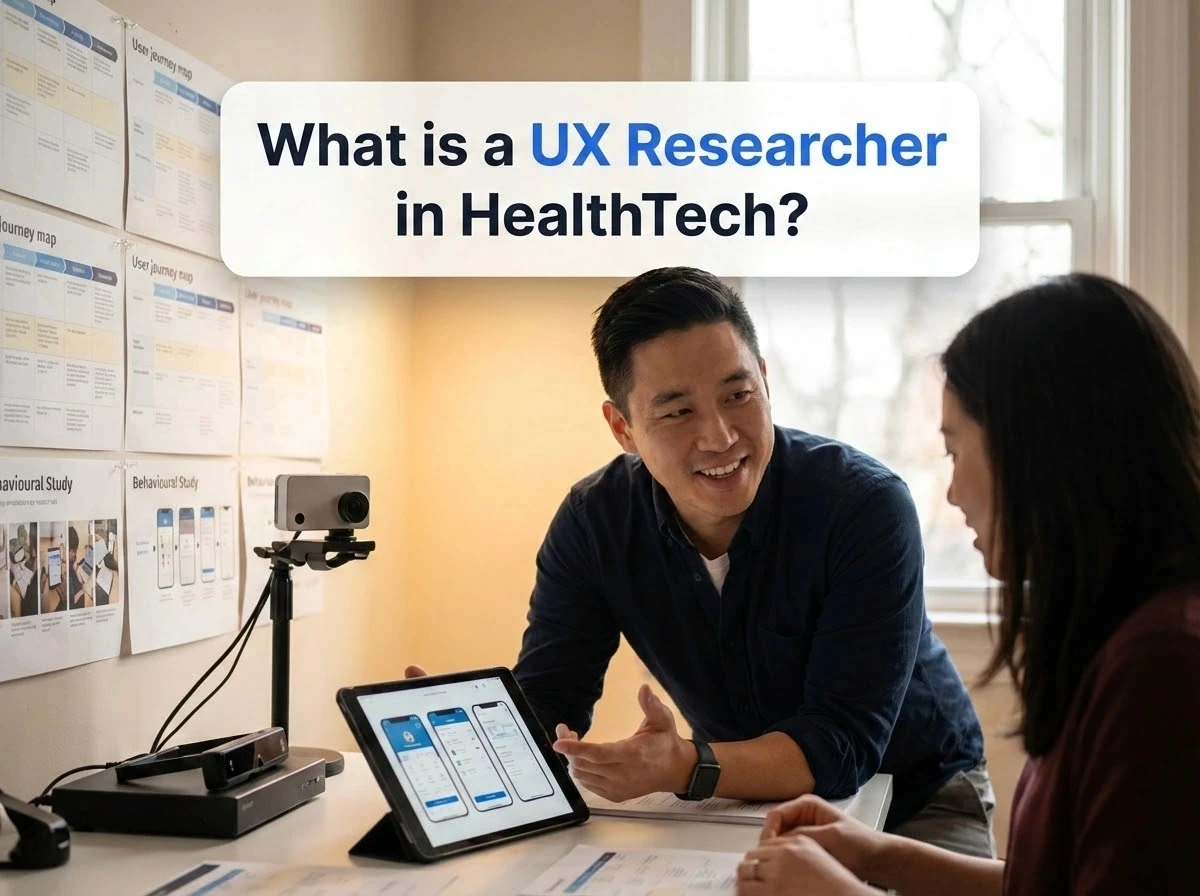
What is a UX Researcher in HealthTech?
A UX Researcher in HealthTech ensures digital health products are built on solid evidence about real users: patients, carers, clinicians, administrators, and support teams. The goal is to make products usable, safe enough for their intended setting, and practical to deliver in resource-constrained healthcare environments. This role exists because good intentions and clever features cannot replace genuine understanding of how care actually works, what information people can act on under pressure, and where design choices might introduce risk.
In practice, this role owns the integrity of user evidence throughout the product lifecycle: establishing what is true about user needs, identifying what remains uncertain, determining acceptable trade-offs, and escalating issues when the cost of getting things wrong is high. Research methods (interviews, usability testing, diary studies, surveys, field research) are important tools, but the real responsibility is producing reliable insight that teams can trust when outcomes affect health, privacy, and trust.
🔍 How this role differs in HealthTech
In many tech sectors, research aims to improve conversion, retention, or satisfaction. Those outcomes matter in HealthTech too, but the decision-making context carries more weight. User experience problems can turn into clinical workflow failures, misunderstood instructions, delayed action, or avoidable support burdens in environments where people are busy, stressed, or vulnerable.
Health data sensitivity changes how research is planned and conducted. Recruitment pathways, consent, data handling, recording, and incentives often face stricter constraints, and accessing real usage contexts may require additional governance and stakeholder coordination. Regulation and assurance expectations may not always fall directly on the UX Researcher, but they shape the working environment, especially where software might influence care decisions or where organisations require stronger safety and risk thinking.
HealthTech also typically involves multi-user systems. A patient-facing experience cannot be separated from clinician review, triage, configuration, reporting, and operational processes. This means the UX Researcher frequently balances competing needs and defines success across an ecosystem, not just a single screen.
🎯 Core responsibilities in HealthTech
Day to day, a UX Researcher turns ambiguity into clear, defensible understanding of user needs and risk points, then keeps that understanding current as products, policies, and services evolve. During discovery, this might mean reframing the problem when the team is solving the wrong thing, or surfacing constraints that make a standard product pattern unsafe or unrealistic in care settings. During delivery, it often means validating designs under time pressure, choosing research that provides the highest confidence with the least disruption, and ensuring findings translate into decisions rather than just slide decks.
In HealthTech, trade-offs are constant and explicit. You might be balancing speed of access against safeguarding, clinician efficiency against patient comprehension, or personalisation against privacy and governance. The UX Researcher's accountability is to make these trade-offs visible, evidence-based, and proportionate to the potential harm of getting them wrong. This includes knowing when research reveals a usability issue that can be iterated versus a hazard that needs escalation, mitigation, or a change in product scope.
A strong HealthTech UX Researcher also bridges domains. They translate between product and engineering timelines, clinical and operational realities, and the legal or assurance constraints that shape what can be built and how it must behave. The output is not just insight, but a shared narrative teams can act on: who the users are, what conditions they work in, what failures look like, and what acceptable truly means.
🧩 Skills and competencies for HealthTech
Core Skill | HealthTech specific requirement | Reason or Impact |
|---|---|---|
Risk-based judgement | Ability to scale evidence and caution to the real-world consequences of error, not just product metrics | Prevents teams treating high-stakes flows like routine UX optimisation and supports safer decision-making under uncertainty |
Stakeholder influence | Confidence working with clinical, operational, governance, and technical stakeholders with different definitions of good | Enables alignment on trade-offs and reduces the chance that research is ignored when it challenges established assumptions |
Research ethics and consent discipline | Comfort operating within stricter expectations around sensitive health information and vulnerable participants | Protects participants, preserves trust, and avoids creating research artefacts the organisation cannot safely use |
Contextual understanding of care workflows | Ability to model real workflows (handoffs, interruptions, time pressure, accountability) rather than idealised journeys | Improves validity of findings and reduces design decisions that collapse under real-world constraints |
Clarity in synthesis and decision framing | Turning complex, sometimes conflicting evidence into crisp choices, confidence levels, and implications | Helps teams act quickly without overstating certainty, especially when evidence is partial or access is constrained |
Cross-user system thinking | Seeing patient, clinician, admin, and support experiences as one connected system | Avoids fixing one interface while breaking downstream operational or clinical work, reducing rework and adoption risk |
Pragmatic research operations | Designing studies that are feasible with limited access to users, narrow windows, and governance needs | Keeps delivery moving whilst maintaining integrity of evidence and reducing reliance on internal opinions |
💷 Salary ranges in UK HealthTech
Compensation for UX Researchers in UK HealthTech depends less on job title and more on scope and risk. The biggest drivers are: how embedded the role is in product strategy, the criticality of the workflows being researched (including potential safety impact), seniority in stakeholder influence, responsibility for research direction across multiple teams, and location. Private HealthTech employers may pay differently from public-sector organisations and suppliers. Regulated or assurance-heavy environments can also command a premium when they require stronger risk thinking, documentation discipline, or harder-to-access user groups.
Experience level | Estimated annual salary range | What drives compensation |
Junior | London & South East: £35,000–£45,000 | Supervised delivery, narrower scope, supporting research ops; limited ownership of roadmap decisions |
Mid-level | London & South East: £45,000–£65,000 | Independently running studies end-to-end; influencing squad decisions; reliability of synthesis and stakeholder handling |
Senior | London & South East: £65,000–£90,000 | Leading ambiguous discovery, shaping product direction, managing higher-risk journeys, mentoring, stronger cross-functional influence |
Lead | London & South East: £90,000–£120,000 | Owning research strategy for a domain, setting standards, coaching multiple researchers, consistent impact on roadmap trade-offs |
Head / Director | London & South East: £110,000–£160,000 | Organisational accountability for research quality and prioritisation; executive-level influence; building capability, governance, and measurable impact |
Beyond base salary, typical add-ons include performance bonus (often modest and tied to company and product outcomes), equity in venture-backed companies, and enhanced pension contributions. On-call is uncommon for UX Researchers. Where it exists, it is usually indirect (supporting incident reviews, urgent risk investigations, or critical release decisions) and varies by product criticality and organisational maturity. Total compensation tends to rise when the role owns research strategy across multiple teams, operates in higher-assurance contexts, or repeatedly changes roadmap decisions with credible evidence.
🚀 Career pathways
Many people enter HealthTech UX Research from psychology, HCI, anthropology, design, service design, data or insight roles, or clinical-adjacent operational backgrounds. The most reliable entry point is not a specific credential but evidence you can run ethical research end-to-end, produce clear synthesis, and influence a decision without overstating certainty.
Progression typically means widening ownership. Early on, you are trusted to execute studies and deliver clear findings. At mid-level and senior, you are trusted to choose the right questions, define trade-offs, and shape what gets built, especially when users are hard to reach and the environment is constrained. Lead and Head or Director progression is driven by accountability for quality and consistency of evidence across teams: building research practice, setting decision standards, and ensuring the organisation can move quickly without becoming careless.
❓ FAQ
1) How do I show HealthTech readiness if my research background is in consumer apps? Focus on your judgement: how you handled sensitive topics, ambiguity, and stakeholder conflict, and how you calibrated confidence when evidence was imperfect. Show that you can model real workflows and make trade-offs explicit, not just report findings. Hiring teams want proof you can work responsibly when context and consequences are heavier.
2) Will I need experience with clinical regulation to be hired as a UX Researcher in HealthTech? Not always, but you should be comfortable working within governance constraints and collaborating with safety, clinical, and privacy stakeholders. What matters is your ability to operate carefully: consent, data handling, and communicating risk without drama. For more assurance-heavy products, employers will value experience in safety-minded environments even if it was not formally regulated.
3) Is on-call ever part of a UX Researcher role in HealthTech? It is not typical, but some teams expect availability around high-risk releases, incident investigations, or urgent usability risks that affect care workflows. If it exists, clarify what on-call means in practice: frequency, hours, expectations, and whether it is compensated. The more operationally critical the product, the more likely you will be pulled into time-sensitive decision-making.
🔎 Find your next role
Ready to apply your research judgement to real-world health outcomes? Search UX Researcher roles on Meeveem and compare scope, impact, and expectations before you commit.
You might also like