Published Date: January 2, 2026
Updated Date: January 2, 2026
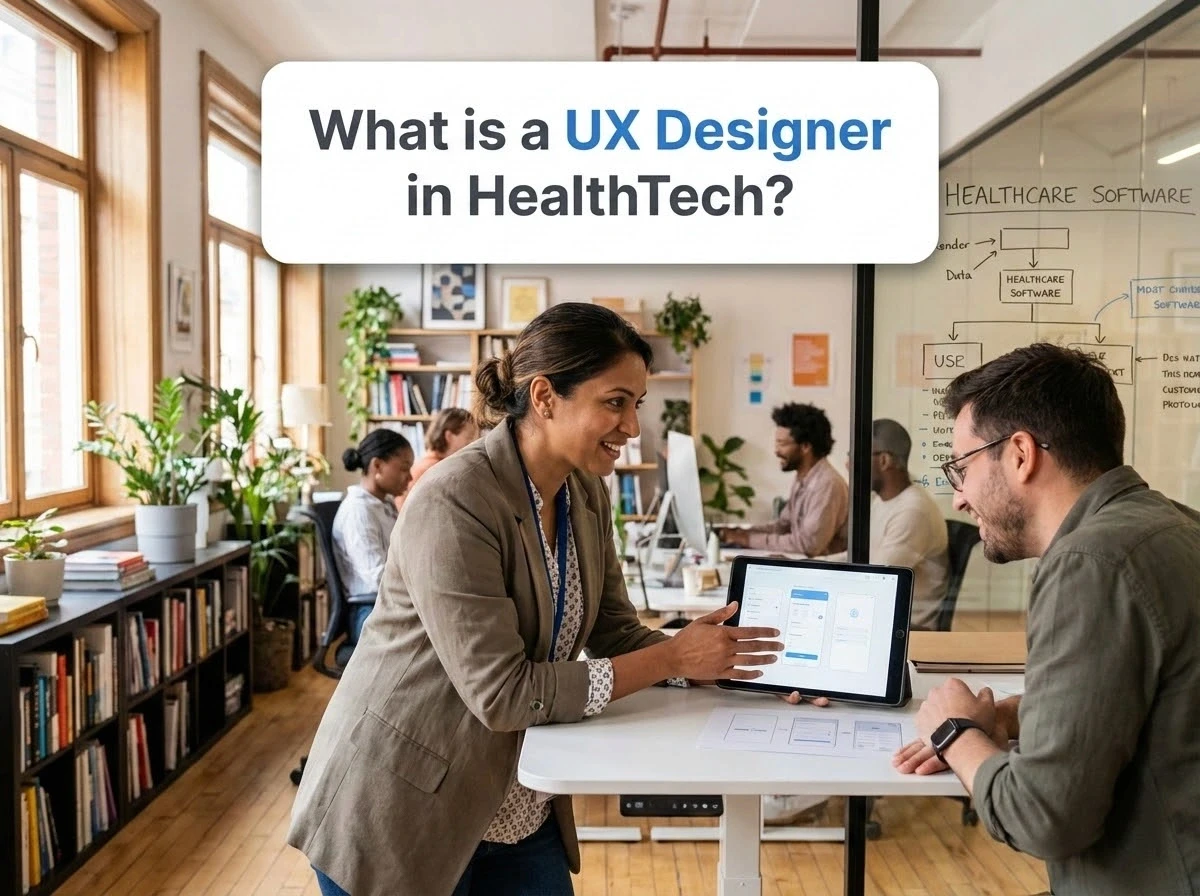
What is a UX Designer in HealthTech?
A UX Designer in HealthTech is accountable for how people experience digital health products and services, whether that person is a patient managing care at home, a clinician under time pressure, or an admin team coordinating pathways. The role exists to ensure the product is not only usable and accessible, but also safe, trustworthy, and fit for real clinical and operational contexts.
In practice, this means owning the user experience outcomes that affect adoption, error rates, comprehension, and confidence. A UX Designer translates complex health journeys into interactions people can complete correctly the first time, even when they're stressed, unwell, or working in constrained environments. The methods (research, prototyping, testing) matter, but the job is defined by responsibility: reducing preventable friction and risk whilst helping the organisation deliver measurable health and service outcomes.
🔍 How this role differs in HealthTech
In many tech sectors, UX decisions are optimised primarily for conversion, engagement, or efficiency. In HealthTech, the same UX decision can influence safety, equity of access, clinical workload, and downstream outcomes. Good UX is less about delight and more about reducing harm, misunderstanding, and missed steps.
Health data sensitivity raises the bar for consent, transparency, and secure-by-design journeys, which often tightens what designers can do with personalisation, notifications, and analytics. The context of use is also different: users may be cognitively overloaded, anxious, in pain, or switching between systems mid-task. That reality changes everything from information hierarchy to error prevention and the tolerance for experimentation.
Finally, regulated and evidence-driven environments can shift design work from "ship and iterate" to "justify, validate, document, and then iterate", especially when the product influences clinical decisions, triage, medication flows, or identity and access. The best HealthTech UX Designers are comfortable making progress whilst respecting constraints that are non-negotiable.
🎯 Core responsibilities in HealthTech
Day to day, a UX Designer in HealthTech is responsible for shaping and defending the end-to-end experience across critical journeys: onboarding and identity, consent, data capture, symptom or form flows, results and messaging, and clinical or operational tasks that must be completed accurately. They work within multidisciplinary teams, but their accountability is specific: ensuring the experience remains coherent, usable, and safe as product requirements, clinical input, and technical constraints evolve.
Much of the role is decision-making under pressure. A designer may need to balance accessibility needs with clinical complexity, reconcile competing stakeholder priorities (clinical safety, information governance, commercial goals), and define what "good enough to release" means when the cost of confusion is high. Trade-offs are explicit: when simplifying a flow risks removing necessary context, the designer must find a way to reduce cognitive load without removing essential safety information.
HealthTech also demands strong navigation of ambiguity. Evidence may be incomplete, user groups may be diverse and hard to recruit, and operational realities may contradict "ideal" journeys. UX Designers succeed by building alignment around user needs, clarifying risks, and creating experiences teams can implement and maintain without degrading safety or trust over time.
🧩 Skills and competencies for HealthTech
Core Skill | HealthTech specific requirement | Reason or Impact |
|---|---|---|
Risk-based judgement | Ability to recognise when a usability issue becomes a safety issue and escalate appropriately | Prevents design decisions that inadvertently increase clinical risk, user error, or harm |
Contextual empathy | Designing for stress, low health literacy, fluctuating capacity, and time-pressured clinical environments | Improves comprehension and completion rates when users are least able to "work things out" |
Clarity under constraint | Communicating complex medical/operational concepts without over-simplifying or misrepresenting | Reduces misunderstanding, supports informed consent, and improves adherence to guidance |
Accessibility ownership | Treating accessibility as a product requirement across journeys, not a compliance checklist | Broadens access and reduces exclusion in services that can be essential rather than optional |
Stakeholder alignment | Balancing clinical, operational, legal, and product priorities without losing user-centred outcomes | Keeps delivery moving whilst protecting the experience from fragmented decision-making |
Evidence-minded practice | Comfort working with imperfect data, defining what evidence is sufficient, and iterating responsibly | Helps teams make defensible decisions and improves outcomes without reckless experimentation |
System thinking | Understanding cross-product pathways, handoffs, and how design impacts service delivery | Avoids "local optimisations" that create downstream burden for patients and staff |
Credible communication | Explaining design decisions in terms of risk, outcomes, and constraints rather than preference | Builds trust with clinical and technical partners and speeds up decision-making |
💷 Salary ranges in UK HealthTech
Compensation for UX Designers in UK HealthTech is shaped less by job title and more by scope and criticality: the complexity of the journeys owned, the level of autonomy, the degree of clinical and data risk, and how directly the work influences outcomes and operational load. Location still matters (with London and South East typically paying more), but regulated constraints, domain expertise, and leadership responsibility can outweigh geography, especially for roles tied to safety-critical workflows.
Experience level | Estimated annual salary range | What drives compensation |
Junior | London & South East: £30,000–£40,000 | Supervision level, portfolio quality, ability to execute within established patterns, exposure to regulated contexts |
Mid-level | London & South East: £42,000–£58,000 | Ownership of end-to-end journeys, independent decision-making, collaboration with clinical/ops stakeholders, accessibility responsibility |
Senior | London & South East: £60,000–£85,000 | Breadth of product scope, leading complex trade-offs, shaping standards, improving measurable outcomes, mentoring and influencing roadmaps |
Lead | London & South East: £80,000–£105,000 | Accountability across multiple squads/streams, design strategy, governance, quality gates for high-risk journeys, stakeholder management at senior level |
Head / Director | London & South East: £100,000–£140,000 | Org-wide UX direction, hiring and capability building, operating model, risk management, executive accountability for experience outcomes and standards |
Typical add-ons vary by employer type. Private HealthTech often includes bonus and equity, with total compensation moving most when the company is scaling, the role carries broad product ownership, or the designer is expected to lead cross-functional decisions. On-call allowances are uncommon for UX Designers; if they exist, it's usually in environments running time-sensitive services where design support is tied to incident response or urgent changes. More often this affects adjacent technical roles than design.
🚀 Career pathways
Entry into HealthTech UX commonly comes from general digital product design, service design, or interaction design, then deepens through exposure to healthcare journeys and constraints. Many designers move in after working on complex, high-stakes domains (public sector services, identity, regulated industries) because the underlying skill is accountable decision-making, not a specific toolset.
Progression happens when ownership expands. A junior designer becomes valuable by reliably delivering parts of a journey; a mid-level designer becomes trusted by owning an end-to-end flow and making sound trade-offs; a senior designer shapes standards, prevents risk, and improves outcomes across multiple areas. Lead and Head/Director progression follows the same pattern at a larger scale: responsibility for coherence across teams, for how design decisions are made, and for the organisation's ability to deliver safe, usable experiences repeatedly.
❓ FAQ
Do I need clinical experience to be hired as a UX Designer in HealthTech?
No, but you do need evidence that you can learn complex domains quickly and make careful decisions under constraints. Hiring teams look for how you handle risk, accessibility, and stakeholder tension, not whether you can recite clinical terminology.
What will my portfolio be judged on for HealthTech roles, beyond screens?
Expect scrutiny on your reasoning: how you defined the problem, validated assumptions, and managed trade-offs like safety messaging versus completion rate. Strong portfolios show outcomes, constraints, and what you did when evidence was incomplete.
Will I be expected to do on-call in HealthTech UX roles?
Usually not. If a role is connected to a service with urgent operational needs, you may be asked to support high-priority incidents or rapid changes, but that's typically handled through normal working patterns rather than formal on-call rotations.
🔎 Find your next role
Ready to apply your UX skills to products that affect real health outcomes? Search roles on Meeveem and find HealthTech teams that value evidence, accessibility, and accountable design ownership.
You might also like