Published Date: January 2, 2026
Updated Date: January 2, 2026
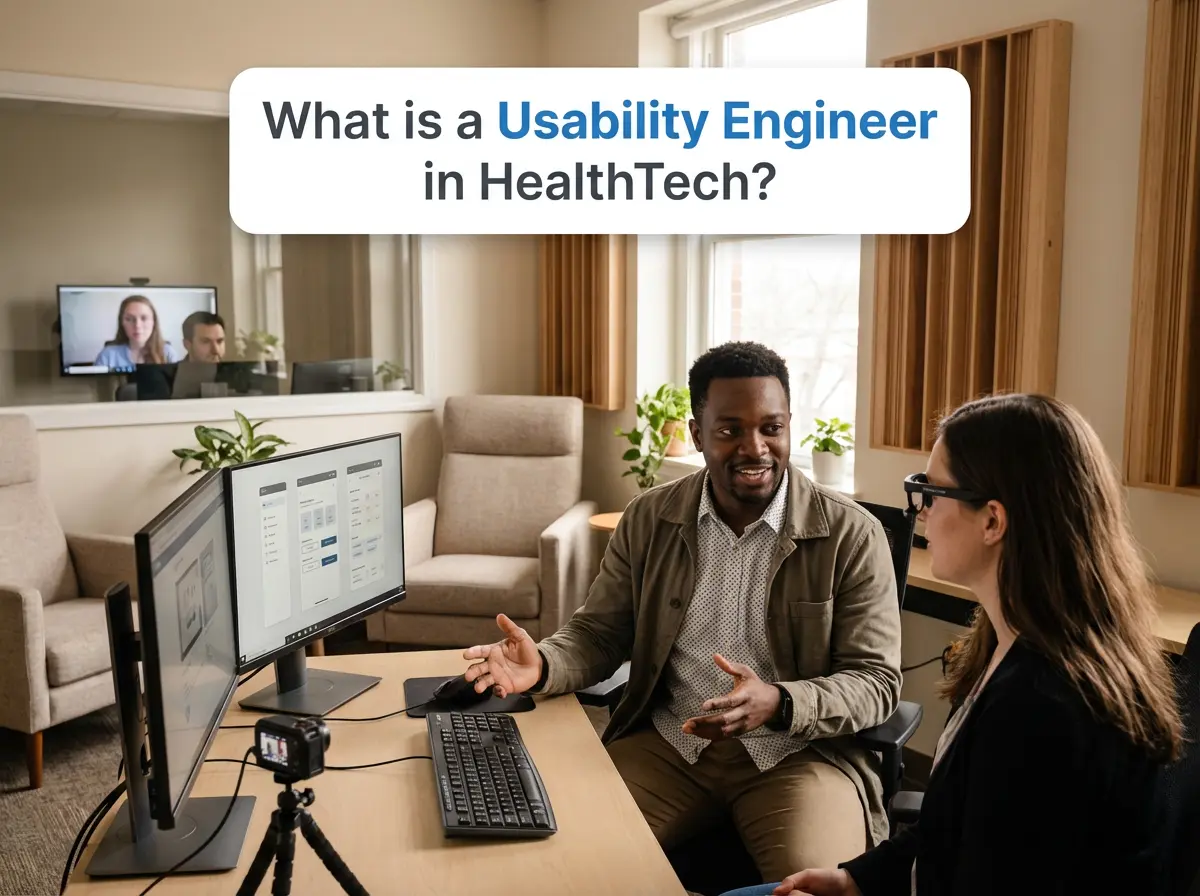
What is a Usability Engineer in HealthTech?
A Usability Engineer in HealthTech ensures that digital health products and medical technologies can be used safely, effectively, and consistently by the people who rely on them: patients, clinicians, carers, and operational staff, often in high-pressure, high-stakes environments. The role exists because "working" software or hardware is not enough in healthcare. Confusing interactions, unclear instructions, or poorly designed workflows can create real-world harm, operational risk, and regulatory exposure.
In practice, a Usability Engineer owns the usability evidence and the usability risk posture of a product area. They define what "safe and usable" means for the intended users, make that standard measurable, and drive design and engineering decisions until the product meets it. Their value isn't limited to running studies; it's the accountability for reducing use-related risk, preventing avoidable errors, and ensuring the product can stand up to scrutiny, both internally and externally.
🔍 How this role differs in HealthTech
In many tech sectors, usability work primarily optimises adoption, conversion, retention, and satisfaction. In HealthTech, those goals still matter, but they sit beneath a different top line: patient safety, clinical safety, reliability, and defensible decision-making. The same interface pattern that might be "good enough" in a consumer app can be unacceptable when it affects dosing, triage, alerts, consent, clinical documentation, or handover.
HealthTech also changes the day-to-day context of usability engineering. The user base is broader (patients and clinicians, but also administrators, pharmacists, lab staff, support teams), the constraints are tighter (privacy expectations, auditability, real-world workflows, accessibility needs), and the cost of misunderstanding is higher. Even when the product is not a regulated medical device, the organisation typically behaves more cautiously because incidents create clinical risk, reputational risk, and operational disruption.
🎯 Core responsibilities in HealthTech
A Usability Engineer's day-to-day work is less about "owning research tasks" and more about owning the decisions that research enables. They shape how the team defines intended use, user groups, and critical tasks. They surface where the design could provoke user error, and they make sure those risks are either designed out, mitigated, or explicitly accepted by the right accountable stakeholders.
They spend significant time translating messy reality into decisions that engineering and product can act on: converting observations into design constraints, prioritising fixes against delivery pressure, and documenting why certain trade-offs were made. In HealthTech, those trade-offs often include workload and interruption costs for clinicians, accessibility and health literacy for patients, data sensitivity, and the operational realities of settings like wards, clinics, home care, or community services.
Where the product has safety-critical interactions (or interacts with regulated components), the Usability Engineer typically also owns the usability evidence trail: clear study plans, traceable findings, and crisp documentation that connects user needs to design inputs and risk controls. Their influence is measured by whether the product becomes easier to use in the real world, and whether the organisation can justify its choices when something goes wrong.
🧩 Skills and competencies for HealthTech
Core Skill | HealthTech specific requirement | Reason or Impact |
|---|---|---|
Risk-based judgement | Ability to distinguish "annoying" from "unsafe," and to prioritise accordingly under delivery pressure | Prevents teams from optimising for preference while missing use-related risks that can lead to clinical or operational harm |
Stakeholder-grade decision ownership | Confidence to drive decisions across product, engineering, clinical, quality, and compliance perspectives | Reduces ambiguity and ensures usability outcomes are treated as accountable commitments, not optional improvements |
Context-of-use reasoning | Skill in modelling real environments (busy clinics, low connectivity, shared devices, interruptions, fatigue) and how they shape interaction errors | Produces designs that hold up outside ideal conditions, lowering error rates and support burden |
Clear, defensible communication | Ability to write and present findings in a way that is auditable, reproducible, and action-oriented | Makes usability work credible at leadership and governance levels and accelerates adoption of mitigations |
Study design under constraints | Ability to run appropriate evaluations when access to users is limited, time is tight, or scenarios are sensitive | Ensures teams still generate reliable evidence without over-claiming and without blocking delivery unnecessarily |
Human factors mindset beyond UI | Ability to spot where process, training, labelling/instructions, or workflow drives failure, not just screen layout | Prevents "UI-only" fixes and improves end-to-end safety and effectiveness in real care pathways |
Ethical handling of sensitive insights | Comfort working with privacy, consent, and vulnerability-aware research practices | Protects users and organisations whilst enabling learning in sensitive health contexts |
💷 Salary ranges in UK HealthTech
Salary for a Usability Engineer in UK HealthTech is driven less by toolset and more by scope and accountability: whether you own usability for a single feature or an entire product line, whether your work is tied to safety-critical decisions, the degree of documentation and governance expected, and how directly you influence release decisions. Location still matters, but variation is often amplified by domain complexity (clinical workflows, device interaction, multi-user systems), seniority, and whether the organisation expects you to lead programmes rather than contribute to them.
Experience level | Estimated annual salary range | What drives compensation |
Junior | London & South East: £32,000–£42,000 | Early-career roles vary by how much responsibility you hold for study execution, synthesis quality, and handling sensitive user contexts |
Mid-level | London & South East: £42,000–£58,000 | Independence, ability to run end-to-end studies, translate findings into design constraints, and influence roadmap trade-offs |
Senior | London & South East: £58,000–£78,000 | Owning usability strategy for a product area, leading complex evaluations, and carrying accountability for risk-based decisions and documentation quality |
Lead | London & South East: £75,000–£100,000 | Cross-team leadership, setting standards, governing critical decisions, mentoring, and acting as final escalation point for usability risk |
Head / Director | London & South East: £95,000–£140,000 | Organisational accountability (capability, policy, governance), portfolio-level prioritisation, and executive-level ownership of safety/usability posture |
Typical add-ons include performance-related bonus, pension, and (more commonly in scale-ups) equity. On-call is not a standard expectation for most Usability Engineer roles, but total compensation can rise if the job sits within a safety or operational function that participates in incident response, high-severity release gates, or urgent remediation cycles. The largest differences in total comp usually come from scope (single product vs portfolio), the criticality of user interactions, leadership expectations, and whether the company is regulated or operating with device-like evidence standards.
🚀 Career pathways
Most Usability Engineers in HealthTech enter from one of three routes: UX/interaction backgrounds moving into more risk-aware decision ownership; engineering or product backgrounds drawn towards workflow and human factors; or research/human factors disciplines stepping into product delivery environments. Early progression tends to come from proving you can run solid evaluations and turn messy insights into clear constraints that teams will actually implement.
As you grow, responsibility expands from "running usability work" to owning outcomes across a product area: defining what good looks like, setting evaluation strategy, and influencing release decisions when trade-offs collide. Senior progression is usually earned by handling complexity (multiple user groups, contested workflows, sensitive data, and governance expectations) whilst keeping delivery moving. Leadership roles are then less about doing more studies and more about building capability: standards, coaching, portfolio prioritisation, and credible escalation paths when usability risk meets delivery pressure.
❓ FAQ
Do I need medical device or clinical background to be hired as a Usability Engineer in HealthTech?
Not always. Many teams value strong usability decision-making and the ability to learn clinical context quickly, especially for digital health products. However, roles that involve safety-critical interactions or formal evidence expectations tend to prefer candidates who can demonstrate risk-based thinking and comfort with structured documentation.
What will an interview actually test for in a HealthTech usability engineering role?
Expect scenarios where you must prioritise usability risks, justify trade-offs, and explain how you'd generate evidence under constraints (limited access to clinicians, sensitive contexts, time pressure). You'll often be assessed on how you communicate findings to engineering and product, and whether you can push for changes without overstating certainty.
Will I be on-call, and how does incident response relate to usability?
Most Usability Engineers are not on a formal on-call rota. That said, in some organisations you may be pulled into urgent incident reviews when usability contributes to errors, confusion, or workflow breakdowns, especially around high-severity safety or compliance events. The expectation is typically "available for escalation," not continuous on-call coverage.
🔎 Find your next role
Search for Usability Engineer roles in HealthTech on Meeveem and focus your applications on scope, ownership, and the real-world context your work can improve.
You might also like