Published Date: December 31, 2025
Updated Date: December 31, 2025
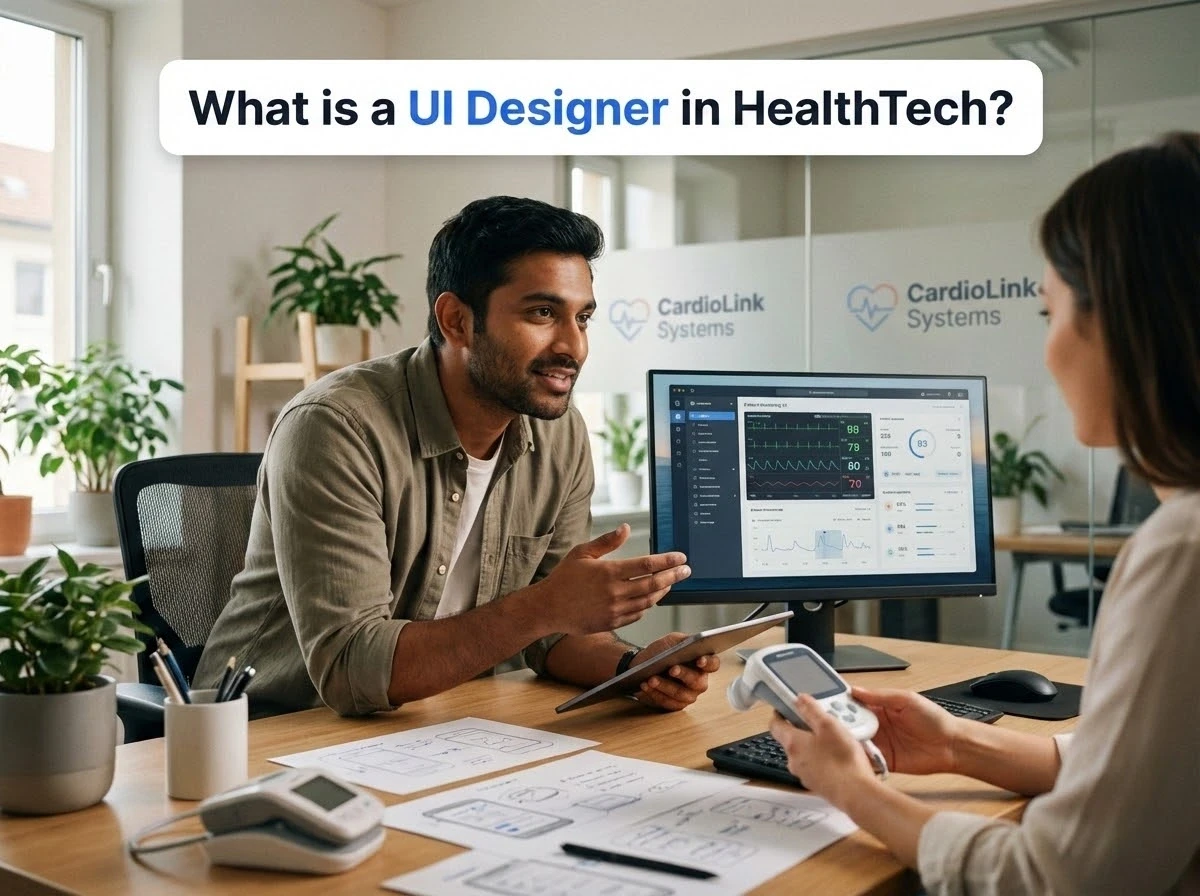
What is a UI Designer in HealthTech?
A UI Designer in HealthTech is responsible for how a digital health product looks, behaves, and communicates at the point of care: the screens clinicians use during a busy shift, the flows patients rely on when they are anxious, and the interfaces that translate sensitive health data into decisions and actions. The role exists to reduce friction and error in high-stakes journeys by making interfaces consistent, legible, and predictable, especially when people are tired, unwell, time-pressured, or working around complex processes.
This isn't about making things pretty. In HealthTech, UI design is a reliability function. A UI Designer owns the clarity of the interface: what gets attention first, what is easy to misread, what can be done accidentally, and what the product must never allow without deliberate confirmation. They are responsible for shaping the visual layer so it supports safe outcomes, trusted data handling, and confident use across a wide range of abilities and environments.
Most commonly, a UI Designer sits within a Product Design or Experience Design team, partnering closely with Product, Engineering, Clinical/Domain specialists, and Quality/Compliance functions. In smaller HealthTech companies, they may also own much of the design system and front-end UI governance; in larger organisations, they operate within established standards and contribute to shared patterns.
🔍 How this role differs in HealthTech
In many industries, UI decisions optimise conversion, engagement, or brand expression. HealthTech still cares about those things, but the definition of done changes: the interface must remain usable and safe when the user is stressed, interrupted, or working with incomplete information. Risk is not abstract. Poor hierarchy, ambiguous labels, or inconsistent components can cause real-world harm, operational disruption, or loss of trust.
Health data sensitivity also changes the UI bar. The UI Designer must think about what is shown, when it is shown, and how it is protected, without making legitimate workflows impossibly slow. On top of that, accessibility expectations tend to be higher and more scrutinised because the user population is broader and the impact of exclusion is more serious. Even when regulation is handled by specialists, UI choices often become part of evidence: why a warning appears, why a confirmation step exists, why certain actions are constrained, and how the interface supports safe use.
Finally, HealthTech UI is frequently multi-context: patient-facing experiences, clinician workflows, admin tooling, and integrations. A UI Designer must keep interfaces coherent across these contexts while respecting different risk profiles and user needs.
🎯 Core responsibilities in HealthTech
Day to day, a UI Designer in HealthTech is accountable for turning product intent into an interface that people can operate correctly the first time, and still operate correctly on the hundredth time, when they are rushing. They make decisions about layout, typography, hierarchy, colour use, spacing, and interaction states so that the product is readable, navigable, and resistant to common mistakes.
They typically steward consistency through a design system: defining components and patterns, tightening usage rules, and partnering with engineers to ensure implementation matches intent. In HealthTech this is not nice to have; consistency reduces cognitive load, speeds up training, and prevents edge-case behaviour that can create safety risks.
A strong UI Designer also becomes a constraint navigator. They balance clinical and operational realities (what users must do), technical constraints (what can be built reliably), compliance requirements (what must be captured or displayed), and accessibility needs (what must be perceivable and operable). When trade-offs are required, they don't just present options. They recommend a direction, articulate the risk, and help the team choose the safest workable path.
🧩 Skills and competencies for HealthTech
Core Skill | HealthTech specific requirement | Reason or Impact |
|---|---|---|
Risk-aware interface judgement | Anticipate misuse, misreads, and "wrong-time/wrong-context" actions, then design guardrails without blocking legitimate work. | Reduces error likelihood in high-stakes workflows and makes the product safer under pressure. |
Accessibility ownership | Treat accessibility as a baseline for every component and state, not a retrofit, including keyboard behaviour, focus, contrast, and readable hierarchy. | HealthTech audiences are diverse; accessible UI expands safe use and reduces preventable exclusion. |
Design systems governance | Define clear rules for components, variants, and content hierarchy that engineers can implement consistently across surfaces. | Consistency improves reliability, speeds delivery, and reduces clinical/operational training burden. |
Information clarity under constraint | Present complex health information (status, trends, warnings, tasks) with deliberate hierarchy and unambiguous labels. | Supports correct interpretation and reduces cognitive load when decisions must be made quickly. |
Cross-functional decision leadership | Partner confidently with product, engineering, and domain experts, and resolve disagreements through principles and risk framing. | HealthTech work is constraint-heavy; progress depends on designers who can drive alignment and accountability. |
Evidence-minded design thinking | Document rationale for key UI decisions (especially warnings, confirmations, and critical states) and keep it auditable. | Helps teams defend decisions in regulated or safety-conscious environments and accelerates future change. |
Operational empathy | Understand real workflows: interruptions, handovers, role-based permissions, and the realities of busy services. | Prevents "perfect on paper" UI that fails in real use, improving adoption and safety. |
💷 Salary ranges in UK HealthTech
UI Designer pay in UK HealthTech typically tracks responsibility more than pure craft. The biggest drivers are scope (single feature vs multi-product), risk and criticality (patient-facing, clinician-facing, or safety-relevant workflows), autonomy (how independently you lead decisions), and breadth (design system ownership, governance, and cross-team influence). Location still matters: London and South East often pays a premium, while remote-first roles may benchmark somewhere between regional and London rates depending on hiring strategy. On-call is uncommon for pure UI Designers, but some teams in operationally critical services may expect incident support for major UI regressions or urgent production issues.
Experience level | Estimated annual salary range | What drives compensation |
Junior | London and South East: £30,000–£42,000 | Strength of portfolio fundamentals, ability to work within an existing design system, and the level of supervision required in a regulated domain. |
Mid-level | London and South East: £42,000–£60,000 | Ownership of end-to-end UI for meaningful journeys, consistency in execution, and reliability partnering with engineering on implementation details. |
Senior | London and South East: £60,000–£80,000 | Leading high-impact workflows, improving system-level quality (components, patterns, standards), and making sound trade-offs in riskier product areas. |
Lead | London and South East: £80,000–£105,000 | Cross-team influence, design system strategy, quality bar ownership, and accountability for UI outcomes across a product area. |
Head / Director | London and South East: £105,000–£150,000 | Org-wide design accountability, hiring and capability building, governance across multiple products, and ownership of quality, delivery, and risk posture. |
Typical add-ons can include performance bonus (often modest but meaningful), pension contributions, private healthcare, and learning budgets. Equity is more common in venture-backed HealthTech than in larger public or enterprise environments, and it can materially change total compensation at senior levels. Where on-call or incident participation exists, it's usually framed as an allowance or compensatory time rather than a core pay driver; total compensation tends to move most with scope, leadership expectations, and the criticality of the product surface you own.
🚀 Career pathways
Common entry points include UI-focused roles in agencies serving healthcare clients, general product/UI roles in tech that translate well to HealthTech, or hybrid UX/UI positions where the UI craft becomes your differentiator. Early progression usually comes from taking ownership of a defined surface: owning not just screens, but the quality bar: consistent states, accessible interaction, and clean handover to engineering.
As you move into seniority, the work expands from designing pages to designing rules: components, patterns, content hierarchy, and decision frameworks that other teams can rely on. Lead progression is less about producing more UI and more about ensuring the organisation produces better UI through standards, coaching, and governance that improves safety, consistency, and delivery speed. Head/Director pathways broaden into organisational accountability: building teams, shaping operating models with product and engineering, and setting quality and risk posture across portfolios.
❓ FAQ
Do I need clinical experience to be credible as a UI Designer in HealthTech?
You usually don't need a clinical background, but you do need comfort working with domain experts and translating complex workflows into clear interfaces. Hiring teams often look for evidence that you can absorb constraints quickly, ask precise questions, and design responsibly around risk and user diversity.
How is my UI work evaluated when the product is safety-critical?
Expect scrutiny on clarity, consistency, and error-resistance: how you handle warnings, confirmations, edge states, and ambiguity in data. You may also be assessed on how well you document decisions and collaborate with engineering and safety/compliance partners to land changes safely.
Will I be expected to join an on-call rota as a UI Designer?
Most UI Designer roles are not on-call in the traditional sense. However, some HealthTech teams supporting always-on services may expect responsiveness during major incidents, especially if UI changes could be implicated; it's worth asking how incident handling works and what compensation or time-off policies exist.
🔎 Find your next role
If you want to design interfaces that prioritise clarity, safety, and real-world usability, search UI Designer roles on Meeveem.
You might also like