Published Date: December 31, 2025
Updated Date: December 31, 2025
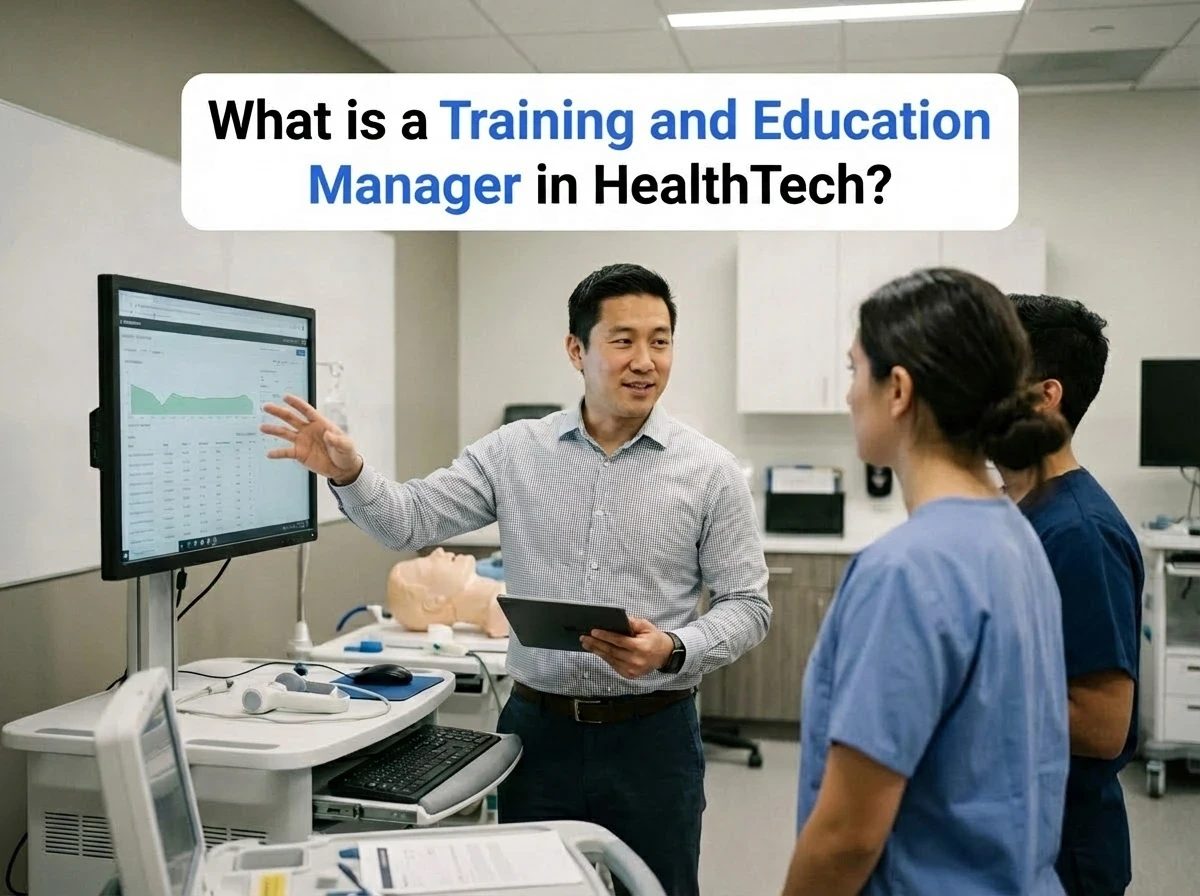
What is a Training and Education Manager in HealthTech?
A Training and Education Manager in HealthTech ensures that everyone who uses a health technology product (clinicians, care teams, operational staff, and sometimes patients) can use it correctly, safely, and consistently in their daily workflows. This role exists because simply knowing the product isn't enough: adoption needs to work under pressure, across different shifts, and within clinical governance and data-sensitive environments.
At its heart, this is an ownership role. You're responsible for readiness: making sure new users are prepared, training is fit for purpose, learning can be evidenced and audited where necessary, and education keeps up with product changes, new pathways, and evolving customer configurations. In many HealthTech organisations, this person sits at the crossroads of Product, Implementation/Customer Success, and Clinical/Quality functions, often acting as the single point of accountability for education strategy and training quality throughout the customer lifecycle.
🔍 How this role differs in HealthTech
In most SaaS businesses, training success is largely measured by activation, feature usage, and renewals. In HealthTech, whilst those metrics still matter, they're rarely enough on their own. The consequences of misunderstanding a workflow, misconfiguring a feature, or training the wrong process can be operationally serious and, in some cases, clinically significant.
This changes how decisions are made. Training content may need stronger version control, clearer sign-off, and tighter alignment with "what is approved to be taught" rather than "what is technically possible in the product." You may also need to design education that works in real clinical conditions: time-poor users, high staff turnover, mixed digital confidence, and multiple local policies. Even when you're not directly responsible for regulation, you're often responsible for making sure training doesn't create risk by overpromising, skipping guardrails, or failing to reflect how the product should be used in a governed environment.
🎯 Core responsibilities in HealthTech
Day to day, a Training and Education Manager makes judgement calls about what "good" looks like and how to achieve it without breaking the realities of healthcare delivery. That usually starts with mapping who needs to be competent in what, by when, and under which constraints, then building a training approach that can survive real-world rollout conditions.
You'll constantly balance depth against time: how to teach the safest and most reliable workflow without turning training into a barrier to go-live. You'll decide when education should be standardised and when it must flex for local pathways, and how to manage that flexibility without creating an unmaintainable set of bespoke materials. You'll also be accountable for feedback loops: capturing what users struggle with, separating training problems from product problems, and pushing the right issues back to Product, Implementation, or Clinical teams with evidence.
In stronger HealthTech organisations, the role also owns training governance: keeping materials aligned to current product behaviour, making sure trainers and customer-facing teams teach consistently, and providing defensible proof of training completion and competency where customers require it. The work is often less about delivering sessions and more about making sure an education system works at scale during implementation peaks, product releases, and organisational change on the customer side.
🧩 Skills and competencies for HealthTech
Core Skill | HealthTech specific requirement | Reason or Impact |
|---|---|---|
Accountability for safe adoption | Ability to define "safe and correct use" in workflow terms, not just feature knowledge, and to hold the line when shortcuts increase operational or clinical risk | Prevents training from becoming a tick-box exercise and reduces failure modes during go-live and high-pressure usage |
Stakeholder judgement | Comfort navigating clinical leaders, operational managers, IT, and vendor/customer governance without becoming captive to any single viewpoint | Enables decisions that work in real care settings whilst protecting product integrity and training standards |
Instructional decision-making under constraints | Designing training that is credible for clinical audiences and realistic for time-poor teams, without diluting essential guardrails | Improves completion and retention whilst maintaining minimum safe competency |
Quality and version control mindset | Treating training artefacts like controlled assets: clear ownership, change discipline, and clarity on what version was taught | Reduces confusion after product updates and supports auditability where customers require evidence |
Evidence-driven improvement | Ability to instrument learning outcomes with practical signals (incidents, tickets, workflow errors, adoption drop-offs) and act on them | Turns education into a measurable lever for reliability, not just an enablement function |
Cross-functional leadership | Leading without relying on hierarchy, aligning Product/Implementation/Clinical/Support on what training should cover and who owns what | Prevents gaps (or duplication) between training, documentation, and in-product guidance |
💷 Salary ranges in UK HealthTech
Training and Education Manager pay in UK HealthTech is driven less by "training delivery" and more by scope and risk. The biggest factors are: whether you own education for a regulated or safety-critical workflow; whether you manage a team or a single programme; how customer-facing the role is (and the seniority of stakeholders you train); whether you own training governance and competency evidence; and whether you're expected to support high-intensity go-lives or out-of-hours deployments. Location still matters, but the premium is usually highest where the role carries cross-functional accountability or direct influence on customer outcomes.
Experience level | Estimated annual salary range | What drives compensation |
Junior | London & South East: £35,000–£45,000 | Supporting delivery and coordination, building materials, assisting onboarding; limited ownership of training strategy or governance |
Mid-level | London & South East: £45,000–£60,000 | Owning training for a product area or customer segment, running enablement for implementations, managing feedback loops with Support/Product |
Senior | London & South East: £60,000–£75,000 | Owning education programmes end-to-end, setting standards, handling complex workflows, influencing go-live readiness and adoption at scale |
Lead | London & South East: £75,000–£90,000 | Multi-product or multi-region ownership, formal governance and quality control, leadership across trainers/CS/Implementation, high visibility with customers |
Head / Director | London & South East: £90,000–£120,000 | Function leadership, budget and staffing, training operating model, executive stakeholder management, measurable impact on adoption, retention, and safety outcomes |
Typical add-ons vary by employer type and how customer-facing the role is. Bonus is common where the role is tied to commercial outcomes (successful deployments, retention, expansion) and less consistent where the function is positioned as internal enablement. Equity is more likely in venture-backed HealthTech, usually increasing with seniority and scope. On-call allowances aren't universal for this job family, but some roles effectively carry "go-live support" expectations; where that includes evenings/weekends or rapid response during deployments, total compensation can be higher, especially when travel intensity, customer criticality, or governance burden is significant.
🚀 Career pathways
Entry points are often through implementation coordination, customer support in a clinically oriented product, learning design for regulated environments, or operational roles inside healthcare where you've trained teams on systems and pathways. What accelerates progression isn't the number of sessions delivered, but the ability to take ownership of outcomes: reducing errors, improving time-to-competency, and making training scalable and consistent across customers.
Over time, responsibility expands from delivering and maintaining materials to owning a full education system: standards, trainer enablement, governance, and performance measurement. The step into Lead typically comes when you can run multiple programmes in parallel, influence Product and Implementation priorities with evidence, and protect quality under delivery pressure. Head/Director progression tends to come when you can define the operating model for education across the company, build a team, and show measurable impact on adoption reliability without creating unnecessary friction for customers.
❓ FAQ
Do I need a clinical background to be credible as a Training and Education Manager in HealthTech?
Not always, but you do need credibility with clinical and operational stakeholders. That credibility can come from deep workflow understanding, strong facilitation, and consistently accurate, safety-aware training. Some organisations prefer clinical experience for products embedded in clinical decision-making or complex pathways.
How will I be assessed at interview beyond "can you run training sessions"?
Expect evaluation on ownership: how you define readiness, how you handle version control and conflicting stakeholder demands, and how you prove training works. Strong candidates describe trade-offs they made under delivery pressure and how they used evidence (tickets, errors, adoption signals) to improve training and influence other teams.
Will I be expected to support go-lives outside normal hours?
Sometimes. Many HealthTech deployments happen around shift patterns, busy clinical periods, or constrained windows, and education often needs to flex around that. Clarify whether expectations are informal (being available during rollouts) or formal (rota/on-call), and whether any allowance or time off in lieu is standard.
🔎 Find your next role
Search Training and Education Manager roles on Meeveem to find HealthTech opportunities that match your domain focus, customer exposure, and desired level of ownership.
You might also like