Published Date: January 2, 2026
Updated Date: January 2, 2026
What is a Tender Manager in HealthTech?
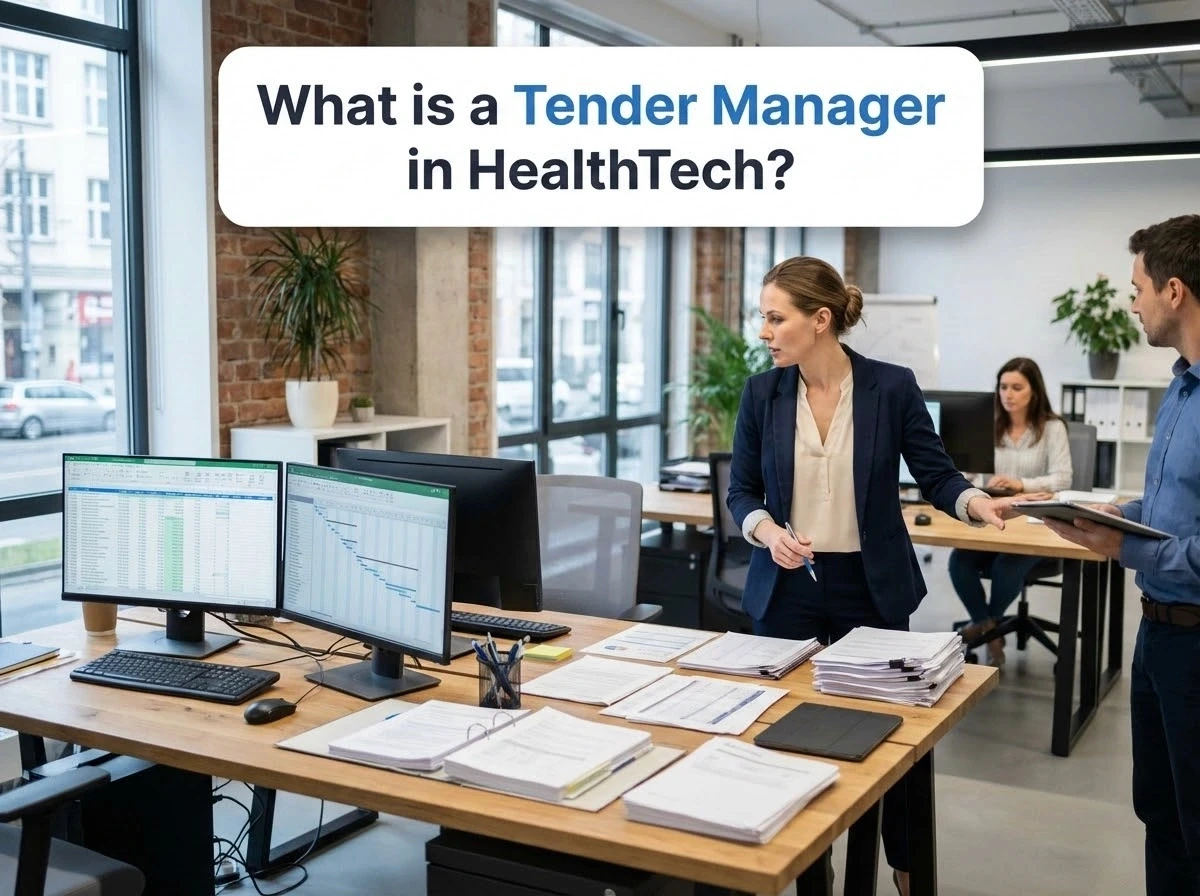
A Tender Manager in HealthTech is the person responsible for transforming a complex healthcare buying process into a submitted, compliant, and competitive tender that a provider can actually deliver, without creating avoidable clinical, regulatory, or commercial risk. Put simply: they "own the bid" from the moment an opportunity is qualified to the moment it is submitted (and often through clarifications and contract award), ensuring the organisation's promises are accurate, evidenced, and commercially sound.
This role exists because healthcare procurement is high-stakes and formalised. Buyers expect traceability: clear answers, measurable outcomes, implementation detail, security assurance, and contractual commitments that stand up to scrutiny. A Tender Manager sits at the intersection of sales, delivery, product, clinical stakeholders, security, and legal, carrying responsibility for what the company commits to, not just how the document reads.
In most HealthTech organisations, the role typically sits within commercial, revenue, or business development functions, and partners closely with clinical, information governance/security, and delivery leadership. Their value is measured in both win rate and "win quality": contracts you can implement safely, on time, and profitably.
🔍 How this role differs in HealthTech
In many tech sectors, bids are often lightweight, commercially led, and can rely on standard product narratives. In HealthTech, the tender is frequently treated as an auditable statement of capability. The bar for evidence is higher, the tolerance for ambiguity is lower, and the cost of overpromising can be operationally and reputationally severe.
HealthTech also changes the risk profile. You're dealing with sensitive data, complex stakeholder environments, and services that can influence patient pathways and clinical workflows. That means tender decisions are shaped by real-world constraints: implementation capacity, interoperability expectations, assurance materials, and contract terms that may shift risk onto the supplier.
As a result, a Tender Manager in HealthTech tends to be more embedded in delivery reality than in other industries: they're constantly balancing competitiveness with assurance, and speed with correctness.
🎯 Core responsibilities in HealthTech
Day to day, a Tender Manager is accountable for governing the end-to-end tender lifecycle: shaping the bid plan, coordinating subject-matter input, and making judgement calls when different functions disagree. They decide what "good" looks like for a given opportunity: how far the organisation can stretch on outcomes, timelines, service levels, reporting, and commercial terms without creating delivery risk.
A typical HealthTech tender involves tight deadlines, dense requirements, and multiple constraints at once: clinical credibility, operational feasibility, information governance, and contractual obligations. The Tender Manager keeps these threads connected. When a buyer asks for a capability that is partially available, they don't just "write it well". They drive a decision: commit, propose an alternative, qualify the assumption, or walk away.
They also lead the organisation through clarifications and governance. That means ensuring answers stay consistent across sections, evidence aligns with claims, pricing reflects the delivery model, and the final submission is compliant. In many teams, they become the internal "truth owner" of what has been promised, because once awarded, delivery teams inherit those commitments.
🧩 Skills and competencies for HealthTech
Core Skill | HealthTech specific requirement | Reason or Impact |
|---|---|---|
Commercial judgement | Translate buyer requirements into an offer that is both competitive and deliverable within healthcare constraints | Prevents "winning the wrong deal" and protects margins, reputation, and implementation outcomes |
Risk ownership | Recognise clinical, operational, and information governance risk within tender language and commitments | Reduces the chance of signing contracts that create patient-safety or service-continuity exposure |
Stakeholder leadership | Influence clinical, security, product, legal, and delivery leaders without formal authority | Keeps bids coherent and timely while aligning the organisation behind a single set of commitments |
Evidence discipline | Build answers that are provable: measurable outcomes, clear delivery approach, and defensible assurance | Improves evaluation scores and avoids later disputes during mobilisation and service acceptance |
Decision-making under ambiguity | Make clear calls when requirements are unclear, conflicting, or unrealistic within deadlines | Maintains bid momentum and prevents last-minute rewrites that introduce inconsistency or risk |
Communication clarity | Explain complex HealthTech delivery and data-handling concepts in buyer-friendly language | Helps non-technical evaluators assess suitability and reduces misunderstanding that can harm scoring or delivery |
💷 Salary ranges in UK HealthTech
Tender Manager pay in HealthTech is primarily driven by the level of ownership you carry: the value and complexity of opportunities, the regulated or high-assurance nature of the solution, and how directly you influence commercial outcomes. Compensation also shifts with seniority (individual contributor vs team leadership), proximity to revenue targets, and the intensity of bid cycles (volume, deadlines, and the level of stakeholder orchestration required). Location still matters in the UK market, with London and South East often paying a premium, though hybrid roles can narrow the gap.
Experience level | Estimated annual salary range | What drives compensation |
Junior | London & South East: £30,000–£40,000 | Support scope, narrower ownership, smaller tenders, more supervision, less direct accountability for commercial decisions |
Mid-level | London & South East: £40,000–£55,000 | End-to-end ownership of standard bids, cross-functional coordination, increased responsibility for compliance and bid quality |
Senior | London & South East: £55,000–£70,000 | High-value or complex tenders, tougher governance, stronger accountability for risk trade-offs, influencing exec stakeholders |
Lead | London & South East: £70,000–£90,000 | Portfolio leadership, bid strategy, coaching others, improving win rate and process maturity, handling "must-win" opportunities |
Head / Director | London & South East: £90,000–£125,000 | Function ownership, team and resource planning, governance, forecasting, executive accountability for commercial performance and bid quality |
Beyond base salary, total compensation commonly includes a performance bonus (often linked to bookings, win rate, margin quality, or strategic milestones). Equity can appear in scaling HealthTech companies, particularly for Lead and Head/Director roles, and tends to be higher where the tender function materially drives growth. On-call allowance is typically uncommon for Tender Managers (it's more associated with operational/service roles), but some employers offer occasional out-of-hours compensation during peak submissions or critical clarifications; more often this shows up as flexible time off rather than a formal allowance. Variation in total package is mostly driven by deal size, leadership scope, how tightly the role is tied to revenue outcomes, and the level of regulated assurance work expected.
🚀 Career pathways
People typically enter HealthTech tender management through adjacent routes: bid writing, proposals, commercial operations, healthcare procurement support, or account roles that have handled formal tenders. A common early shift is from producing sections of bids to owning the whole submission, where responsibility expands from "my content" to "our commitments".
Progression tends to follow ownership rather than title. As you grow, you move from running single tenders to shaping bid strategy across a pipeline: deciding when to bid, setting standards, building reusable evidence, and improving governance. Lead and Head/Director progression usually comes from demonstrating you can scale outcomes: raising bid quality, increasing win rate, and protecting delivery realism across many opportunities, not just managing more documents.
❓ FAQ
Do I need NHS procurement experience to get hired as a Tender Manager in HealthTech?
It helps, but it's not always required. Many teams will prioritise your ability to run a disciplined bid process, manage stakeholders, and make safe commitments. If you're new to healthcare, expect to be assessed on how quickly you can learn buyer language, assurance expectations, and delivery constraints.
What will I be judged on in the first 90 days: documents or outcomes?
Both, but outcomes usually matter more. Hiring managers look for improved bid discipline: clearer governance, fewer last-minute surprises, stronger compliance, and better coordination across SMEs. Early wins often come from creating structure: bid plans, review rhythms, and a reliable "source of truth" for evidence and assumptions.
How intense are deadlines, and should I expect out-of-hours work?
Tender cycles can be spiky: quiet periods followed by high-pressure submission windows. Out-of-hours work can happen near deadlines, especially for complex public-sector submissions and clarifications, but formal on-call is uncommon. The key is how the organisation plans and resources bids. Strong governance reduces the need for repeated late nights.
🔎 Find your next role
If you're ready to own high-stakes bids that shape real healthcare delivery, search Tender Manager roles on Meeveem.
You might also like