Published Date: January 2, 2026
Updated Date: January 2, 2026
What is a Telehealth Coordinator in HealthTech?
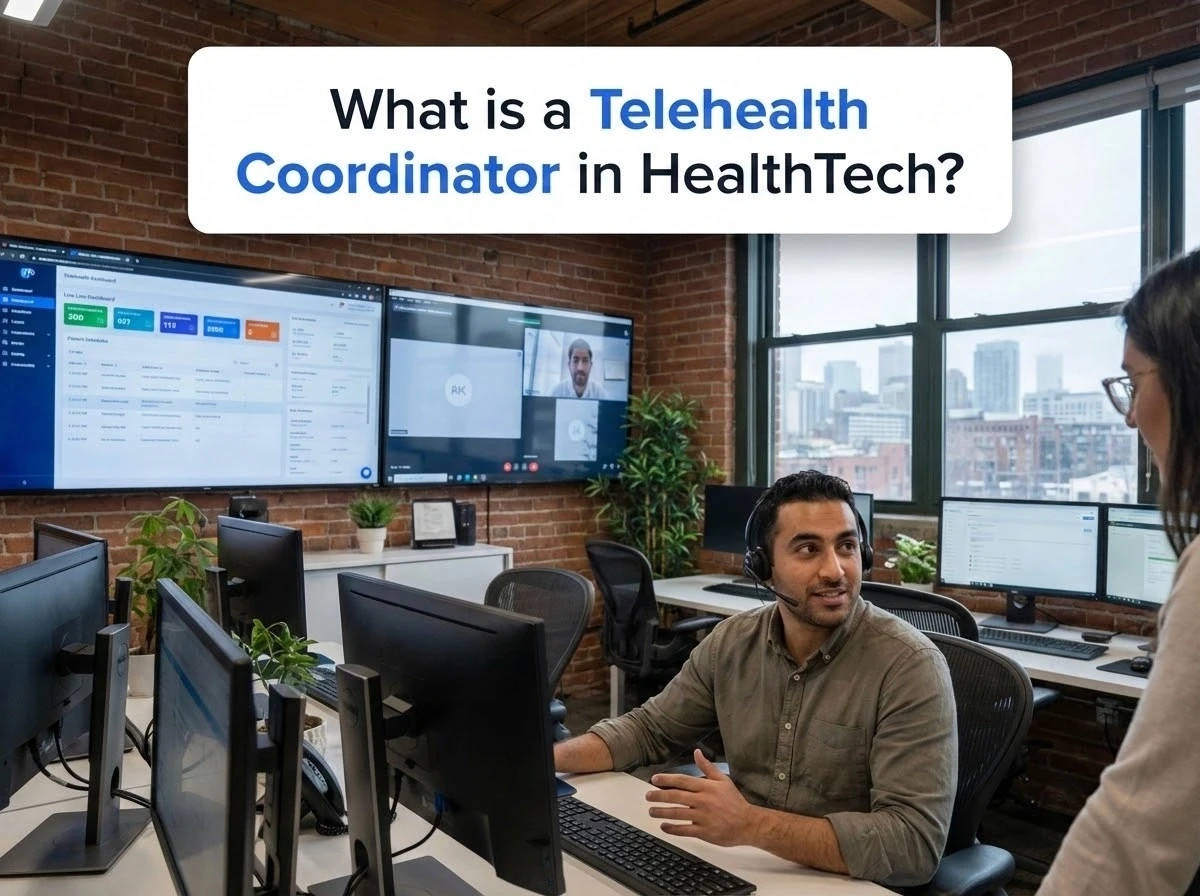
A Telehealth Coordinator in HealthTech is the operational owner of making sure remote care visits actually happen. They work at the intersection of patients, clinicians, and the digital care platform, ensuring appointments are scheduled correctly, patients can access the right channel at the right time, information is captured where it needs to be, and issues are resolved or escalated without compromising safety, privacy, or clinical flow.
This role exists because virtual care adds a second operational layer to healthcare delivery. It's not enough to have clinicians and a product that "works". Someone has to run the day-to-day system that connects real patients to regulated care, handling access, identity and data hygiene, clinical handoffs, and the inevitable exceptions (failed joins, incomplete histories, consent gaps, language needs, safeguarding concerns, urgent clinical signals). In practice, Telehealth Coordinators are accountable for reliability, patient experience, and operational control in a setting where mistakes can delay treatment or create clinical risk.
🔍 How this role differs in HealthTech
In many tech industries, a coordination role primarily protects customer experience and internal efficiency. In HealthTech, it also protects clinical safety and information integrity. The Telehealth Coordinator's choices (how to verify a patient, when to proceed versus pause, what to document, when to escalate, how to route a concern) can change outcomes, not just satisfaction scores.
HealthTech also raises the stakes on data sensitivity and process discipline. The work is shaped by strict confidentiality expectations, careful handling of patient-identifiable data, and the operational reality of healthcare: late-running clinics, capacity constraints, clinician availability, and patients who may be unwell, distressed, or unable to self-serve. Compared with consumer tech, "move fast" becomes "move accurately", and compared with FinTech, "fraud prevention" becomes "right patient, right pathway, right escalation".
🎯 Core responsibilities in HealthTech
Day to day, a Telehealth Coordinator owns the operational workflow that turns demand into completed care: confirming the right appointment type, aligning calendars, ensuring pre-visit prerequisites are met, and preventing avoidable failures (missing forms, wrong links, incompatible devices, unresolved ID checks, unclear instructions). They often become the first human "system check" for whether a patient is ready and appropriate for a remote pathway, and they are responsible for escalating when something doesn't fit (clinical red flags, safeguarding concerns, or operational conditions that could compromise care quality).
A key part of the job is decision-making under constraints. Clinics run late, patients arrive without required information, connectivity fails, and urgent messages arrive mid-session. The Telehealth Coordinator must make fast, defensible trade-offs: protect clinician time whilst not abandoning the patient; resolve simple issues quickly whilst escalating anything that could be clinical; maintain throughput whilst preserving documentation quality. In a strong HealthTech organisation, they also feed patterns back into the system (highlighting recurring failure points, proposing workflow changes, and helping translate "what keeps going wrong" into operational fixes the wider team can implement).
🧩 Skills and competencies for HealthTech
Core Skill | HealthTech specific requirement | Reason or Impact |
|---|---|---|
Operational ownership | Treat "successful, safe completion of the episode" as your outcome, not "tasks completed" | Prevents gaps between booking, access, documentation, and follow-up that can create clinical and reputational risk |
Patient-centred communication | Explain processes to patients who may be anxious, unwell, time-poor, or digitally excluded | Reduces missed appointments and complaints, and increases adherence to instructions that affect care quality |
Clinical-context judgement | Recognise when something is operational versus potentially clinical, and escalate appropriately | Protects patients from being incorrectly routed or having warning signs overlooked |
Documentation discipline | Capture key interactions consistently, with clear timestamps and minimal ambiguity | Creates an auditable operational trail and supports safe handoffs across clinical and support teams |
Risk awareness and confidentiality | Apply privacy-first handling of patient data in everyday actions (sharing, screen habits, verification) | Reduces the chance of data exposure and strengthens trust in remote care delivery |
Exception handling under pressure | Stay calm when clinics overrun, platforms fail, or multiple stakeholders need updates | Maintains service reliability and avoids compounding errors during peak load |
Cross-functional coordination | Align clinicians, operations, and product/support without "dropping" the patient | Improves throughput and resolves root causes rather than repeatedly patching symptoms |
Service improvement mindset | Turn recurring issues into actionable feedback (patterns, triggers, proposed workflow changes) | Helps HealthTech scale safely by reducing failure demand and improving standardisation |
💷 Salary ranges in UK HealthTech
Telehealth Coordinator pay tends to follow the weight of operational accountability rather than the word "coordinator". The biggest drivers are: how much clinical-risk triage sits in the workflow; whether you're coordinating one clinician or multiple pathways; the volume and complexity of patient interactions; on-call or out-of-hours coverage; and whether the organisation expects you to own performance metrics (utilisation, DNA reduction, booking accuracy, patient access time) rather than simply execute steps. Location still matters, but scope and criticality often matter more.
Experience level | Estimated annual salary range | What drives compensation |
Junior | London & South East: £24,000–£30,000 | Mainly administrative coordination versus end-to-end episode ownership; supervised work; narrower pathways; limited exception handling |
Mid-level | London & South East: £30,000–£36,000 | Independently running clinics/queues; handling more complex patient needs; stronger accountability for accuracy, privacy, and service reliability |
Senior | London & South East: £36,000–£45,000 | Owning performance outcomes; training/mentoring; managing escalations; coordinating across multiple clinicians/pathways; higher incident and complaint exposure |
Lead | London & South East: £45,000–£60,000 | Leading a team or shift function; setting standards and controls; capacity planning; QA; escalation frameworks; operational reporting and improvement delivery |
Head / Director | London & South East: £60,000–£85,000 | Accountability for virtual care operations across services; governance, risk and audit readiness; workforce strategy; vendor/platform oversight; multi-site or multi-contract delivery |
Beyond base salary, common add-ons include performance-related bonuses (more common in private HealthTech providers and scale-ups), enhanced pay for evenings/weekends, and on-call allowances where telehealth is part of a time-sensitive service or where operational cover is required outside core hours. Equity can appear in earlier-stage companies, usually for Lead and above, and total compensation varies most with out-of-hours intensity, clinical risk exposure, and whether the role carries line management and measurable service KPIs.
🚀 Career pathways
Entry points often come from healthcare administration, medical reception and booking, patient services, care coordination, or contact-centre roles supporting clinical services. People also move into this role from clinical support positions where they've learnt healthcare workflows and patient communication, even if they are not clinically registered.
Progression happens when you move from "handling appointments" to owning a system: you become responsible for reducing failure demand, setting operational standards, and improving reliability across a pathway. Over time, that ownership expands from individual clinics to multi-pathway operations, then into people leadership, capacity planning, quality assurance, and governance. The strongest career moves typically come from demonstrating control under pressure, building repeatable processes, and becoming the person others trust to handle escalations safely.
❓ FAQ
Do Telehealth Coordinators need a clinical background, or is this an operations role?
It's primarily an operations role, but it requires clinical-context judgement: you must know what you can resolve operationally and what must be escalated. Some employers prefer healthcare experience (GP, outpatient booking, patient services) because it reduces risk in handoffs and documentation. Clinical registration is usually not required unless the role includes structured clinical triage.
What does "good performance" look like in this job beyond answering calls and booking appointments?
Good performance means high reliability with low operational noise: fewer failed joins, fewer rebook loops, clean documentation, and smooth clinic flow even when conditions are messy. It also means sound escalation judgement (patients feel supported, clinicians feel protected, and issues are surfaced early rather than becoming incidents or complaints).
Should I expect on-call or out-of-hours work in a Telehealth Coordinator role?
Sometimes. If the service runs evenings/weekends, supports urgent pathways, or promises rapid turnaround, you may see shift work, weekend rotations, or an on-call model for operational issues. Always clarify the rota, what "on-call" actually means (availability versus active work), and whether there's an allowance or enhanced rates.
🔎 Find your next role
Search Telehealth Coordinator roles on Meeveem to find opportunities across virtual clinics, remote patient services, and HealthTech operations teams.
You might also like