Published Date: January 2, 2026
Updated Date: January 2, 2026
What is a Technical Recruiter in HealthTech?
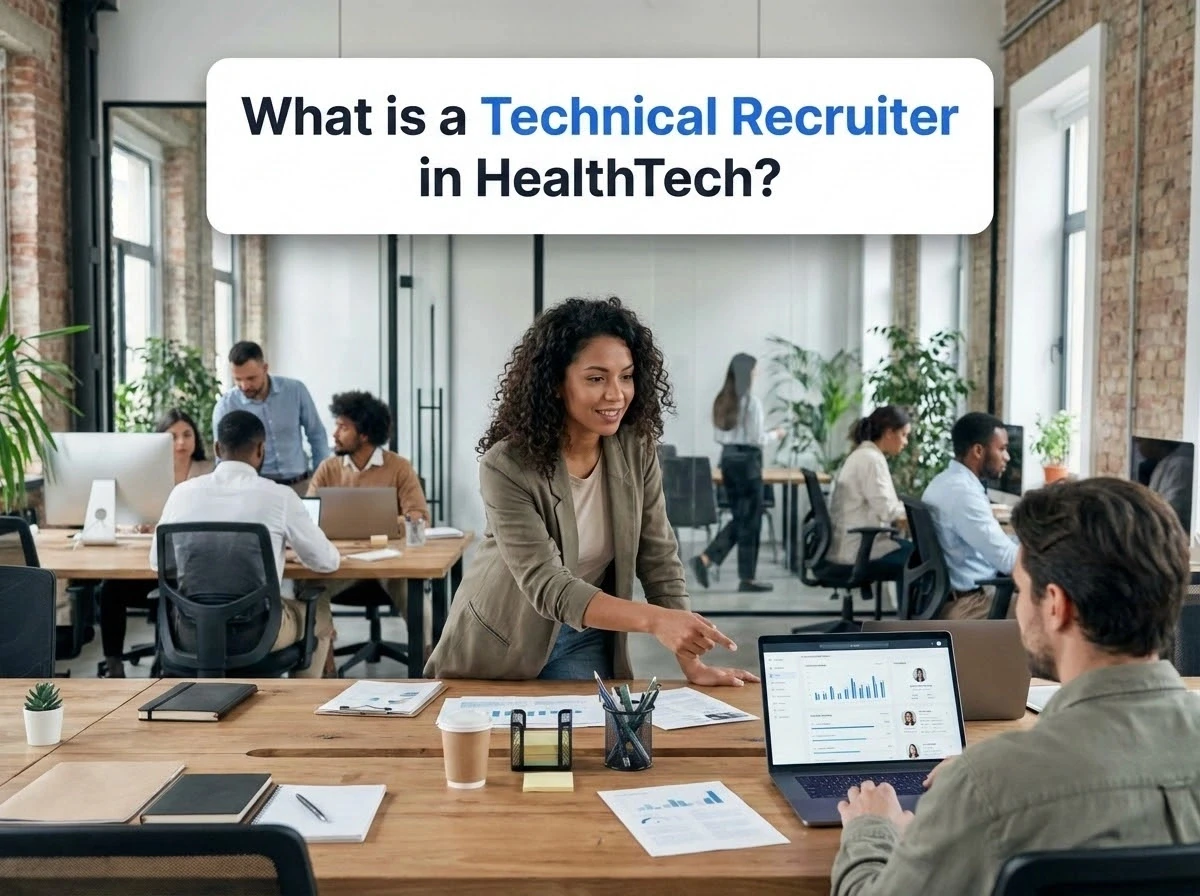
A Technical Recruiter in HealthTech is an in-house or embedded hiring specialist responsible for building the engineering, data, security, and technical product teams that healthcare-focused companies need to deliver safe, reliable software in environments where mistakes carry real consequences. They don't simply "fill roles"; they own the entire outcome of critical technical hiring, balancing speed, quality, fairness, privacy, and organisational risk.
This role exists because HealthTech organisations often depend heavily on scarce technical skills (engineering, data, platform, security, QA) whilst facing constraints that make hiring harder: sensitive personal data, rigorous assurance expectations, complex customer stakeholders, and long-term accountability for how systems behave in the real world. A strong Technical Recruiter creates predictability in an otherwise uncertain process so teams can scale without compromising safety, compliance, or delivery.
In most HealthTech organisations, the Technical Recruiter sits within Talent Acquisition (or People) but works day-to-day as a close partner to Engineering leadership, Product, Security, and sometimes Clinical/Quality functions. Their accountability is measured in hires that stick, processes that stand up to scrutiny, and hiring decisions that are defensible and consistent, not just "time-to-fill".
🔍 How this role differs in HealthTech
HealthTech recruiting typically carries a different "cost of a wrong hire" profile than many SaaS, FinTech, or consumer-tech environments. The product may touch highly sensitive data, influence clinical workflows, or support operational decisions where errors have outsized impact. That changes how Technical Recruiters operate: more attention to role design, clearer evidence standards, and tighter alignment between what's evaluated in interviews and what the job actually demands.
In practice, HealthTech also tends to introduce more interfaces and dependencies: security expectations from customers, privacy obligations, procurement requirements, and internal assurance gates that affect who can be hired and how quickly they can start. A Technical Recruiter often becomes the person who translates those constraints into a workable hiring plan, protecting candidate experience whilst ensuring the organisation can stand behind its decisions.
Compared with faster-moving consumer contexts, there is often more emphasis on structured process, calibration across interviewers, and documentation of decisions, because stakeholders may need confidence that hiring is consistent and risk-aware.
🎯 Core responsibilities in HealthTech
Day to day, a Technical Recruiter in HealthTech is responsible for turning ambiguous hiring needs into outcomes: defining what "good" looks like for a specific team, shaping the assessment approach so it measures relevant capability, and running a pipeline that produces hires without creating hidden risk. They manage the trade-off between urgency (teams need capacity now) and correctness (the organisation can't afford poor judgement, weak security practice, or misalignment with delivery standards).
A typical week involves partnering with engineering leaders to clarify the real constraints behind a role: what must be true on day one versus what can be learned, where the system is brittle, and where the team is under operational pressure. They then translate that into a candidate story and a search strategy that reflects the market reality, not an idealised wishlist. When the market pushes back (salary expectations, notice periods, remote flexibility, scarcity of certain skills), the recruiter owns the iteration: adjusting scope, resetting expectations with stakeholders, and preserving process integrity.
In HealthTech, the recruiter also frequently navigates confidence and trust: candidates will ask about data handling, customer expectations, and reliability standards; hiring teams will want signal without over-indexing on proxies (brand names, narrow tool checklists). The recruiter's job is to keep decisions evidence-based and fair, ensuring the process is consistent, defensible, and aligned to the real risks of the domain.
🧩 Skills and competencies for HealthTech
Core Skill | HealthTech specific requirement | Reason or Impact |
|---|---|---|
Role scoping and intake judgement | Translate clinical-adjacent constraints, security expectations, and delivery risk into a realistic technical brief | Prevents "unfillable" roles and reduces downstream risk from hiring against the wrong problem |
Stakeholder management with technical leaders | Hold firm on evidence standards and process consistency whilst operating under delivery pressure | Keeps hiring decisions defensible and reduces expensive churn from rushed, mis-scoped hires |
Assessment design literacy | Ensure interviews test real job performance (reliability thinking, data handling, quality mindset) rather than trivia | Improves signal quality and supports safer, more consistent hiring decisions |
Risk-aware candidate evaluation | Recognise patterns that increase operational or security risk without resorting to blunt exclusions | Supports balanced decisions where reliability and integrity matter as much as output speed |
Candidate communication and trust-building | Explain mission, constraints, and expectations clearly, including "non-negotiables" | HealthTech candidates often screen employers for seriousness about quality, privacy, and impact |
Offer strategy and closing | Align offers to the total package (base, bonus, equity, flexibility) whilst protecting internal parity | Reduces offer fallout and avoids comp decisions that create long-term retention and fairness issues |
Process discipline and documentation | Maintain structured notes, calibration, and consistent decision paths across interviewers | Helps organisations stand behind hiring outcomes and improves repeatability in regulated-adjacent environments |
Market mapping and talent intelligence | Build a view of scarce skill pools (data, security, platform) and realistic sourcing channels | Prevents over-reliance on inbound applicants and reduces time lost chasing low-probability profiles |
💷 Salary ranges in UK HealthTech
Salary in HealthTech technical recruiting is driven less by the job title and more by scope: how specialised the technical hiring is (platform, security, data), how many and what types of roles are owned concurrently, and how much the recruiter is expected to shape process and strategy rather than execute an existing playbook. Location still matters, but so does seniority, stakeholder level (team leads vs VPs), and the "criticality premium" when hiring is tied to delivery timelines, customer commitments, or assurance expectations. On-call is usually not a standard expectation for recruiting roles, but some organisations do expect out-of-hours flexibility during closing or time-sensitive launches.
Experience level | Estimated annual salary range | What drives compensation |
Junior | London & South East: £28,000–£38,000 | Coordinator-to-recruiter transition, limited ownership of requisitions, more support work and structured execution |
Mid-level | London & South East: £38,000–£55,000 | Full-cycle ownership across several technical roles, sourcing depth, hiring manager partnership, consistent delivery against agreed plans |
Senior | London & South East: £55,000–£75,000 | Ownership of hard-to-hire domains (data/security/platform), process improvement, stakeholder influence, and higher bar for judgement under constraints |
Lead | London & South East: £70,000–£95,000 | Team leadership and/or function ownership for technical hiring, workforce planning input, calibration across teams, and accountability for outcomes at scale |
Head / Director | London & South East: £90,000–£130,000 | Organisation-wide TA strategy for technical functions, budgeting and vendor strategy, senior stakeholder management, and accountability for system-level hiring performance |
Beyond base salary, typical add-ons include a performance bonus (often tied to company and/or TA goals), and equity in venture-backed HealthTechs (more common at senior and above). Some organisations include additional rewards linked to delivery-critical hiring (retention or milestone-based incentives), and benefits that materially change total value (enhanced pension, private healthcare, flexible working). Total compensation moves most when the scope shifts from "filling roles" to owning strategy, leading a team, hiring in scarce specialties, or operating in environments with heavier assurance expectations and higher scrutiny on process quality.
🚀 Career pathways
Many Technical Recruiters enter HealthTech through adjacent routes: recruitment coordination, agency tech recruiting, internal generalist recruiting, or operational HR roles that gradually specialise into technical hiring. The early progression is usually about proving dependable ownership: running a clean process, improving hiring manager confidence, and learning how to evaluate technical talent without leaning on shallow proxies.
As responsibility expands, the work becomes less about executing steps and more about shaping outcomes: advising on role design, influencing how teams interview, building repeatable pipelines for hard-to-hire skill sets, and creating market-informed plans when leadership expectations don't match reality. At senior levels, progression is driven by scope and impact: owning multiple technical functions, leading other recruiters, and being accountable for how hiring decisions affect delivery, risk, and retention across the organisation.
❓ FAQ
Do I need an engineering background to be credible as a Technical Recruiter in HealthTech?
No, but you do need enough technical literacy to run an evidence-based process and to challenge vague requirements. In HealthTech, credibility often comes from judgement: clear role scoping, consistent assessment standards, and strong stakeholder management. You can build this through structured intake, calibration with engineers, and learning how systems, reliability, and data risks show up in day-to-day work.
How will I be assessed in interviews for HealthTech technical recruiting roles?
Expect evaluation on how you handle ambiguity and constraints: clarifying a messy requirement, designing an assessment plan, and communicating trade-offs to senior stakeholders. You may be asked to walk through a role you filled end-to-end, including where the process almost failed and what you changed. Strong answers show ownership, market realism, and fairness, not just activity volume.
Is out-of-hours work common for Technical Recruiters in HealthTech?
It's not typically "on-call" in the engineering sense, but bursts of flexibility can happen around offer closing, candidate availability, or time-sensitive hiring tied to launches and customer commitments. The healthiest organisations set clear expectations and share responsibility with hiring managers. If flexibility is expected, it should be reflected in how the role is scoped and rewarded.
🔎 Find your next role
Ready to take ownership of technical hiring in a mission-driven HealthTech environment? Search open roles on Meeveem and find a team where your judgement and delivery discipline matter.
You might also like