Published Date: December 17, 2025
Updated Date: December 17, 2025
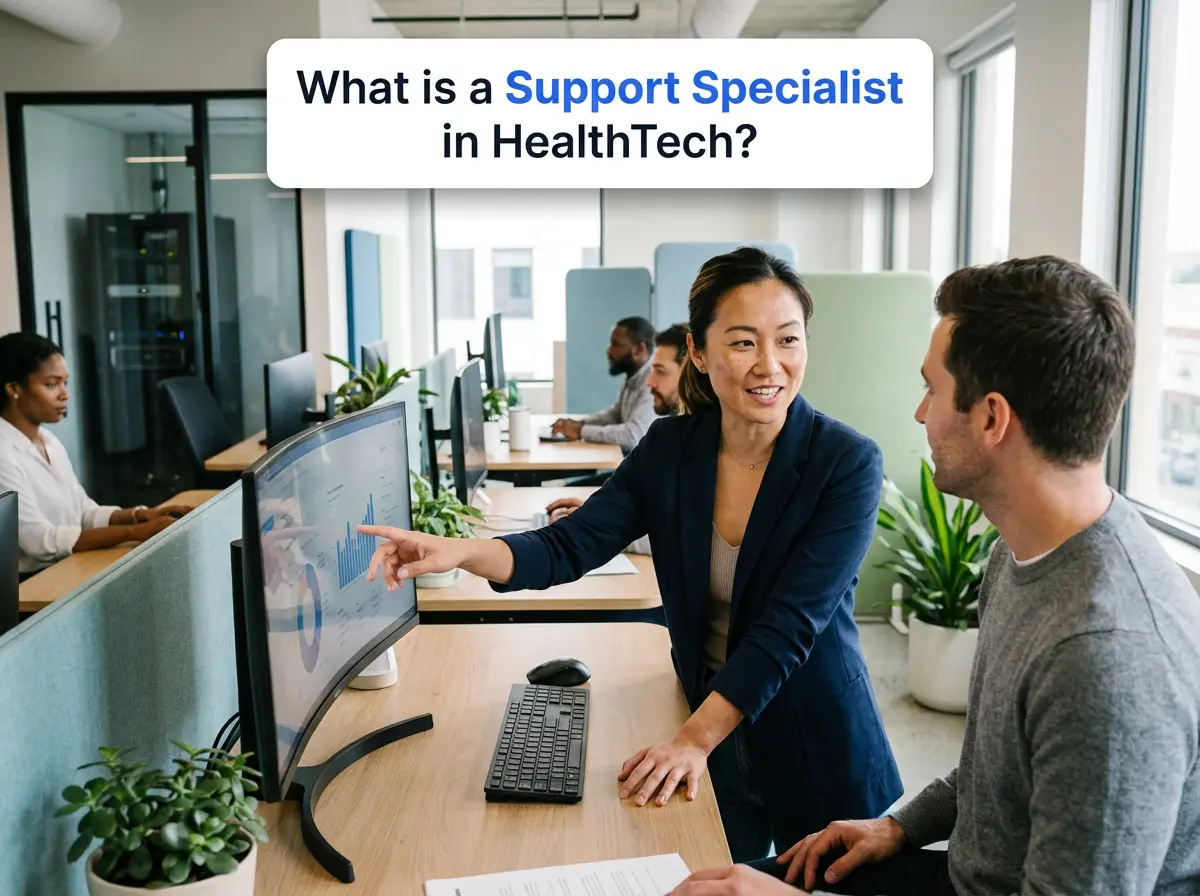
What is a Support Specialist in HealthTech?
A Support Specialist in HealthTech is accountable for keeping customers successfully using a healthcare product in the real world, especially when something breaks, degrades, or becomes risky. They own the path from "a user is blocked or concerned" to "service is restored, impact is understood, and the right teams have acted," whilst protecting patient data and maintaining trust.
This role exists because HealthTech products don't live in a neat lab environment. They run in clinics, hospitals, care settings, and patient-facing contexts where interruptions can affect workflows, decision-making, and continuity of care. A Support Specialist bridges the gap between how the product is designed and how it behaves under real operational pressure, often across complex customer environments, integrations, and access controls.
The job is fundamentally about responsibility: triaging impact, deciding the right next action, escalating with clarity, coordinating stakeholders, and ensuring incidents don't repeat. Tools, scripts, and playbooks matter, but they come after ownership.
🔍 How this role differs in HealthTech
In many SaaS or consumer tech companies, support is primarily judged by speed, friendliness, and resolution rate. In HealthTech, those still matter, but the bar is higher because the "cost of being wrong" is different. A good Support Specialist must weigh urgency against safety, privacy, and operational constraints, and must know when "quickest" is not "safest."
HealthTech support tends to operate closer to risk: sensitive health data, stricter access expectations, and a heavier emphasis on auditability and traceability. Even when the product isn't classed as a regulated medical device, customers may expect evidence-grade communication, careful language, and disciplined change management because their environment is regulated and clinically accountable.
The real-world impact also changes decisions. A performance issue might not just be annoying; it can interrupt appointment flow, triage pathways, or clinical admin processes. That context influences incident severity definitions, escalation speed, and the quality of post-incident follow-through.
🎯 Core responsibilities in HealthTech
Day to day, the Support Specialist is the steward of customer impact. They interpret messy signals (partial user reports, inconsistent logs, environmental differences, integration quirks) and turn them into a clear understanding of what's happening, who is affected, and what "good" looks like for recovery. They make judgement calls continuously: whether to treat a case as a high-severity incident, whether to advise a workaround, whether to freeze changes, and how to communicate without speculation.
They also act as the operational interface to engineering, product, and implementation teams. That doesn't mean simply "passing tickets on." It means shaping escalations into actionable narratives: reproduction context, time windows, suspected triggers, and risk framing. In HealthTech, trade-offs are rarely purely technical. Support has to account for clinical workflows, data access patterns, and the customer's governance constraints, especially when troubleshooting requires logs, exports, or temporary access changes.
Over time, strong Support Specialists become the memory of the system in the field: they spot recurring failure modes, push for permanent fixes, improve runbooks, and tighten feedback loops so that outages and near-misses translate into resilience.
🧩 Skills and competencies for HealthTech
Core Skill | HealthTech specific requirement | Reason or Impact |
|---|---|---|
Risk-based judgement | Ability to assess operational impact without over- or under-escalating when the situation touches patient pathways or sensitive data | Prevents "false calm" during serious events and avoids unnecessary disruption from overreaction |
Clear incident communication | Communicating status, uncertainty, and next steps in a way that supports customer governance and audit expectations | Builds trust under pressure and reduces downstream operational confusion |
Structured problem framing | Turning incomplete reports into a testable hypothesis whilst respecting access constraints and least-privilege principles | Speeds resolution without creating privacy or security exposure |
Stakeholder coordination | Managing handoffs between customer ops, implementation, engineering, and security in time-critical situations | Avoids duplicated effort and ensures the right decisions are made quickly |
Data handling discipline | Knowing what not to request, how to minimise data exposure, and how to document decisions | Reduces the risk of accidental data leakage and improves defensibility of support actions |
Systems thinking | Understanding that issues may span integrations, identity systems, devices, and customer-specific configuration | Improves root-cause accuracy and reduces repeated incidents caused by partial fixes |
Service ownership mindset | Treating reliability and customer outcomes as personal accountability, not "someone else's problem" | Drives better escalation quality, better follow-through, and stronger operational maturity |
💷 Salary ranges in UK HealthTech
Support Specialist pay in UK HealthTech tends to track four factors more than title alone: (1) the criticality of the product to day-to-day care delivery, (2) the depth of technical troubleshooting expected (integrations, identity, environments), (3) the degree of risk exposure (privacy, auditability, patient-facing impact), and (4) whether the role participates in structured out-of-hours or on-call coverage. Location and hiring model (vendor vs scale-up vs public-sector adjacent supplier) can also shift ranges materially.
Experience level | Estimated annual salary range | What drives compensation |
|---|---|---|
Junior | London & South East: £28,000–£35,000 | Entry-level ownership, narrower product surface area, supervised incident handling, limited stakeholder management |
Mid-level | London & South East: £35,000–£45,000 | Independent case ownership, stronger troubleshooting, higher-quality escalations, more complex customer environments |
Senior | London & South East: £45,000–£60,000 | Ownership of major incidents, cross-team coordination, higher-risk decision-making, mentoring, and prevention work |
Lead | London & South East: £60,000–£78,000 | Team leadership, operational strategy (SLAs, incident processes), escalations for critical accounts, on-call design and quality |
Head / Director | London & South East: £80,000–£120,000 | Accountability for support outcomes, budget and tooling, multi-team management, compliance posture, and executive-level incident leadership |
Beyond base salary, typical add-ons include an on-call/standby allowance (where applicable), paid call-outs or time-in-lieu arrangements, and a performance bonus in some organisations. Equity is more common in venture-backed HealthTech than in mature or services-led employers, and it can materially change total compensation at senior levels. The biggest drivers of total comp variation are on-call intensity (frequency and severity), whether support owns regulated or high-risk workflows, and whether the scope includes technical ownership (integrations, incident command) versus primarily customer-facing case handling.
🚀 Career pathways
A common entry point is customer support or service desk work in a regulated environment, then moving into HealthTech where you learn the product's operational reality: identity and access, integrations, clinical admin workflows, and incident coordination. Some candidates enter from NHS-adjacent operational roles, implementation teams, or technical support positions in other industries, bringing strong process discipline and escalation habits.
Progression typically comes from expanding ownership. Early on, you take increasingly complex cases and become reliable during incidents. At senior level, you're trusted to make high-stakes calls, to coordinate cross-functional response, and to turn recurring issues into prevention work. Lead and Head/Director progression is less about "doing more tickets" and more about shaping the support system: SLA design, training, quality standards, customer comms models, tooling, and how engineering and support share responsibility for service reliability.
❓ FAQ
Do HealthTech Support Specialist roles usually include on-call, and how can I tell before accepting?
Some do, especially where the product is operationally critical or supports 24/7 services. Look for wording about "out-of-hours support," "incident response," "rotations," or "major incident management," and ask how often you're on-call, what counts as a page, and whether there's a defined severity model.
What will I be evaluated on beyond closing tickets quickly?
In HealthTech, quality matters: accuracy of triage, clarity of escalations, and disciplined handling of sensitive information. Employers also look for how you manage uncertainty, how you communicate during incidents, and whether your work reduces repeats through better documentation and feedback to product/engineering.
Can I move from Support Specialist into product, implementation, or engineering in HealthTech?
Yes. Support is often the fastest way to learn real customer problems and the true product surface area. The most successful transitions happen when you demonstrate ownership beyond the inbox: leading incident reviews, improving runbooks, analysing patterns, and partnering with other teams to deliver permanent fixes.
🔎 Find your next role
If you're ready to take ownership of real-world outcomes in HealthTech, search Support Specialist roles on Meeveem and filter by product area, on-call expectations, and customer environment complexity.
You might also like