Published Date: December 29, 2025
Updated Date: December 29, 2025
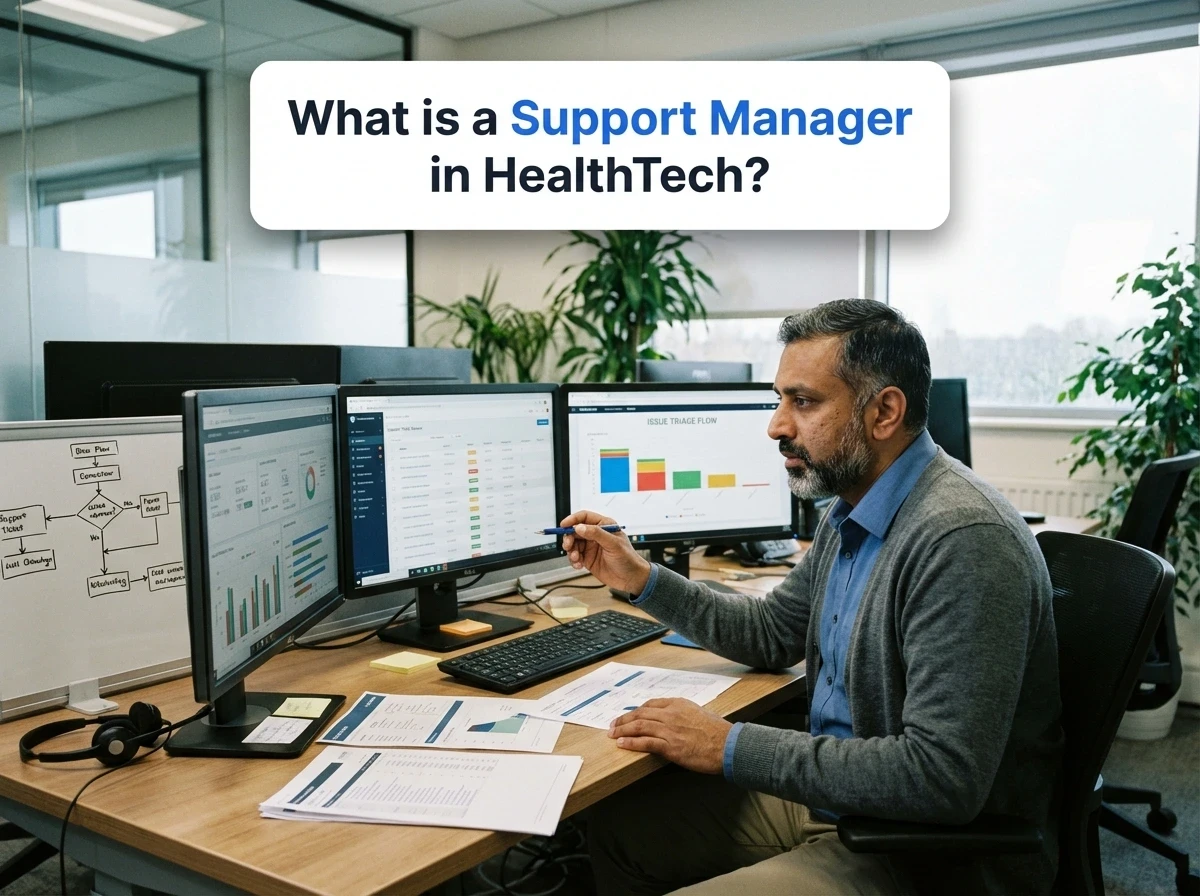
What is a Support Manager in HealthTech?
A Support Manager in HealthTech is the person accountable for the day-to-day reliability of customer support: making sure issues are triaged correctly, resolved safely, communicated clearly, and learned from so they don't repeat. It's a leadership role anchored in operational ownership (service quality, customer confidence, and continuity) rather than a purely people-management or ticket-queue role.
This role exists because HealthTech products are used inside real clinical and operational workflows, where downtime, misconfiguration, or delayed responses can create outsized impact. A Support Manager provides a single point of accountability for how support behaves under pressure: how incidents are handled, how priorities are set, how escalations work, and how the organisation balances speed, safety, and compliance.
At its best, the role sits at the intersection of customers, engineering, product, and clinical operations: owning outcomes (restored service, credible communications, protected data, measurable improvement) even when the Support Manager does not directly "fix" every issue themselves.
🔍 How this role differs in HealthTech
In many SaaS or consumer tech companies, support success can be judged primarily by speed, satisfaction, and cost-to-serve. In HealthTech, those measures still matter, but they are rarely sufficient on their own. The context changes decision-making: systems may support time-sensitive workflows, users can include clinical staff under significant constraints, and the product may sit within governed environments with strict access controls and audit expectations.
HealthTech support also tends to operate closer to risk. Escalations aren't just "an unhappy customer"; they can be a service continuity event, a patient-safety concern, a data-handling issue, or a contractual service-level breach that needs disciplined communications and documentation. That makes the Support Manager's judgement (what to prioritise, what to pause, what to escalate, and how to communicate) more central than any particular tooling.
Finally, organisations often expect tighter operational maturity: clearer incident processes, stronger change discipline, and more robust evidence of what happened and why. Even when the company is small, customers may expect "enterprise-grade" service behaviour.
🎯 Core responsibilities in HealthTech
A Support Manager's day is defined by accountability for flow: what is coming into support, what is being worked on, what is blocked, and what customers believe is happening. They shape triage so that urgent clinical-impacting issues are recognised early, routed correctly, and handled with the right level of senior attention. When something becomes an incident, they own the operational response: ensuring the team can stabilise service, keep stakeholders informed, and avoid unsafe "quick fixes" that create secondary failures.
They also make trade-offs explicit. In HealthTech, "fast" can conflict with "safe," and "helpful" can conflict with "compliant." A Support Manager sets the boundary conditions: what can be done immediately, what needs verification, what requires approvals, and what must be recorded for auditability. They decide when to escalate to engineering, when to involve implementation teams, and when to insist on a structured change rather than an ad-hoc workaround.
Over time, the role becomes less about managing today's queue and more about improving the system that creates the queue. That includes patterns in recurring issues, knowledge quality, customer communications, SLA performance, and the reliability of handoffs between support, product, and engineering. The Support Manager is often the person who turns "support pain" into operational learning the business can act on.
🧩 Skills and competencies for HealthTech
Core Skill | HealthTech specific requirement | Reason or Impact |
|---|---|---|
Operational ownership | Treat incidents, escalations, and service degradation as end-to-end outcomes you own, not tasks you delegate | Prevents "someone else's problem" gaps that are especially costly when systems support real-world workflows |
Risk-based prioritisation | Prioritise based on clinical/operational criticality, data sensitivity, and contractual commitments (not just ticket age or customer loudness) | Ensures limited support and engineering capacity is applied where harm and exposure are highest |
Incident leadership and communications | Run calm, structured incident response with audience-appropriate updates and clear next steps | Maintains trust with healthcare customers who need predictable information to manage their own operations |
Decision-making under constraints | Make defensible calls with incomplete information while preserving safety, traceability, and service continuity | HealthTech environments often restrict access and change velocity, so judgement replaces "move fast" instincts |
Stakeholder management | Align support, engineering, product, and customer teams around a single narrative of impact, cause, and remediation | Reduces contradictory messaging and accelerates coordinated resolution and follow-up |
Process discipline and evidence | Maintain consistent handling, documentation, and review practices that stand up to scrutiny | Supports regulated expectations, audit-readiness, and reliable learning from incidents and changes |
Coaching and quality standards | Build team capability in triage, escalation, and customer communication, including handling sensitive situations | Improves outcomes without relying on heroic individuals, which is essential for dependable service |
Customer empathy with boundaries | Be empathetic while holding firm on what is safe, compliant, and contractually appropriate | Protects patients and data while still delivering a professional, credible support experience |
💷 Salary ranges in UK HealthTech
Pay for a Support Manager in UK HealthTech typically tracks the size and criticality of the supported estate (number of customers, sites, and integrations), the severity profile of incidents, whether there is formal on-call responsibility, and how regulated or security-constrained the environment is.
Location still matters, particularly London & South East, but scope and risk can outweigh geography when the role includes major incident ownership, 24/7 expectations, or leadership across multiple tiers.
Experience level | Estimated annual salary range | What drives compensation |
Junior | London & South East: £35,000–£45,000 | Managing a small team or shift, limited incident ownership, narrower product scope, lighter stakeholder exposure |
Mid-level | London & South East: £45,000–£58,000 | Ownership of escalations and service metrics, clearer accountability for SLAs, broader customer set, more complex triage |
Senior | London & South East: £58,000–£75,000 | Major incident leadership, higher-risk products/workflows, cross-functional influence, responsibility for quality and continuous improvement |
Lead | London & South East: £70,000–£90,000 | Leading managers or multiple support functions, formal service management expectations, deeper accountability for reliability and governance |
Head / Director | London & South East: £90,000–£125,000 | Strategy, org design, multi-team leadership, executive stakeholder management, commercial ownership of support model and outcomes |
Beyond base salary, total compensation often includes a performance bonus (more common where support is tied to retention, SLA outcomes, or operational targets). On-call or incident duty can add a separate allowance, particularly where support provides out-of-hours coverage or major incident leadership. Equity is more common in venture-backed HealthTech and tends to increase with seniority; it varies heavily based on company stage, size, and whether the role is considered part of the leadership group.
🚀 Career pathways
Common entry points include service desk leadership, technical support, implementation/customer success roles that handled escalations, or operations roles in healthcare environments that moved into product support. Early progression is usually driven by taking ownership of increasingly complex situations: moving from managing a queue to owning incident response, then to improving the system that creates incidents.
As responsibility expands, the Support Manager becomes accountable for more than resolution speed: customer communications maturity, service-level performance, knowledge and process quality, and the effectiveness of cross-team escalation. Later-stage progression often comes through owning the support operating model (coverage strategy, tiering, tooling decisions, quality frameworks, and how support interfaces with engineering and product) rather than simply managing a larger team.
In HealthTech specifically, credibility can grow quickly when you can demonstrate calm incident leadership, strong judgement around risk and data handling, and the ability to improve reliability without compromising governance.
❓ FAQ
Do HealthTech Support Managers usually take part in on-call and major incident rotations? Often, yes (especially in products that customers rely on outside standard business hours). Even when engineers are the primary on-call responders, Support Managers may own incident coordination and communications. The intensity depends on customer contracts, service hours, and how operationally mature the company is.
How can I show I'm ready to manage support for clinical users if my background is general B2B SaaS? Focus on examples where you handled high-stakes escalations, protected sensitive data, and improved incident processes (not just customer satisfaction scores). Hiring teams look for structured thinking, disciplined communication, and the ability to prioritise by impact. Demonstrating how you created repeatable practices is often more persuasive than naming specific tools.
What will I be evaluated on beyond ticket KPIs? Expect assessment on judgement under pressure, clarity of customer communications, and how effectively you coordinate across engineering, product, and operations. In HealthTech, leaders also pay attention to traceability: whether incidents and changes are documented cleanly, with credible follow-up and learning. The strongest candidates can explain trade-offs without becoming defensive or vague.
🔎 Find your next role
If you're looking for your next Support Manager role in HealthTech, search roles on Meeveem and compare scope, on-call expectations, and service ownership before you optimise for title.
You might also like