Published Date: December 17, 2025
Updated Date: December 17, 2025
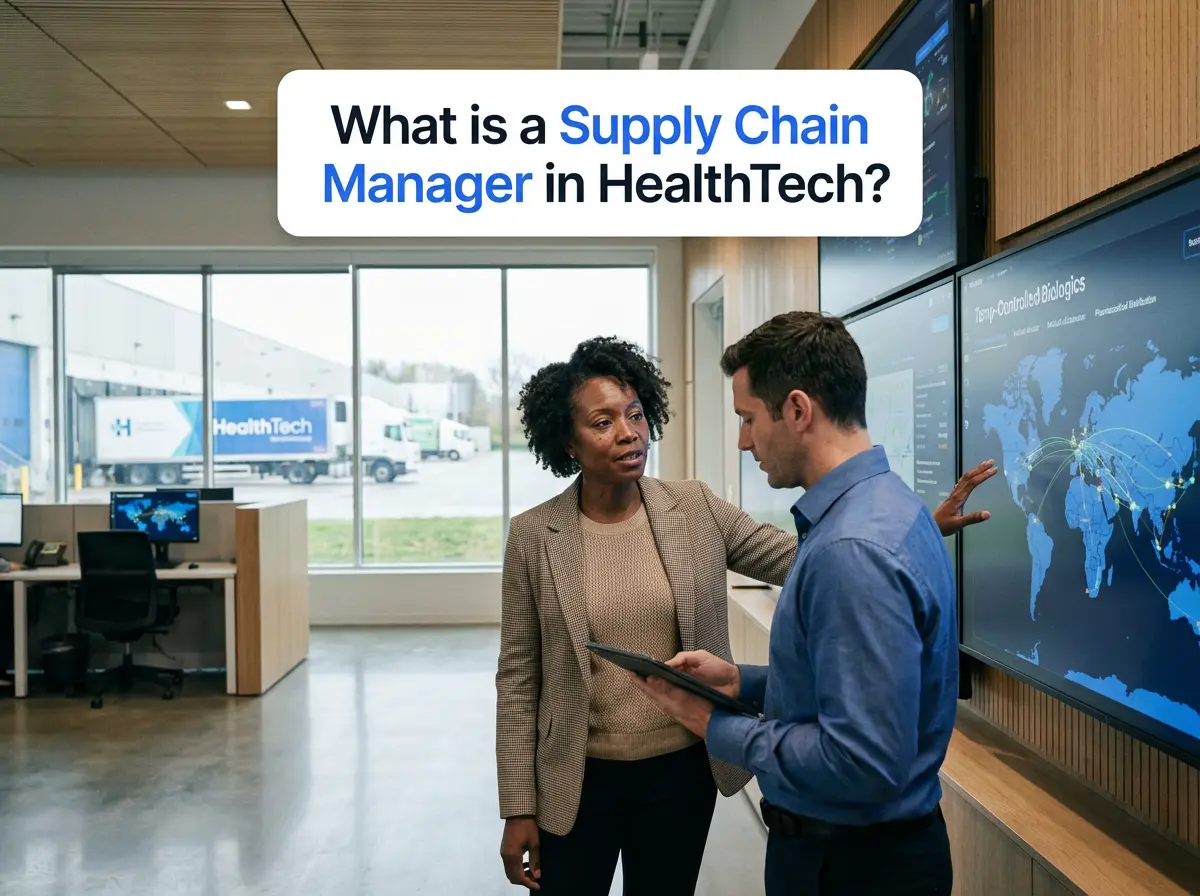
What is a Supply Chain Manager in HealthTech?
A Supply Chain Manager in HealthTech is accountable for getting the right physical products and critical services to the right place, at the right time, at the right quality so patient-facing teams can deliver care safely and reliably. In practice, that can mean anything from managing the flow of regulated medical devices and consumables, to coordinating outsourced manufacturing and logistics partners, to ensuring resilient inventory and traceability for products used in clinical settings.
This role exists because HealthTech can't treat supply as a background "operations" function. When supply fails, the impact isn't just delayed revenue or unhappy customers; it can interrupt diagnostics, treatment, or clinical workflows. A Supply Chain Manager is therefore measured on outcomes: continuity of supply, controlled risk, compliant movement of goods, and predictable availability under real constraints (lead times, shelf life, approvals, supplier capacity, and changing demand).
Ownership comes first. A strong Supply Chain Manager is the named person who can say, with evidence, what's in stock, what's at risk, what will ship when, and what trade-offs the business is making and why.
🔍 How this role differs in HealthTech
In many tech sectors (like SaaS, FinTech, or consumer apps), "shipping" is primarily software delivery and capacity management. In HealthTech, supply chain decisions often touch regulated goods, auditability, and real-world use at the point of care. That shifts the mindset from optimisation alone to controlled reliability: you're not just making a supply chain efficient; you're making it defensible, traceable, and resilient.
HealthTech also changes the cost of mistakes. In a consumer business, a late delivery can be refunded. In a clinical context, delays, substitutions, incomplete traceability, or poorly controlled suppliers can escalate into safety events, service disruption, or formal corrective actions. Even when the company is not a traditional manufacturer, HealthTech supply chains commonly rely on complex partner networks (contract manufacturers, sterilisation providers, 3PLs, calibration services, and clinical distributors) where your influence is indirect and must be exercised through clear agreements, performance governance, and escalation discipline.
Finally, HealthTech demand patterns can be more volatile and less "marketing-driven": tenders, clinical programme ramps, new site onboarding, incident-driven demand spikes, and product changes tied to compliance or patient safety can all force decisions that look irrational in other industries until you understand the risk profile.
🎯 Core responsibilities in HealthTech
Day to day, a Supply Chain Manager in HealthTech is accountable for whether the business can fulfil what it has promised without compromising quality, compliance, or patient impact. That starts with building an honest, evidence-based view of supply: what's available now, what's committed, what's constrained, and what could fail. They translate commercial plans and clinical realities into supply plans that can actually be executed, then hold internal teams and external partners to delivery.
The work is defined by trade-offs under constraints. You may be choosing between holding more inventory (and tying up cash or risking expiry) versus carrying less (and risking backorders or service disruption). You may be balancing supplier consolidation for cost against multi-sourcing for resilience. You may need to make allocation decisions when supply is short, deciding which sites or customers get priority based on safety, contractual obligations, and reputational risk.
In HealthTech, supply chain management also means being "recall-ready" and "audit-ready" as a matter of habit, not a one-off project. That includes maintaining product and batch-level traceability expectations, ensuring suppliers meet required standards, and making sure changes (materials, packaging, manufacturing locations, logistics routes) are controlled because seemingly small changes can create outsized downstream risk.
🧩 Skills and competencies for HealthTech
Core Skill | HealthTech specific requirement | Reason or Impact |
|---|---|---|
Risk-based judgement | Ability to prioritise actions by patient impact, service continuity, and compliance exposure (not just cost or speed) | Prevents "efficient but unsafe" decisions and supports defensible trade-offs when supply is constrained |
Supplier governance | Confidence setting expectations with regulated suppliers and critical service partners, including escalation paths and evidence requirements | HealthTech supply chains often fail at interfaces; strong governance reduces hidden risk and improves recoverability |
Traceability mindset | Comfort working with item/batch/lot concepts and being able to explain what shipped where, and why | Enables faster incident response, better recall readiness, and higher confidence in clinical availability |
Cross-functional leadership | Ability to align Quality, Regulatory, Commercial, Customer Ops, and Finance around a single supply narrative | Reduces internal conflict and prevents "optimising one function" at the expense of patient-facing reliability |
Decision-making under ambiguity | Ability to commit to a plan with imperfect data, then revise transparently as signals change | HealthTech demand and supply signals can be noisy; hesitation creates stockouts, whilst overreaction creates waste |
Contract and service thinking | Ability to manage supply outcomes through terms, SLAs, and operational cadence when execution is outsourced | Many HealthTech businesses depend on third parties; outcomes depend on how work is structured and governed |
💷 Salary ranges in UK HealthTech
Compensation for Supply Chain Managers in UK HealthTech is largely driven by what sits in your span of control. The biggest levers are: whether you own end-to-end supply (planning, procurement, logistics, inventory) versus a segment; whether the product is regulated and traceability-heavy; the financial and patient impact of stockouts; the complexity of suppliers (contract manufacturing, specialist logistics, cold chain); the scale (SKUs, sites, countries); and whether you carry escalation responsibility outside office hours. Location still matters, with London and the South East typically paying a premium for comparable responsibility.
Experience level | Estimated annual salary range | What drives compensation |
Junior | London & South East: £30,000–£40,000 | Usually supporting planning, purchasing, or supplier coordination with limited decision rights; higher pay if the remit includes regulated documentation or critical availability targets |
Mid-level | London & South East: £40,000–£55,000 | Ownership of a product line or a core process (planning, inventory, supplier performance) with measurable service levels; variation driven by complexity of suppliers and operational urgency |
Senior | London & South East: £55,000–£75,000 | Accountable for reliability across multiple products/sites, leading escalations, driving resilience, and influencing commercial commitments; premiums for regulated device traceability and high stockout risk |
Lead | London & South East: £75,000–£95,000 | End-to-end accountability (often including S&OP leadership, multi-sourcing strategy, and executive reporting); higher comp when failure modes affect clinical operations or contractual penalties are material |
Head / Director | London & South East: £95,000–£140,000 | Strategy and governance across supply chain, procurement, logistics, and partner ecosystems; strongest driver is scale and criticality, especially where resilience and compliance are board-level concerns |
Beyond base salary, many HealthTech employers add a performance bonus (often tied to service levels, cost-to-serve, working capital, or operational KPIs). Equity is more common in venture-backed HealthTech and typically increases at Lead and Head/Director levels. On-call allowances are not universal for supply chain roles, but may appear where the business operates time-critical fulfilment, supports clinical services that cannot pause, or manages urgent field actions; in those settings, the combination of allowance plus expectation of rapid escalation handling can meaningfully shift total compensation.
🚀 Career pathways
Common entry points include supply planning, demand planning, procurement, logistics coordination, customer operations, or manufacturing-facing roles in regulated environments. Early progression comes from proving you can run a reliable process end-to-end: owning a supplier relationship, stabilising a product's availability, or creating forecasting and replenishment discipline that others can trust.
As responsibility expands, the role shifts from "managing transactions" to "owning outcomes." You start shaping policy: how the company sets safety stock, qualifies suppliers, approves changes, and decides what to do when demand exceeds supply. The strongest candidates grow by taking on ambiguity and accountability: leading cross-functional planning cycles, owning risk registers, driving resilience programmes, and becoming the person the business relies on when something breaks.
At the top end, progression is less about volume of work and more about organisational leverage: setting the operating cadence, building teams and partner ecosystems, and making the supply chain a strategic advantage rather than a cost centre.
❓ FAQ
1) Will I be expected to understand Quality and regulatory constraints, or is that "someone else's job"?
You won't replace Quality or Regulatory, but you will be expected to operate within their constraints and spot supply risks that become compliance risks. Interviewers often test whether you can make decisions that respect traceability, change control, and supplier governance. The practical expectation is: you can explain what evidence you need from suppliers and why it matters.
2) How do hiring managers judge a Supply Chain Manager in HealthTech during interviews?
They tend to look for structured thinking under pressure: how you prioritise shortages, how you escalate, and how you prevent repeat incidents. Strong candidates can describe trade-offs with numbers (service level impact, lead time, inventory exposure) and show how they aligned stakeholders around a single plan. They also look for accountability language: what you owned, not just what you "supported."
3) Is on-call or out-of-hours escalation common for this role?
It depends on how time-critical the product and service model is. If the organisation supports clinical operations, urgent deployments, or has tight fulfilment windows, you may be part of an escalation rota for supply disruptions. Where it exists, employers value calm incident handling, clear decision logs, and fast coordination across suppliers and internal teams.
🔎 Find your next role
If you're ready to take ownership of availability, risk, and real-world delivery in HealthTech, search Supply Chain Manager roles on Meeveem.
You might also like