Published Date: December 31, 2025
Updated Date: December 31, 2025
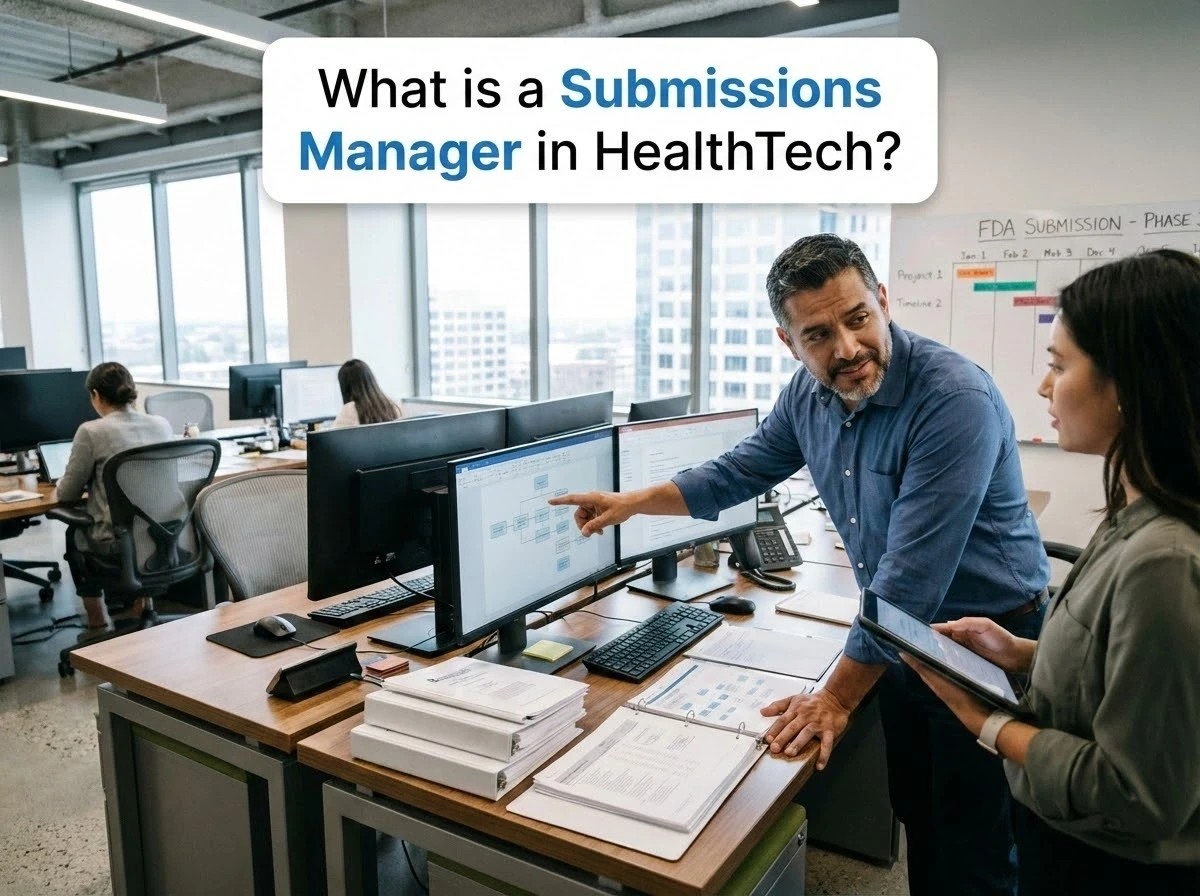
What is a Submissions Manager in HealthTech?
A Submissions Manager in HealthTech is the person accountable for getting high-stakes external submissions "out the door" correctly, on time, and in a form that stands up to scrutiny. In practice, this usually means owning the operational management of regulatory submissions (and closely related filing, publishing, and submission-readiness work) for software-enabled medical products, digital health services, or health data solutions. Often, a late, incomplete, or inconsistent submission can delay market access, disrupt a clinical programme, or trigger avoidable rework across multiple teams.
This role exists because HealthTech organisations must translate fast-moving internal work (product changes, clinical evidence, quality documentation, risk management, labelling, post-market updates) into controlled external packages that meet formal expectations. The Submissions Manager owns the end-to-end submission outcome: not just assembling documents, but ensuring the organisation can reliably execute submissions as a repeatable, auditable capability under deadlines, ambiguity, and competing stakeholder priorities.
Ownership is the centre of gravity: the Submissions Manager is the person who can be held responsible for whether a submission is complete, coherent, technically acceptable, and delivered to the right place in the right way, without betting the company's timeline on last-minute heroics.
🔍 How this role differs in HealthTech
In many SaaS or consumer tech environments, "submissions" often means internal governance (security questionnaires, procurement packs, app store updates) where errors are inconvenient but rarely existential. In HealthTech, submissions tend to sit much closer to permissioning: they can gate revenue, constrain claims, shape go-to-market sequencing, and influence whether a product can be used in real clinical workflows.
That changes the decision-making culture. The Submissions Manager works in a world where data sensitivity, traceability, and controlled change matter, and where teams must demonstrate that what they are claiming externally matches what they can evidence internally. Even when the submission is not directly to a regulator, the standard is often "regulator-grade": consistent document control, clear provenance of evidence, and a defensible narrative about safety, performance, and intended use.
The result is a role that blends operational precision with business judgement. You're constantly balancing speed with integrity: moving quickly enough to support the roadmap, whilst refusing shortcuts that create downstream risk, rejections, or credibility loss.
🎯 Core responsibilities in HealthTech
Day to day, a Submissions Manager is responsible for turning dispersed organisational outputs into a submission that is credible as a single artefact. That starts with clarifying what "done" means for the specific submission: what must be included, what must be consistent across documents, what must be signed off, and what constitutes an unacceptable risk. You'll set the plan, then actively manage execution: timelines, dependencies, version control, and the often messy handoffs between regulatory, clinical, quality, engineering, product, and external partners.
A key part of the job is constraint-led decision-making. When the clinical evidence is still evolving, when a product change lands late, or when quality documentation is not at the maturity expected, the Submissions Manager forces a decision: do we pause, narrow scope, restructure claims, or accept delay to protect integrity? You are also the person who ensures that technical submission requirements don't become an afterthought. Format, lifecycle management, completeness checks, and readiness for external review are treated as core quality, not admin.
Over time, strong Submissions Managers become the organisation's "truth-maintainers" for what has been submitted, what commitments were made, what correspondence exists, and what future changes will trigger resubmission or updates. That institutional memory, properly managed, reduces repeated mistakes and makes future submissions faster and safer.
🧩 Skills and competencies for HealthTech
Core Skill | HealthTech specific requirement | Reason or Impact |
|---|---|---|
Accountability for external outcomes | Comfort being the single point of responsibility for whether a submission is acceptable, not just "sent" | HealthTech timelines often hinge on external acceptance; shared responsibility easily becomes no responsibility |
Risk-based judgement | Ability to distinguish "formatting risk" from "patient / clinical / market access risk" and escalate appropriately | Teams need decisions that protect safety and credibility without stalling delivery unnecessarily |
Cross-functional authority without formal power | Influencing senior stakeholders to meet submission standards even when priorities conflict | Submissions fail more from late inputs and misalignment than from lack of effort |
Quality mindset in fast iteration | Maintaining traceability and document integrity whilst product and evidence change rapidly | A small inconsistency can force rework, delays, or constrain what can be claimed externally |
Timeline and dependency management | Building plans that reflect real lead times for reviews, approvals, and controlled documents | HealthTech work frequently has fixed external deadlines and slow approval gates |
Clear writing and narrative coherence | Ensuring the submission tells a consistent story across evidence, claims, risk controls, and intended use | Reviewers assess the whole picture; contradictions undermine trust even if each piece is "technically correct" |
Stakeholder communication under pressure | Crisp status reporting, early warning signals, and decision framing that reduces panic | Submission crunch periods are inevitable; calm visibility prevents last-minute chaos and errors |
Process improvement with auditability | Improving repeatability without breaking control: templates, SOP-aligned workflows, and "lessons learned" that stick | Better process reduces cost and risk, but HealthTech cannot trade away traceability for speed |
💷 Salary ranges in UK HealthTech
Pay for Submissions Managers in UK HealthTech is shaped less by job title and more by the consequences of getting it wrong. Compensation typically rises with: breadth of submissions ownership (single product vs portfolio), complexity of evidence and change control, whether you manage vendors or a team, proximity to external deadlines, and how tightly the work is coupled to regulated outcomes. Location still matters, with London and South East generally paying a premium, but the biggest swings usually come from scope and accountability rather than geography alone.
Experience level | Estimated annual salary range | What drives compensation |
Junior | London & South East: £32,000–£40,000 | Supporting components of submissions, learning controlled documentation, increasing reliability under supervision |
Mid-level | London & South East: £40,000–£55,000 | Owning discrete submissions or major workstreams, managing timelines and handoffs, reducing rework through better submission readiness |
Senior | London & South East: £55,000–£75,000 | Owning end-to-end submission delivery, handling ambiguity, coordinating multiple stakeholders, and protecting quality under time pressure |
Lead | London & South East: £75,000–£95,000 | Portfolio ownership, mentoring, vendor management, standard-setting across teams, and being the escalation point for submission risk decisions |
Head / Director | London & South East: £95,000–£130,000 | Organisational accountability for submissions capability, operating model design, resourcing strategy, and executive ownership of submission timelines and outcomes |
Beyond base salary, typical add-ons can include annual bonus (often tied to company and delivery goals), equity in venture-backed HealthTech, and enhanced pension/benefits. On-call allowances are not universal for this role, but can appear where submission windows, gateway timings, or high-impact releases create out-of-hours coverage expectations; when present, intensity and frequency of those windows often drive variation in total compensation. The biggest determinants of total package remain scope (single product vs portfolio), regulated criticality, and how much of the submission system you personally "own" (people, vendors, and process).
🚀 Career pathways
People typically enter Submissions Manager tracks from adjacent operational roles: regulatory operations, regulatory affairs support, quality systems, clinical operations coordination, technical documentation, or project management in regulated environments. Early progression is about earning trust: becoming the person who delivers clean, consistent outputs and catches issues before they become external problems.
As responsibility expands, you move from coordinating inputs to owning submission outcomes. That usually means running timelines, leading cross-functional readiness, and deciding what must change to protect acceptance (scope, sequencing, review strategy, or resourcing). The most senior pathway is less about doing more submissions personally and more about building the organisational capability: standard workflows, vendor strategy, quality gates, metrics, and escalation routes so that submissions are reliable at scale, especially as products and markets multiply.
❓ FAQ
Do I need prior regulator-facing experience to become a Submissions Manager in HealthTech?
It helps, but it's not always required if you've worked in controlled documentation, quality systems, or regulated project delivery. Hiring managers often look for proof you can manage deadlines, maintain document integrity, and hold teams to a submission standard. The strongest candidates can explain how they prevent "last-minute surprises."
What will I be judged on in the first 90 days?
Usually on whether you bring order and predictability: clear plans, dependable status reporting, tighter handoffs, and fewer avoidable errors. You'll also be assessed on judgement: what you escalate, how early you escalate it, and whether your decisions reduce downstream risk rather than simply pushing work around.
Is out-of-hours work common for Submissions Managers?
It can be periodic rather than constant, clustering around submission cut-offs, external portal windows, and late-breaking changes. In some teams, you'll be expected to provide short-burst coverage during critical filing periods; in others, the role is largely standard hours with planned peaks. Asking about submission cadence, vendor support, and approval lead times will usually tell you what the reality is.
🔎 Find your next role
If you're ready to own submission outcomes in HealthTech, search Submissions Manager roles on Meeveem and compare scope, team maturity, and accountability before you optimise for title.
You might also like