Published Date: January 5, 2026
Updated Date: January 5, 2026
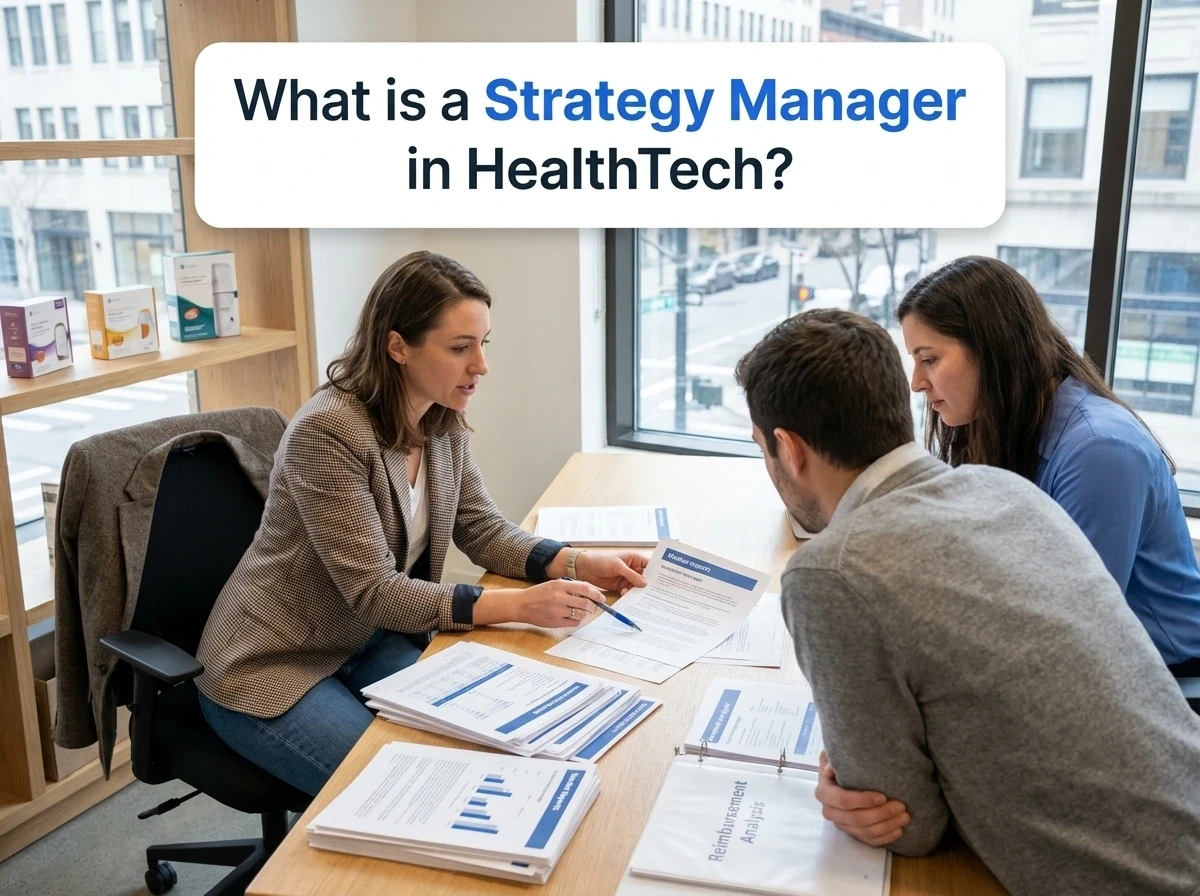
What is a Strategy Manager in HealthTech?
A Strategy Manager in HealthTech is the person responsible for turning an organisation's ambition (growth, clinical impact, efficiency, or expansion into new care pathways) into clear choices, sequenced priorities, and executable plans that hold up in a high-stakes environment. They sit close to leadership (often within Corporate Strategy, Strategy & Operations, or a Transformation function) and act as the connective tissue between commercial reality, product direction, operational capacity, and the healthcare context the business must operate within.
This role exists because HealthTech companies face a constant stream of competing "right answers": build vs partner, scale vs stabilise, growth vs safety, speed vs assurance, experimentation vs evidence. Someone needs to own how decisions get made, what gets prioritised, and how the organisation stays coherent when teams are moving fast under constraints. A Strategy Manager is not there to simply "produce a strategy". They are accountable for making sure strategic intent becomes decisions, trade-offs, and outcomes that leaders can stand behind.
In practice, a Strategy Manager is often the person who can be trusted with an ambiguous question ("Should we enter this segment?" "Why is this unit economics story not working?" "What must change for us to be trusted by enterprise buyers?") and return with a recommendation that is operationally viable, risk-aware, and measurable.
🔍 How this role differs in HealthTech
In many tech sectors, strategy work can lean heavily on market speed, distribution advantage, or product iteration cadence. In HealthTech, strategy is still about winning, but "winning" is constrained by trust, safety, data sensitivity, and the downstream impact of decisions on patient outcomes and clinical workflows. That changes what good looks like and how quickly an organisation can responsibly move.
HealthTech strategy is shaped by higher switching costs (clinical adoption, integrations, governance), greater scrutiny of claims (outcomes, safety, evidence), and more complex stakeholder landscapes (patients, clinicians, commissioners, payers, employers, regulators, and procurement functions). Even when regulation is not the centre of the role, the presence of regulated constraints and formal assurance expectations changes how strategy is evaluated. A path that looks optimal on a spreadsheet may be non-viable if it increases operational risk, weakens data controls, or creates clinical workflow burden that blocks adoption.
As a result, the Strategy Manager's job is less about abstract "best practice" and more about judgement: choosing a direction that the organisation can execute without compromising safety, trust, or long-term credibility.
🎯 Core responsibilities in HealthTech
A Strategy Manager's day-to-day accountability centres on helping leadership make hard choices and then making those choices real. They take messy questions (often triggered by growth pressure, margin erosion, new market opportunities, product ambiguity, or operational bottlenecks) and structure them into decisions the business can act on. That means clarifying what the organisation is optimising for (clinical impact, revenue quality, cost-to-serve, speed to scale, enterprise readiness), what constraints are non-negotiable (data handling, safety, contractual obligations), and what trade-offs leadership is truly willing to accept.
In HealthTech, they typically operate across commercial, product, data, operations, and clinical-facing teams, translating between different definitions of "risk" and "value". A recommendation is rarely complete unless it accounts for real delivery capacity, patient or clinician experience implications, and the evidence or assurance burden needed to sustain trust. The Strategy Manager often owns the narrative that aligns stakeholders (what is changing, why it matters, what will not change, and how success will be measured) then drives the follow-through via prioritisation, operating cadence, and decision forums.
When the organisation is under pressure, they become the person who keeps decisions explicit: where to invest, what to stop, what must be standardised, and what can remain flexible. The output is not a slide deck. It is clarity, accountability, and a plan that survives contact with operational and clinical reality.
🧩 Skills and competencies for HealthTech
Core Skill | HealthTech specific requirement | Reason or Impact |
|---|---|---|
Decision quality under uncertainty | Make recommendations when evidence is incomplete and the cost of being wrong can affect safety, trust, or care access | HealthTech often requires acting before perfect data exists, but with a higher bar for defensible decisions and risk mitigation |
Stakeholder alignment | Navigate clinicians, operations, product, data, and commercial leaders who optimise for different outcomes | Misalignment shows up as failed adoption, stalled procurement, or delivery plans that collapse under real-world workflow constraints |
Commercial judgement | Understand unit economics alongside healthcare buying dynamics, longer sales cycles, and cost-to-serve realities | Growth that ignores delivery burden or support intensity can destroy margins and credibility in healthcare settings |
Risk and assurance thinking | Build strategies that account for data sensitivity, governance expectations, and operational controls | A strategy that scales demand without strengthening controls increases the likelihood of incidents and reputational damage |
Systems thinking | Anticipate knock-on effects across patient journey, clinical workflow, support teams, and integrations | HealthTech value is often created (or lost) in the end-to-end system, not in a single feature or team |
Operational pragmatism | Turn strategy into sequencing, resourcing, ownership, and measurable outcomes | Healthcare contexts punish vague plans; progress requires clear execution paths that respect constraints and dependencies |
Communication with credibility | Explain trade-offs in plain language without oversimplifying safety, data, or clinical implications | Trust is a strategic asset in HealthTech; clarity helps leaders act and helps teams commit to difficult priorities |
💷 Salary ranges in UK HealthTech
HealthTech strategy pay is primarily driven by scope and consequence: the size of budget or P&L influenced, the criticality of the decisions (patient impact, enterprise commitments, safety or data risk), and how close the role sits to executive decision-making. Location still matters, but the biggest swings come from whether the Strategy Manager is shaping corporate direction versus driving a narrower function, and whether the role carries accountability for measurable outcomes (growth, margin, delivery performance) rather than analysis alone. On-call is not typical for strategy roles, but some roles that blend strategy with operations in always-on patient services may carry incident leadership expectations, which can shift compensation.
Experience level | Estimated annual salary range | What drives compensation |
Junior | London & South East: £45,000–£60,000 | Analyst-to-manager transition, narrower problem scope, structured project work, less ownership of executive decisions |
Mid-level | London & South East: £60,000–£80,000 | Ownership of discrete strategic initiatives, cross-functional leadership, increased accountability for outcomes and stakeholder alignment |
Senior | London & South East: £80,000–£105,000 | Portfolio-level impact, complex trade-offs across product/commercial/ops, higher exposure to enterprise buyers and assurance expectations |
Lead | London & South East: £105,000–£135,000 | Leading a strategy domain (e.g., growth, partnerships, operating model), managing managers or a small strategy team, stronger accountability for delivery and results |
Head / Director | London & South East: £130,000–£180,000+ | Organisation-wide strategy ownership, executive-level decision authority, P&L or major budget influence, responsibility for risk posture and enterprise credibility |
Beyond base salary, total compensation commonly includes an annual bonus (often tied to company and personal performance), and in scale-ups it may include equity (typically more meaningful at senior and above, but sometimes offered earlier). Strategy roles rarely attract an on-call allowance, but hybrid "strategy & operations" roles supporting always-on services may include additional pay or a higher base to reflect incident leadership expectations, service reliability accountability, or demanding stakeholder environments. Total compensation also varies with company stage (start-up vs scale-up vs enterprise), proximity to revenue/P&L, and how regulated or assurance-heavy the operating context is.
🚀 Career pathways
Common entry points include management consulting (especially healthcare, technology, or operations), strategy roles in larger healthcare or life sciences organisations, commercial analytics, product operations, or transformation programmes in health systems and suppliers. In HealthTech scale-ups, people also move into strategy from customer-facing functions (implementation, partnerships, or enterprise account roles) because they understand adoption friction and real-world constraints.
Progression is primarily a story of expanding ownership. Early on, you may own analysis and recommendation quality on a defined problem. At mid-level, you own the cross-functional plan and stakeholder alignment needed to make a decision stick. At senior level, you own a portfolio of priorities and the operating rhythm that turns strategic intent into delivery. Lead and Head/Director progression comes when you own not just "what should we do", but the conditions that make execution reliable: prioritisation, resource allocation, governance, and accountability for outcomes over time.
❓ FAQ
Do HealthTech Strategy Manager interviews test healthcare knowledge, or strategic thinking? Most processes test strategic thinking first (structured problem solving, commercial judgement, and decision-making under constraints) then probe how you handle healthcare context (data sensitivity, adoption friction, assurance expectations). You don't need to be a clinician, but you do need to demonstrate respect for real-world workflow and risk.
Will I be expected to own delivery, or just produce recommendations? Many HealthTech organisations expect strategy to be execution-linked: you may be accountable for driving cross-functional plans, setting metrics, and maintaining decision cadence, not just presenting options. Clarify early whether the role sits in Corporate Strategy (more directional) or Strategy & Operations/Transformation (more delivery ownership).
Is on-call ever part of this role in HealthTech? Pure strategy roles rarely have on-call requirements. However, if the role is closer to operations (especially in services with continuous patient access) there can be expectations to lead incident reviews, support escalation decisions, or participate in reliability governance, which can affect workload and pay.
🔎 Find your next role
Ready to take ownership of high-impact decisions in healthcare? Search Strategy Manager roles on Meeveem and find a HealthTech team where your judgement and execution drive real outcomes.
You might also like