Published Date: December 29, 2025
Updated Date: December 29, 2025
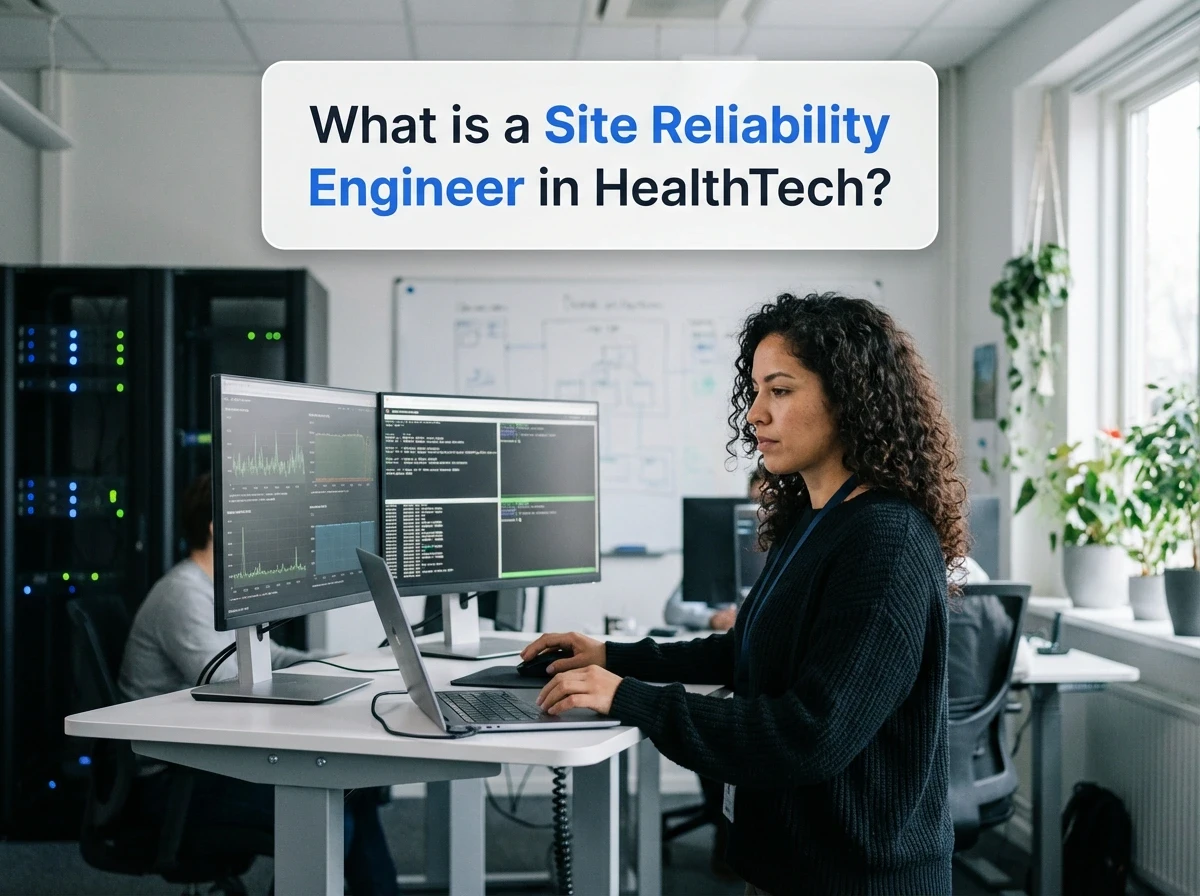
What is a Site Reliability Engineer in HealthTech?
A Site Reliability Engineer (SRE) in HealthTech is the engineer accountable for keeping patient and clinician-facing digital services reliably available, safe to operate, and recoverable when things go wrong. The role exists because modern HealthTech platforms are distributed, always-on systems where downtime, degraded performance, or data issues can quickly become clinical risk, operational disruption, or a regulatory headache, not just a bad user experience.
At its core, SRE is an ownership role. You're responsible for how production behaves: how quickly teams detect issues, how confidently they can change systems, how services fail (and recover), and whether reliability goals are met over time. The methods (observability, incident response, automation, SLOs, post-incident reviews) are important, but they sit behind a simple expectation: someone must be clearly accountable for production reliability and the decisions that protect it.
🔍 How this role differs in HealthTech
In many SaaS or consumer tech environments, reliability is often optimised primarily for growth, conversion, or engagement. In HealthTech, reliability decisions are shaped by a different set of constraints: sensitive data, high consequence workflows, and a tighter tolerance for "acceptable failure" when systems support real clinical or care operations.
That changes what "good" looks like. You may choose slower, more controlled deployment patterns if a change could affect medication workflows, appointment capacity, or access to records. You may spend more time proving system behaviour, auditability, and rollback safety than you would in a less regulated domain. And you'll often work with a broader set of stakeholders (security, governance, service management, clinical ops) who legitimately influence operational decisions.
HealthTech SRE is less about maximising speed at all costs, and more about earning speed through dependable controls: predictable operations, clear boundaries, and evidence that reliability won't be traded away unintentionally.
🎯 Core responsibilities in HealthTech
Day to day, an SRE in HealthTech lives in the tension between change and stability. You will be making calls on when to push forward (shipping fixes, scaling capacity, improving performance) and when to slow down (tightening controls, pausing risky releases, reducing operational load) because the system's users are depending on consistent outcomes, not just features.
In practice that means owning production health end-to-end: defining what "reliable enough" means with measurable targets, ensuring monitoring is meaningful (and not just noisy), and leading incident response in a way that restores service quickly without creating new risk. You'll work across engineering and platform teams to reduce repeated failure modes through better design, safer deployment paths, clearer runbooks, and eliminating manual steps that don't hold up at 3am.
The distinctive part is how trade-offs are handled. In HealthTech, you often can't optimise only for cost, only for velocity, or only for uptime. You are balancing patient impact, operational continuity, privacy expectations, and organisational tolerance for risk. Reliability becomes a product decision as much as a technical one, and SRE is frequently the person expected to articulate the options clearly, then own the consequences.
🧩 Skills and competencies for HealthTech
Core Skill | HealthTech specific requirement | Reason or Impact |
|---|---|---|
Operational ownership | Comfortable being the named owner for production outcomes across critical user journeys, not just "supporting" a team | HealthTech services often underpin time-sensitive work; ambiguity about ownership extends incidents and increases real-world impact |
Incident leadership under pressure | Ability to coordinate response across engineering, security, and operations with clear decision rights | Faster recovery depends on crisp triage and comms; missteps can worsen availability or introduce data-handling risk |
Risk-based decision making | Habit of choosing approaches that fit the criticality of the workflow and the organisation's risk posture | HealthTech frequently rewards "safe and reversible" over "fast and clever," especially when change affects core care operations |
Reliability target setting (SLO thinking) | Translating "patient/clinician impact" into service objectives that actually drive prioritisation | Without explicit targets, reliability work becomes reactive; with them, teams can trade feature work against measurable operational risk |
Systems thinking | Understanding how failures propagate across vendors, integrations, identity, networks, and data pipelines | HealthTech platforms are often integration-heavy; outages are commonly cross-system and require end-to-end reasoning |
Communication and stakeholder management | Explaining production risk and reliability trade-offs to non-engineering stakeholders without overpromising | HealthTech stakeholders often need clarity, evidence, and predictability; unclear messaging damages trust and slows decisions |
Continuous improvement discipline | Running blameless learning cycles that result in concrete reliability improvements, not just documentation | Regulated or high-stakes environments can drift into process theatre; measurable follow-through is what reduces repeat incidents |
💷 Salary ranges in UK HealthTech
SRE compensation in UK HealthTech is driven less by the title and more by the risk you carry: the criticality of the services, whether you’re the escalation point for major incidents, the maturity of the platform, and the intensity of on-call expectations. Location still matters: London & South East typically pays more but seniority in HealthTech also correlates strongly with governance responsibilities, the ability to influence change controls, and the breadth of systems you can safely operate.
Experience level | Estimated annual salary range | What drives compensation |
Junior | London & South East: £45,000–£60,000 | Exposure to production ownership, ability to troubleshoot under guidance, and competence with safe operational practices |
Mid-level | London & South East: £60,000–£80,000 | Independence in incident handling, improving reliability through engineering changes, and contributing to operational standards |
Senior | London & South East: £80,000–£105,000 | Ownership of critical services, leading incident response, setting reliability targets, and influencing platform-wide reliability decisions |
Lead | London & South East: £105,000–£135,000 | Scope across multiple teams/services, accountable reliability roadmap, on-call health and escalation design, and governance alignment |
Head / Director | London & South East: £130,000–£180,000 | Organisation-wide accountability, budget and vendor strategy, risk management, audit readiness, and reliability culture across engineering |
Beyond base salary, total compensation commonly includes an on-call allowance (sometimes structured as a rota-based supplement or flat stipend), performance-related bonus, and (more frequently in venture-backed HealthTech) equity. Variation is primarily driven by how demanding the on-call rotation is, whether the organisation operates truly 24/7, how regulated and audited the environment is, and whether you're accountable for a single product's reliability or a broader platform serving multiple clinical or operational services.
🚀 Career pathways
Many HealthTech SREs enter from software engineering, platform engineering, infrastructure, operations, or DevOps roles, often after being the person who "gets called when production is on fire" and decides to make that work systematic. A realistic entry point is a team that needs someone to own observability, incident response discipline, and release safety, rather than just build features.
Progression usually follows expanding circles of responsibility. Early on, you own a service and learn how it fails. At mid-level, you start shaping how it should be run: better monitoring, safer changes, and fewer repeated incidents. Senior SREs become the decision-makers who can balance reliability, delivery, and risk, and who can lead during major incidents without thrashing.
Lead and Head/Director pathways are defined by leverage: setting reliability strategy, building operating models for multiple teams, improving on-call sustainability, and making reliability an organisational capability rather than an individual hero skill.
❓ FAQ
1) If a HealthTech company says "SRE" but has no SLOs, is that a red flag? Not automatically, but it's a signal to probe maturity. Ask who owns production outcomes, how incident reviews lead to change, and what reliability decisions are prioritised when delivery pressure hits. A good team can be early on SLOs yet still have clear accountability and disciplined operations.
2) How is on-call usually handled for SRE roles in HealthTech? Expect some form of rota, with intensity varying widely based on whether the product supports 24/7 workflows. In interviews, ask about paging frequency, what triggers a page, whether there's dedicated incident leadership, and how the team prevents alert fatigue. Sustainable on-call is usually a sign that the organisation invests in reliability rather than relying on heroics.
3) What will I be evaluated on in a HealthTech SRE interview beyond technical depth? You'll often be assessed on judgement: how you trade off speed vs safety, how you communicate risk, and how you lead during uncertainty. Strong candidates can describe concrete incident experience, show how they reduced repeat failures, and explain how they earned reliability improvements through collaboration, not just tooling.
🔎 Find your next role
Ready to take ownership of reliability in HealthTech? Search Site Reliability Engineer roles on Meeveem and find teams building services that matter.
You might also like