Published Date: December 17, 2025
Updated Date: December 17, 2025
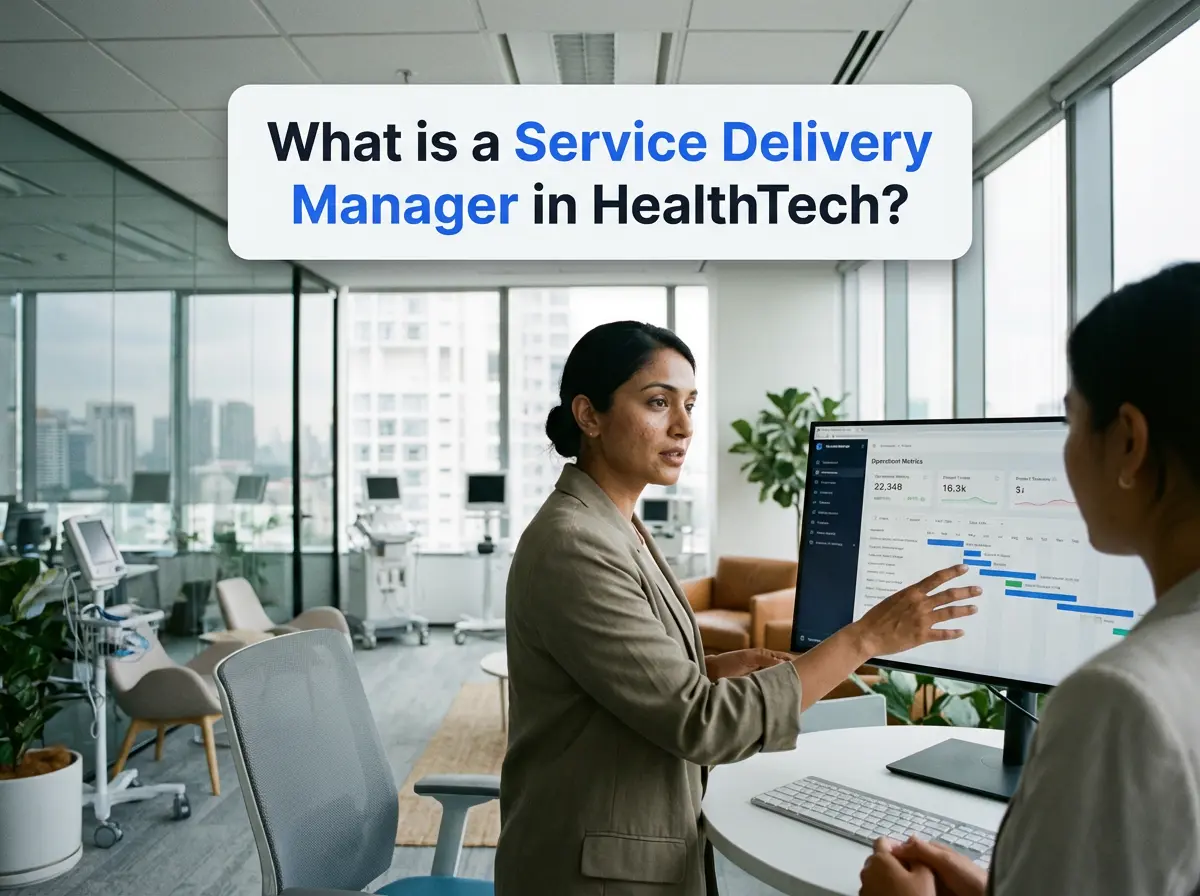
What is a Service Delivery Manager in HealthTech?
A Service Delivery Manager in HealthTech is the person accountable for the day-to-day reliability, performance, and customer outcomes of live technology services that support healthcare delivery. They sit at the intersection of operations, clinical/operational stakeholders, engineering teams, and third-party suppliers, owning the "service" as a running product, not just a project that ships and ends.
This role exists because HealthTech services can't simply be built and left to run. They must be monitored, governed, improved, and defended against operational risk: outages, degraded performance, security incidents, supplier failure, failed changes, and unclear accountability during major incidents. A Service Delivery Manager brings clear ownership to those risks, ensures expectations are explicit (what "good" looks like, how it's measured, what happens when it's not met), and makes sure the organisation can sustain safe, dependable operations at scale.
Above all, this is an accountability role. Methods (ITIL, SIAM, agile, SRE practices) are useful only insofar as they help the Service Delivery Manager meet their core obligation: keep critical services stable, compliant, and trusted, while improving them without increasing risk.
🔍 How this role differs in HealthTech
In many tech sectors, service delivery is primarily about customer satisfaction, uptime targets, and contractual reporting. In HealthTech, those still matter, but they are shaped by a different operating reality: higher data sensitivity, more complex stakeholder environments, and a narrower tolerance for disruption. A "minor" incident in a consumer app can be an inconvenience; a similar incident in HealthTech can interrupt patient flow, delay clinical decisions, or create operational bottlenecks that ripple across services.
HealthTech also tends to have more constraints on change. Release timing, access controls, audit readiness, incident communications, and even the language used to describe impact can be more tightly governed. Service Delivery Managers are often operating in environments with heavier supplier involvement (platform vendors, hosting partners, device and integration providers), and the job includes making that ecosystem behave like one coherent service, especially during incidents.
The practical difference is that HealthTech service delivery is less about optimising for speed alone, and more about balancing continuity, safety, assurance, and improvement without losing momentum.
🎯 Core responsibilities in HealthTech
Day to day, a Service Delivery Manager is accountable for whether the service is actually "working" in the way users and customers experience it, not just whether individual components are up. That means owning operational health: incident patterns, recurring user pain, alert quality, capacity and performance trends, change success rates, and supplier responsiveness. They make sure the right conversations happen at the right altitude: crisp updates during major incidents, honest post-incident follow-through, and evidence-based service reviews that convert data into decisions.
A distinctive part of the HealthTech context is decision-making under constraint. There are trade-offs that look straightforward on paper but become nuanced in reality: stabilising today versus deploying a fix that introduces new risk; meeting a contractual SLA versus prioritising the most clinically disruptive user journeys; pushing for faster delivery versus ensuring operational readiness, documentation, and support coverage. The Service Delivery Manager is the person expected to make those trade-offs explicit, secure alignment, and then carry the accountability for the outcome.
They also act as the operational "integrator" across teams. Engineering may own the code, security may own controls, customer teams may own relationships, and suppliers may own platforms, but service delivery ownership means ensuring handovers are real, responsibilities are unambiguous, and escalations don't stall in organisational gaps. In practice, this often includes shaping governance forums, tightening incident and change practices, and making sure service metrics tell the truth rather than merely looking tidy.
🧩 Skills and competencies for HealthTech
Core Skill | HealthTech specific requirement | Reason or Impact |
|---|---|---|
Accountability under ambiguity | Comfortable owning outcomes even when ownership is distributed across engineering, support, and third-party suppliers | Prevents "everyone and no one" dynamics during incidents and ensures issues are driven to resolution, not just discussed |
Stakeholder judgement | Able to translate operational risk into language that clinical, operational, and commercial stakeholders can act on | Keeps decisions grounded in real-world impact rather than purely technical priority debates |
Operational decision-making | Confident making go/no-go calls, prioritising restoration paths, and controlling scope during live incidents | Reduces time-to-recover and limits secondary harm caused by rushed or poorly sequenced fixes |
Supplier and contract management | Able to run performance conversations with vendors using evidence, not emotion, and enforce obligations without burning relationships | Improves service stability in multi-provider environments and protects the organisation when response quality drops |
Change risk management | Treats operational readiness as part of delivery, not an afterthought, including supportability and rollback thinking | Reduces failed changes and the hidden operational load that can accumulate in regulated or high-impact environments |
Data-led service ownership | Uses service metrics as a decision tool (not reporting theatre), with an eye on what users actually experience | Enables prioritisation that improves real reliability rather than optimising vanity measures |
Communication under pressure | Can issue clear, calm updates during major incidents, including uncertainty and next decision points | Maintains trust with customers and internal teams, and reduces confusion-driven escalation noise |
💷 Salary ranges in UK HealthTech
Compensation for Service Delivery Managers in UK HealthTech usually reflects the breadth of services owned (one product vs a portfolio), the criticality of the service (clinical/operational dependency and tolerance for downtime), the complexity of the supplier landscape, and the expectations around incident leadership and on-call participation. Location still matters, but so do less visible factors: the maturity of the organisation's service management, audit and assurance burden, and whether you're expected to actively reshape processes rather than simply run them.
Experience level | Estimated annual salary range | What drives compensation |
Junior | London & South East: £40,000–£50,000 | Typically smaller service scope, shared accountability, limited supplier ownership, and lighter incident leadership expectations |
Mid-level | London & South East: £50,000–£65,000 | Owning a defined service end-to-end, running service reviews, managing escalations, and coordinating change readiness across teams |
Senior | London & South East: £65,000–£82,000 | Multiple services or higher criticality, stronger supplier leverage, major incident leadership, and measurable improvement in reliability/operational outcomes |
Lead | London & South East: £80,000–£100,000 | Portfolio ownership, coaching other SDMs, governance design, cross-functional decision authority, and accountability for service performance at leadership level |
Head / Director | London & South East: £95,000–£130,000 | Organisation-wide service strategy, senior stakeholder accountability, budget/commercial ownership, multi-supplier operating models, and high scrutiny for resilience and assurance |
Beyond base pay, total compensation often includes a performance bonus (more common where commercial outcomes are explicit), on-call or rota payments where major incident leadership is expected outside core hours, and occasionally equity in venture-backed organisations. Variation usually comes down to service criticality, the intensity and frequency of major incidents, whether the role holds contractual/supplier accountability, and whether it's a "run the machine" job or a mandate to transform service operations.
🚀 Career pathways
Many Service Delivery Managers enter HealthTech from IT service management, customer operations, implementation, or technical support roles where they've already experienced the reality of live incidents and stakeholder pressure. Others transition from project delivery or product operations once they've developed an instinct for operational risk and ownership beyond delivery milestones.
Progression is typically driven by expanding the size and criticality of what you own. Early on, that may mean taking full accountability for one service and proving you can stabilise it, improve it, and communicate clearly when it fails. From there, growth often looks like owning a portfolio, managing suppliers across multiple domains, and shaping governance: moving from "I manage incidents" to "I prevent incidents by changing how delivery and operations work together."
The strongest career trajectories come from visible ownership: taking responsibility for outcomes, reducing operational noise over time, and building trust that you can handle high-stakes trade-offs without drama.
❓ FAQ
Do HealthTech employers expect Service Delivery Managers to be technical, or more governance-focused? Most expect you to be technically fluent rather than hands-on engineering. You should understand failure modes, integrations, environments, and operational constraints well enough to lead incidents and challenge assumptions, even if you're not writing code. The more critical the service, the more valuable this technical judgement becomes.
How is a Service Delivery Manager evaluated in HealthTech interviews? You're typically assessed on incident leadership, stakeholder communication, and whether you can turn recurring issues into sustained improvement. Expect scenario questions about major incidents, difficult suppliers, failed changes, and prioritisation when multiple groups are demanding different outcomes. Clear accountability and practical decision-making usually matter more than perfect process terminology.
Will I be on-call as a Service Delivery Manager in HealthTech? It depends on the operating model and service criticality. Some roles include a formal on-call rota (especially where the SDM acts as incident commander), while others rely on escalation cover or shared rotations with operations teams. If on-call exists, clarify frequency, compensation, and whether you're expected to actively coordinate resolution or simply support escalation.
🔎 Find your next role
Ready to take ownership of reliability in HealthTech? Search Service Delivery Manager roles on Meeveem and find a position that matches your scope, impact, and growth ambitions.
You might also like