Published Date: December 17, 2025
Updated Date: December 17, 2025
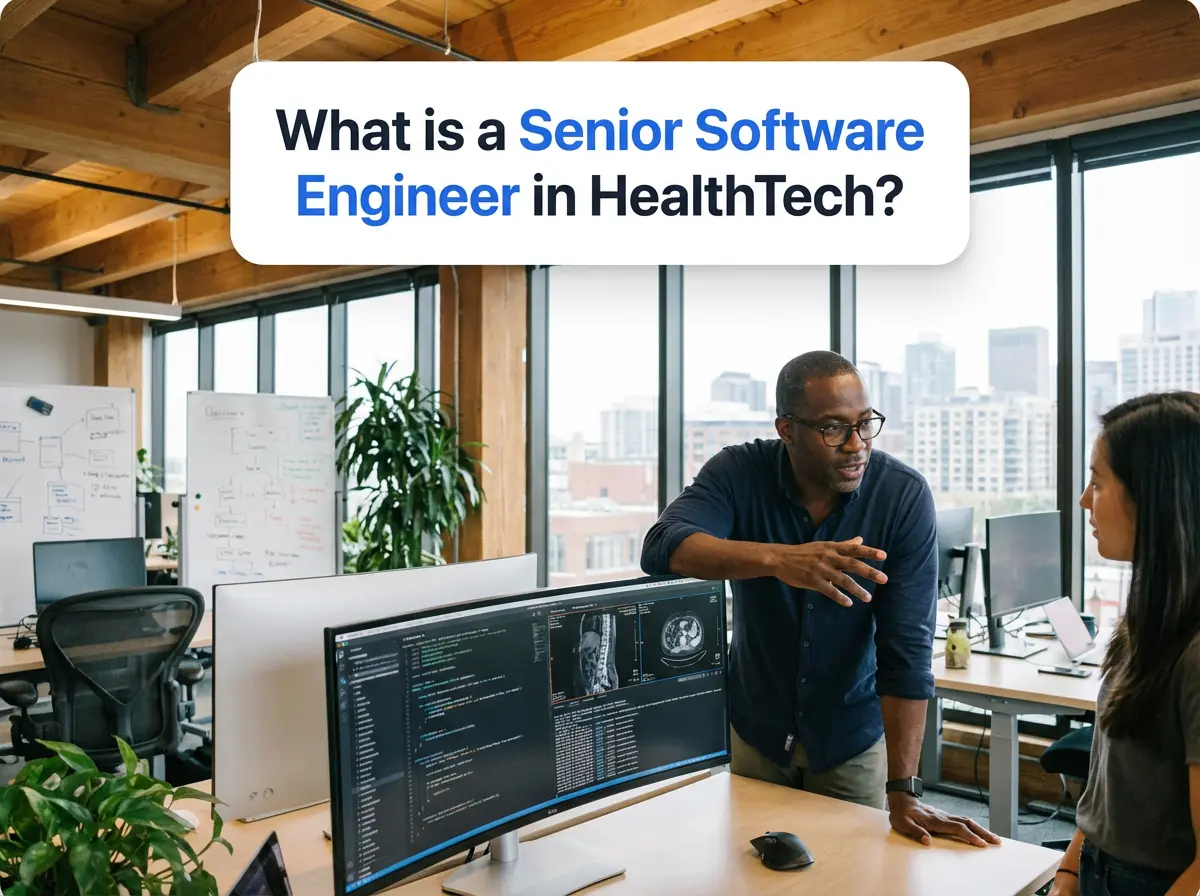
What is a Senior Software Engineer in HealthTech?
A Senior Software Engineer in HealthTech is an experienced engineer trusted to own parts of a healthcare product or platform end to end: building, evolving, and operating software that clinicians, patients, operations teams, or partners rely on. The defining feature isn't a specific programming language or framework; it's accountability for correctness, reliability, privacy, and for how engineering decisions translate into real-world outcomes.
This role exists because HealthTech systems sit close to people's health and highly sensitive data, often across multiple organisations and workflows. A senior engineer is needed to make hard technical calls, reduce operational risk, and ensure the product can be safely maintained as it scales without requiring constant oversight from leads or managers. In practice, they act as a "capable owner" of key services or domains, helping a team ship with confidence while keeping a clear line of sight to patient safety, clinical trust, and platform resilience.
🔍 How this role differs in HealthTech
In many tech sectors, "senior" can mean delivering features quickly with good engineering hygiene. In HealthTech, seniority is more tightly linked to judgement under constraints: the ability to keep delivery moving while protecting safety, privacy, and trust, even when requirements are uncertain, stakeholders are varied, and downstream impact is hard to reverse.
HealthTech changes decision-making because the failure modes are different. A bug can become a patient safety incident, a data leak can trigger regulatory exposure and reputational damage, and an availability issue can disrupt care delivery. As a result, senior engineers tend to spend more time shaping "how we ship" (release safeguards, monitoring, auditability, incident response) and less time optimising purely for speed. The best HealthTech teams still move fast, but they do it by designing systems and processes that make safe change routine rather than exceptional.
🎯 Core responsibilities in HealthTech
Day to day, a Senior Software Engineer in HealthTech is accountable for delivering reliable, secure, maintainable software in an environment where "good enough" often has to be proven, not assumed. They translate messy real-world needs into implementable designs, anticipate edge cases that matter in clinical or operational settings, and make trade-offs explicitly, balancing time-to-value against risk, quality, and long-term cost.
They are also expected to raise the bar for how the team operates: improving observability, tightening data handling practices, strengthening test strategy, and reducing operational toil. When incidents occur, they help lead calm triage and durable fixes, not just quick patches. They collaborate closely with product, clinical, data, security, and support functions, ensuring engineering choices align with patient impact, service reliability, and the organisation's obligations around data and safety.
🧩 Skills and competencies for HealthTech
Core Skill | HealthTech specific requirement | Reason or Impact |
|---|---|---|
Systems ownership | Take responsibility for services across build, release, and operations, including safe change and rollback | HealthTech products often run continuously and support time-sensitive workflows; ownership reduces incident risk and improves recovery quality |
Risk-based judgement | Make defensible trade-offs when requirements, evidence, and timelines conflict | The cost of failure is higher; senior engineers must choose approaches that reduce harm, not just reduce effort |
Data stewardship | Treat patient and operational data as a liability as well as an asset, with careful access, retention, and auditability | Strong data handling reduces breach risk and supports trust with users, partners, and regulators |
Reliability thinking | Design for graceful degradation, observability, and operational readiness, not just happy-path functionality | Outages and degraded performance can disrupt care delivery; resilience is part of the product |
Stakeholder fluency | Communicate clearly with non-engineers (including clinical or operations stakeholders) and turn constraints into actionable engineering choices | Misalignment can create unsafe or unusable workflows; clarity prevents rework and reduces real-world risk |
Change management discipline | Ship incrementally with controls appropriate to criticality, including careful migrations and backwards compatibility | HealthTech often integrates with multiple systems and workflows; disciplined change reduces disruptions and preserves continuity |
💷 Salary ranges in UK HealthTech
Pay in HealthTech is primarily driven by scope of ownership (single service vs a domain), criticality (patient-facing or clinically adjacent vs internal tooling), operational expectations (including on-call), and the complexity of regulated or safety-sensitive constraints. Location still matters in the UK market, but the biggest step-changes usually come from responsibility: owning high-impact systems, leading delivery across teams, or being accountable for availability and incident response.
Beyond base salary, total compensation in HealthTech commonly includes performance bonus (more typical in larger or later-stage organisations), equity or options (more common in venture-backed companies), and benefits such as enhanced pension or private healthcare. If the role participates in on-call, compensation may include an on-call allowance and/or paid incident call-outs; the more clinically critical the platform and the higher the alert volume, the more this can materially affect total pay. Variation is also driven by company stage, funding model, revenue maturity, and how directly engineering supports regulated, safety-sensitive, or 24/7 services.
🚀 Career pathways
Many senior HealthTech engineers enter from general software roles in SaaS, data platforms, or infrastructure, then deepen domain understanding through exposure to healthcare workflows, integrations, and operational constraints. Others come via public-sector or clinically adjacent environments where reliability and data governance are already central to daily work.
Experience level | Estimated annual salary range | What drives compensation |
Junior | London & South East: £35,000–£50,000 | Baseline engineering fundamentals, supervised delivery, and lower-risk ownership; salaries vary with team maturity and training investment |
Mid-level | London & South East: £50,000–£75,000 | Independent delivery and partial ownership of services; higher pay when engineers operate in production-heavy environments with strong reliability expectations |
Senior | London & South East: £75,000–£110,000 | End-to-end ownership of key systems, design leadership, incident accountability, and ability to deliver safely under constraints; on-call and platform criticality can push towards the top of range |
Lead | London & South East: £105,000–£140,000 | Technical leadership across a team or multiple services, setting standards, unblocking delivery, and owning cross-cutting risks (performance, security, reliability) |
Head / Director | London & South East: £130,000–£200,000 | Org-level accountability for delivery, reliability, security posture, and hiring; compensation rises with business impact, scale, and operational responsibility |
Progression is typically marked by expanding ownership rather than accumulating titles. Early on, engineers grow by taking responsibility for a service and its production outcomes; later, by owning a domain that spans multiple services, setting technical direction, and reducing risk for the wider organisation. Moving from Senior to Lead usually means becoming accountable not only for what you build, but for how a team builds: raising standards, improving delivery predictability, and making safe change repeatable. Head/Director progression adds organisational accountability: hiring, budgeting, portfolio trade-offs, and ensuring engineering practices meet the expectations of partners, auditors, and customers.
❓ FAQ
How do HealthTech interviews assess seniority beyond coding ability?
Expect evaluation on system ownership: how you design, ship, and operate in production, including incident handling and safe rollout strategies. You may be asked to reason about data access, auditability, and failure modes in workflows that matter to users. Strong candidates make trade-offs explicit and can explain how they would reduce risk while still delivering.
Will I be expected to do on-call as a Senior Software Engineer in HealthTech?
Often, yes, especially for product platforms with real-time workflows, integrations, or clinician/patient-facing components. What matters is how on-call is run: alert quality, escalation paths, compensation, and whether the team invests in reducing noise. It's reasonable to ask about incident frequency, after-hours expectations, and how reliability work is prioritised.
How can I move into HealthTech from another industry without prior healthcare experience?
You don't need to arrive as a domain expert, but you do need to show respect for constraints: privacy, safety, and operational continuity. Demonstrate examples of responsible ownership: careful releases, strong observability, secure data handling, and collaborative decision-making with non-engineers. Teams tend to value engineers who learn workflows quickly and build systems that are safe to change.
🔎 Find your next role
If you're ready to take on real ownership in a mission-driven environment, search Senior Software Engineer roles on Meeveem.
You might also like