Published Date: January 1, 2026
Updated Date: January 1, 2026
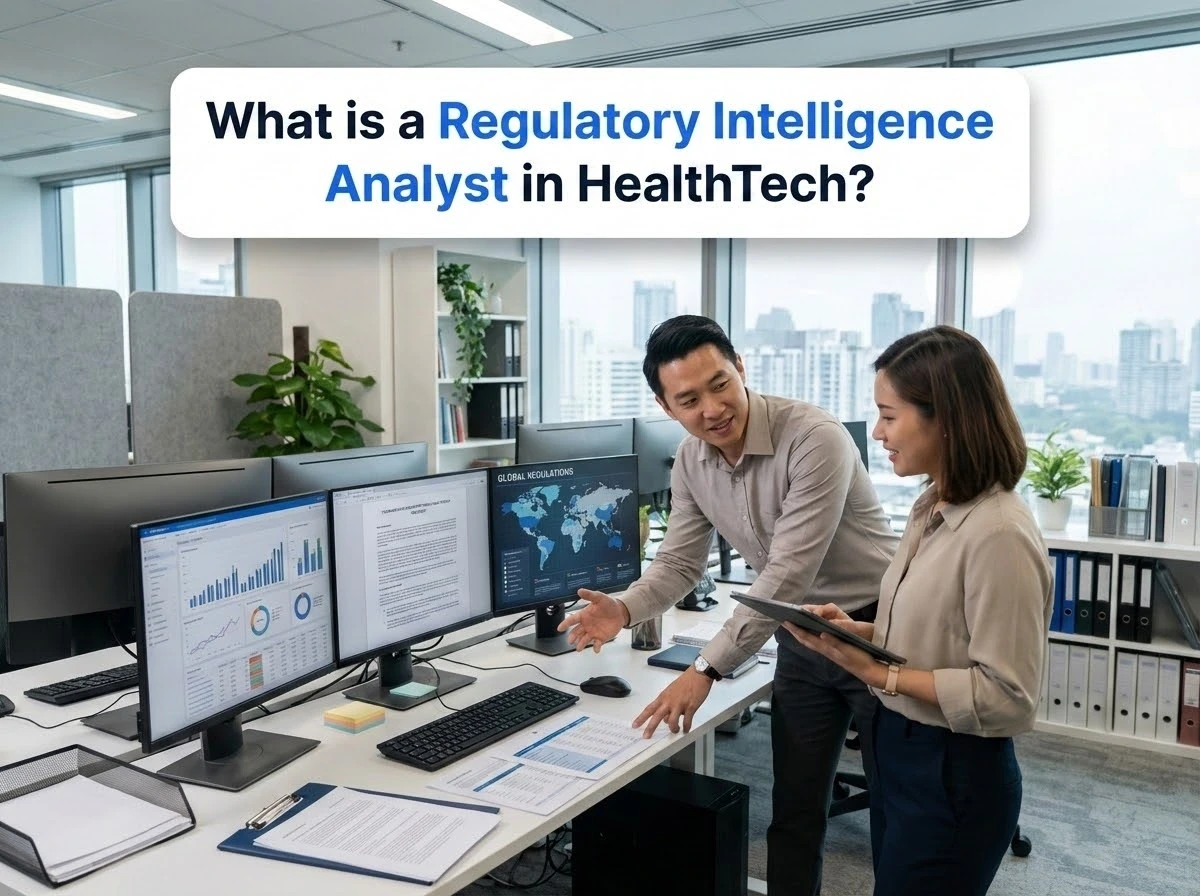
What is a Regulatory Intelligence Analyst in HealthTech?
A Regulatory Intelligence Analyst in HealthTech is responsible for transforming a fast-moving, multi-jurisdiction regulatory landscape into clear, actionable guidance for the business. They monitor what is changing (or likely to change), interpret what it means for a specific product and operating model, and ensure leaders don't make roadmaps, clinical, go-to-market, or assurance decisions based on outdated assumptions.
This role exists because HealthTech sits at the intersection of healthcare delivery, software, and regulated product development. Requirements can shift through new guidance, evolving standards, enforcement focus, and policy updates, often with implications for patient safety, data handling, clinical evidence, quality management, and claims. A Regulatory Intelligence Analyst reduces the risk of late surprises by making regulatory change visible early enough to act, and by creating internal alignment on what the organisation will do about it.
In practice, the role is less about collecting updates and more about ownership: owning the "so what" for the company, owning the escalation when something materially changes risk, and owning the internal narrative that links external requirements to practical choices (what to build, what to stop, what to evidence, and what to document).
🔍 How this role differs in HealthTech
In many tech sectors, regulatory change is important but often limited to a narrower set of concerns (consumer protection, financial conduct, platform rules). In HealthTech, regulatory expectations can reach into the core of how product decisions are made: how safety is assured, how clinical performance is supported, how updates are controlled, and how sensitive data is governed. That means regulatory intelligence isn't a peripheral "watchlist". It becomes a steering input to product strategy and delivery.
HealthTech also amplifies the consequences of misinterpretation. A missed requirement can trigger delays to market access, forced rework of evidence plans, constrained deployments in clinical settings, or loss of trust with healthcare stakeholders. The Regulatory Intelligence Analyst therefore operates in a higher-friction environment where ambiguity is normal, timelines are interdependent (clinical, quality, technical), and the safest answer isn't always "slow down". It's "choose a defensible path and document why."
Organisationally, the role often sits within Regulatory Affairs, Quality/Compliance, or an integrated RA/QA function, but the impact is cross-functional: it influences Product, Engineering, Clinical, Security, and commercial teams. In smaller HealthTech companies, it may also act as a force-multiplier for leadership by preventing regulatory strategy from becoming reactive.
🎯 Core responsibilities in HealthTech
Day to day, the Regulatory Intelligence Analyst is responsible for maintaining a reliable "single source of truth" on what matters externally and for converting that into decisions internally. They continuously evaluate incoming signals (updates, consultations, new interpretations, enforcement themes, standards changes), then perform impact analysis against the company's product scope, clinical claims, markets, and delivery model. The output is rarely a simple summary; it is a judgement call on materiality, urgency, and who must act.
A strong analyst doesn't just notify teams that something changed. They drive the trade-off conversation. For example: if an upcoming requirement will tighten expectations on clinical evidence or post-market monitoring, they help define whether the response is a roadmap adjustment, a change in intended use/claims, a shift in evidence generation, or a strengthening of quality processes. They manage constraints explicitly: time, budget, technical feasibility, patient risk, and the company's tolerance for regulatory uncertainty.
They also own escalation and governance. When an issue crosses a threshold (risk to patient safety, market access, or compliance posture), they ensure it reaches the right decision-makers with a clear recommendation, alternatives, and the downstream implications. In mature environments, they partner with RA/QA leaders to embed intelligence into planning cycles so regulatory strategy is proactive rather than crisis-led.
🧩 Skills and competencies for HealthTech
Core Skill | HealthTech specific requirement | Reason or Impact |
|---|---|---|
Regulatory interpretation and judgement | Translate ambiguous or evolving requirements into a position the company can implement without over-building or under-complying | HealthTech decisions often need a defensible interpretation before "perfect clarity" exists; poor judgement creates safety risk or costly rework |
Impact analysis under real constraints | Map regulatory change to product scope, clinical claims, evidence plans, release processes, and operational controls | In HealthTech, regulatory change can affect architecture, UX, monitoring, documentation, and clinical workflows, not just policies |
Risk-based prioritisation | Calibrate urgency by patient impact, market exposure, and assurance gaps rather than by volume of updates | Teams drown in information unless someone owns what is material and what can wait |
Stakeholder influence without formal authority | Drive alignment across Product, Engineering, Clinical, Security, and Quality when priorities conflict | Compliance outcomes depend on cross-functional choices; the analyst must create shared understanding and commitment |
Clear written recommendations | Produce concise briefs that separate facts, assumptions, and recommended actions, including what to document | HealthTech organisations need traceability; clarity reduces audit/inspection anxiety and speeds leadership decisions |
Systems thinking and process ownership | Build lightweight, repeatable ways to capture updates, assess impact, and track actions to closure | A one-off interpretation is not enough; HealthTech needs an inspection-ready trail that survives team changes and scales with growth |
Commercial awareness with regulatory discipline | Understand how claims, market entry sequencing, and partnerships change regulatory exposure | Go-to-market choices in HealthTech can unintentionally create "regulated product" expectations that the company isn't prepared to meet |
💷 Salary ranges in UK HealthTech
Compensation for Regulatory Intelligence Analysts in UK HealthTech is driven less by "years in role" and more by risk exposure and decision-criticality. The biggest variables are: whether the product is regulated (and how tightly), how many markets are covered, whether the analyst is expected to own impact assessments and executive recommendations, and how close the work sits to audits/inspections, clinical evidence strategy, and release governance. Location matters, but scope matters more, especially when the role acts as a hub between Regulatory, Quality, Product, and Clinical teams. On-call is not typical for pure regulatory intelligence, but some companies expect responsiveness during major incidents, safety escalations, or urgent regulatory actions.
Experience level | Estimated annual salary range | What drives compensation |
Junior | London & South East: £32,000–£42,000 | Level of independence in interpreting updates, strength of written outputs, and whether the role is primarily monitoring vs supporting impact analysis |
Mid-level | London & South East: £42,000–£60,000 | Owning impact assessments end-to-end, handling multiple jurisdictions, and influencing product decisions without heavy supervision |
Senior | London & South East: £60,000–£80,000 | Being the point person for regulatory change, setting internal positions, coaching others, and operating close to audits, evidence planning, and release governance |
Lead | London & South East: £80,000–£105,000 | Owning the regulatory intelligence programme, defining escalation thresholds, and being responsible for cross-functional alignment and executive-ready recommendations |
Head / Director | London & South East: £105,000–£140,000 | Strategic ownership across markets and product lines, responsibility for regulatory strategy readiness, and leadership across RA/QA interfaces and governance |
Beyond base salary, total compensation commonly includes a performance bonus, and in venture-backed HealthTech an equity component is more likely at Senior and above (and sometimes Mid-level). Allowances tend to be situational: on-call payments are uncommon for the role itself, but some organisations add compensation for high-intensity responsiveness during major regulatory deadlines, incident-driven escalations, or frequent travel. Variation is mainly driven by how regulated the product is, whether the role covers global markets, how much executive accountability it carries, and whether the company is building (or remediating) an inspection-ready system.
🚀 Career pathways
Entry points are often through Regulatory Affairs support roles, Quality/Compliance coordination, clinical operations exposure, or policy/research backgrounds where interpreting complex requirements is core. Some candidates also transition from healthcare consulting or evidence-focused roles when they develop a strong understanding of how product, clinical, and quality decisions connect.
Progression tends to follow ownership. Early on, the analyst may support monitoring and help shape internal summaries; with experience, they become responsible for impact assessments and recommendations that directly affect product scope, claims, and delivery timelines. At senior levels, the pathway expands into leading a regulatory intelligence programme, defining governance, coaching stakeholders on risk-based decision-making, and shaping broader regulatory strategy, often moving toward Regulatory Strategy, RA leadership, Quality leadership, or an integrated compliance leadership role in scaling HealthTech organisations.
❓ FAQ
Do I need a Regulatory Affairs background to become a Regulatory Intelligence Analyst in HealthTech?
It helps, but it's not the only route. Hiring teams often look for people who can interpret requirements, communicate clearly, and make defensible recommendations under uncertainty. Candidates who can demonstrate structured impact analysis and strong stakeholder management can transition successfully with the right domain learning.
What will I actually be judged on in interviews for this role?
Expect to be assessed on judgement, not recall: how you decide what is "material," how you translate ambiguous updates into actions, and how you handle disagreements with Product or Engineering. Strong candidates explain trade-offs, propose escalation thresholds, and show how they would document decisions for future scrutiny.
Is there on-call work for Regulatory Intelligence Analysts in HealthTech?
Usually not in the classic operational sense. However, some organisations expect fast turnaround during major regulatory deadlines, urgent safety-related escalations, or when a release decision becomes compliance-sensitive. It's worth clarifying expectations around responsiveness, peak periods, and how that is recognised in compensation.
🔎 Find your next role
Ready to step into a role where regulatory change directly shapes product decisions? Search for a Regulatory Intelligence Analyst role on Meeveem.
You might also like