Published Date: January 5, 2026
Updated Date: January 5, 2026
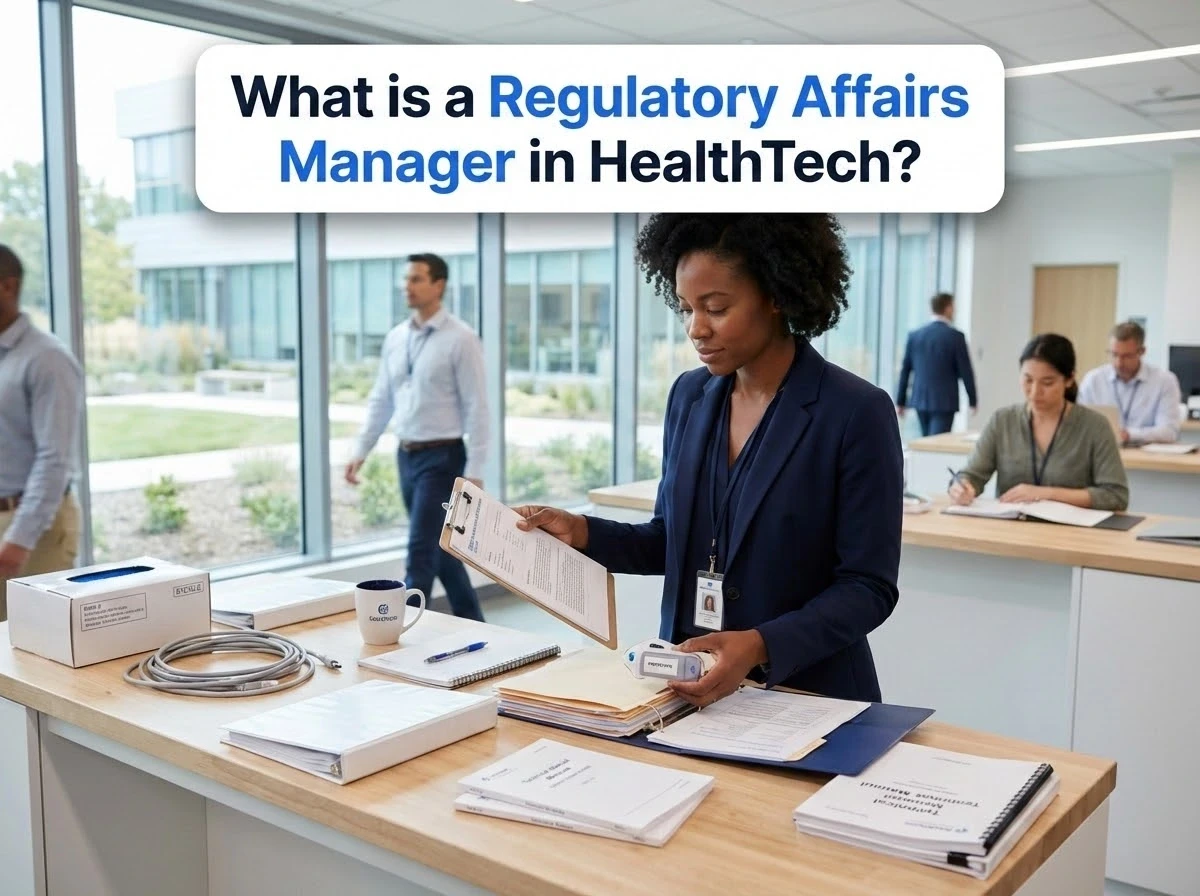
What is a Regulatory Affairs Manager in HealthTech?
A Regulatory Affairs Manager in HealthTech is responsible for ensuring health products get to market legally and safely, and stay there. This means making sure the organisation follows all applicable rules for what it builds, claims, and sells. In practical terms, the role involves owning the regulatory strategy and decisions that bridge ambitious product delivery with the realities of regulated healthcare.
This role exists because HealthTech products can directly affect clinical decisions, patient outcomes, and sensitive data flows. Compliance isn't a final tick-box exercise. Regulatory requirements influence product design, evidence generation, labelling, marketing claims, post-market monitoring, and how changes are released. A Regulatory Affairs Manager ensures the business can move quickly without creating patient risk, triggering enforcement action, or jeopardising approvals and revenue.
Above all, it's an ownership role. When the organisation wants to ship something new, expand into a new market, change an algorithm, update a device, or adjust a claim, this person is accountable for the regulatory position and for making sure leadership understands what's possible, what's risky, and what needs to change to stay compliant.
🔍 How this role differs in HealthTech
In many tech sectors, the cost of being wrong is usually commercial: customer churn, reputational damage, maybe contractual disputes. In HealthTech, the cost of being wrong can include patient harm, clinical workflow disruption, product withdrawal, and legal exposure, often with regulators, auditors, and healthcare buyers scrutinising decisions.
That changes how a Regulatory Affairs Manager operates. They don't just interpret requirements; they help define what the product is allowed to be. Decisions around product scope, intended use, clinical claims, evidence thresholds, data handling, and release governance tend to be more constrained, more documented, and less reversible than in a typical SaaS environment.
HealthTech also tends to have compound compliance. Regulation is rarely a single framework. A product can be constrained by medical device rules, quality management expectations, clinical evidence norms, post-market surveillance obligations, and healthcare procurement requirements, all while engineering teams are iterating. The Regulatory Affairs Manager is often the connective tissue ensuring the organisation doesn't make locally sensible decisions that create global regulatory problems later.
🎯 Core responsibilities in HealthTech
Day to day, the Regulatory Affairs Manager is the decision owner for how the company navigates regulatory pathways whilst still hitting product and commercial timelines. They shape regulatory strategy for new products and significant changes, define what evidence is needed to support intended use and claims, and ensure submissions and lifecycle documentation remain coherent as the product evolves.
A large part of the job is trade-off management under constraints. When product wants speed, the Regulatory Affairs Manager must decide what can be accelerated safely (and defensibly), what must wait for evidence, and what needs design changes to avoid a higher-risk classification or a heavier regulatory burden. When engineering wants to ship frequent updates, they must ensure change control is robust enough to avoid silent compliance drift that becomes an audit failure or post-market issue.
They also carry accountability for regulatory-facing communication and outcomes: responding to questions, maintaining registrations where relevant, driving alignment between regulatory strategy and quality system expectations, and ensuring post-market obligations (complaints, vigilance, surveillance, trending, corrective actions) are not treated as operational afterthoughts. In smaller HealthTech companies, this role often blends into quality responsibilities and may be the primary person building processes that will later scale into a dedicated QA/RA function.
🧩 Skills and competencies for HealthTech
Core Skill | HealthTech specific requirement | Reason or Impact |
|---|---|---|
Regulatory judgement | Ability to take ambiguous product reality (software behaviour, clinical workflow, data outputs) and translate it into a defensible regulatory position | Prevents over-claiming and under-controls, both of which can block access to healthcare customers or trigger regulatory action |
Risk-based decision-making | Comfort balancing patient safety, clinical impact, cybersecurity/privacy risk, and operational feasibility, not just letter of the rule compliance | Keeps the product safe and shippable whilst ensuring decisions stand up in audits and incident reviews |
Cross-functional leadership | Capability to influence product, engineering, clinical, security, and commercial teams without relying on authority | Regulatory constraints only work when embedded into real delivery plans, not parked in a document |
Evidence thinking | Ability to set evidence expectations (what good enough means) for claims, performance, and safety in context | Avoids expensive late-stage rework and supports credible adoption by healthcare buyers |
Lifecycle ownership | Discipline to treat approved once as the start: changes, incidents, and surveillance must be managed continuously | Protects the organisation from regulatory drift as the product evolves and new risks emerge |
Stakeholder communication | Skill in explaining constraints and options to executives and delivery teams in practical terms | Enables faster decisions, fewer surprises, and a clearer risk appetite across leadership |
Documentation and traceability mindset | Ability to insist on traceability between requirements, risks, testing, claims, and post-market inputs without turning delivery into bureaucracy | Creates audit-ready coherence that supports scale, partnerships, and procurement confidence |
💷 Salary ranges in UK HealthTech
Compensation for Regulatory Affairs Managers in UK HealthTech is driven less by the title and more by the risk profile and accountability you carry: device classification or clinical impact, whether you own strategy versus execution, the complexity of submissions and lifecycle change, how mature the quality system is, and whether you're the only regulatory leader in the company. Location still matters, but scope and regulatory criticality often matter more, especially in smaller HealthTech firms where one person can carry outsized responsibility.
Experience level | Estimated annual salary range | What drives compensation |
Junior | London & South East: £35,000–£45,000 | Support-heavy roles versus partial ownership of defined workstreams; exposure to regulated product development; documentation intensity |
Mid-level | London & South East: £45,000–£60,000 | Owning submissions/components, managing change control inputs, acting as a key point of contact internally, and handling higher-impact products |
Senior | London & South East: £60,000–£80,000 | End-to-end ownership for a product line, stronger strategic input, higher independence with regulators/auditors, and greater accountability for post-market outcomes |
Lead | London & South East: £75,000–£100,000 | Setting regulatory strategy across products/markets, leading cross-functional decisions, mentoring a team, and carrying single point of failure accountability in scale-ups |
Head / Director | London & South East: £100,000–£150,000 | Owning the regulatory function (often with QA/RA scope), representing the company externally, board-level risk ownership, and leading audits, strategy, and resourcing |
Beyond base salary, many UK HealthTech employers add a performance bonus (often modest at junior levels and more meaningful at senior/leadership), plus benefits such as pension and private medical. Equity is more common in start-ups and scale-ups, typically as options rather than public-company stock, and its value varies with stage and risk. On-call allowances are not a standard feature for regulatory roles, but some organisations may offer additional compensation when regulatory leaders are expected to be available for urgent incident/vigilance escalation, field safety actions, or time-critical audit/regulator interactions. Where that expectation exists, it tends to raise total compensation.
🚀 Career pathways
Most people enter HealthTech regulatory careers from life sciences, medical devices, clinical research, quality, or technical documentation, often starting in specialist or officer roles and then expanding their scope. Another common entry point is moving from QA into regulatory, especially in smaller companies where the boundary between quality system ownership and regulatory delivery is thin.
Progression happens when you move from contributing to the file to owning the regulatory position. Early growth looks like taking responsibility for defined deliverables and learning how decisions are justified. Mid-career growth is about becoming the person who can choose an approach, defend it, and coordinate the organisation around it, especially when product and commercial pressure is high.
Senior and lead progression is less about volume and more about breadth and consequence: managing product portfolios, owning strategy across markets, building scalable governance for continuous software change, and leading external interactions. Head/Director roles expand into organisational design: setting risk appetite, resourcing, integrating regulatory into product operating models, and being accountable for regulatory outcomes as a business constraint, not a support function.
❓ FAQ
1) If I'm coming from pharma regulatory, what's the biggest adjustment in HealthTech?
Expect faster iteration cycles and more change-driven work. In HealthTech, especially software-led products, updates and feature releases can be frequent, so strong change control thinking and cross-functional influence become as important as submission expertise.
2) Will I be expected to own Quality as well as Regulatory?
In many smaller HealthTech companies, yes, at least partially. Even when QA and RA are separate on paper, regulatory decisions often depend on whether the quality system, risk management, and post-market processes are credible and audit-ready.
3) How do interviewers evaluate a Regulatory Affairs Manager in HealthTech?
They look for judgement under constraint: how you classify products, set intended use boundaries, decide evidence thresholds, and handle trade-offs without creating hidden risk. You'll usually be tested on how you communicate with product and engineering, and how you respond when timelines conflict with compliance.
🔎 Find your next role
Ready to take ownership of regulatory outcomes in HealthTech? Search Regulatory Affairs Manager roles on Meeveem and find a team where compliance enables progress, not delays it.
You might also like