Published Date: January 5, 2026
Updated Date: January 5, 2026
What is a Quality Control Analyst in HealthTech?
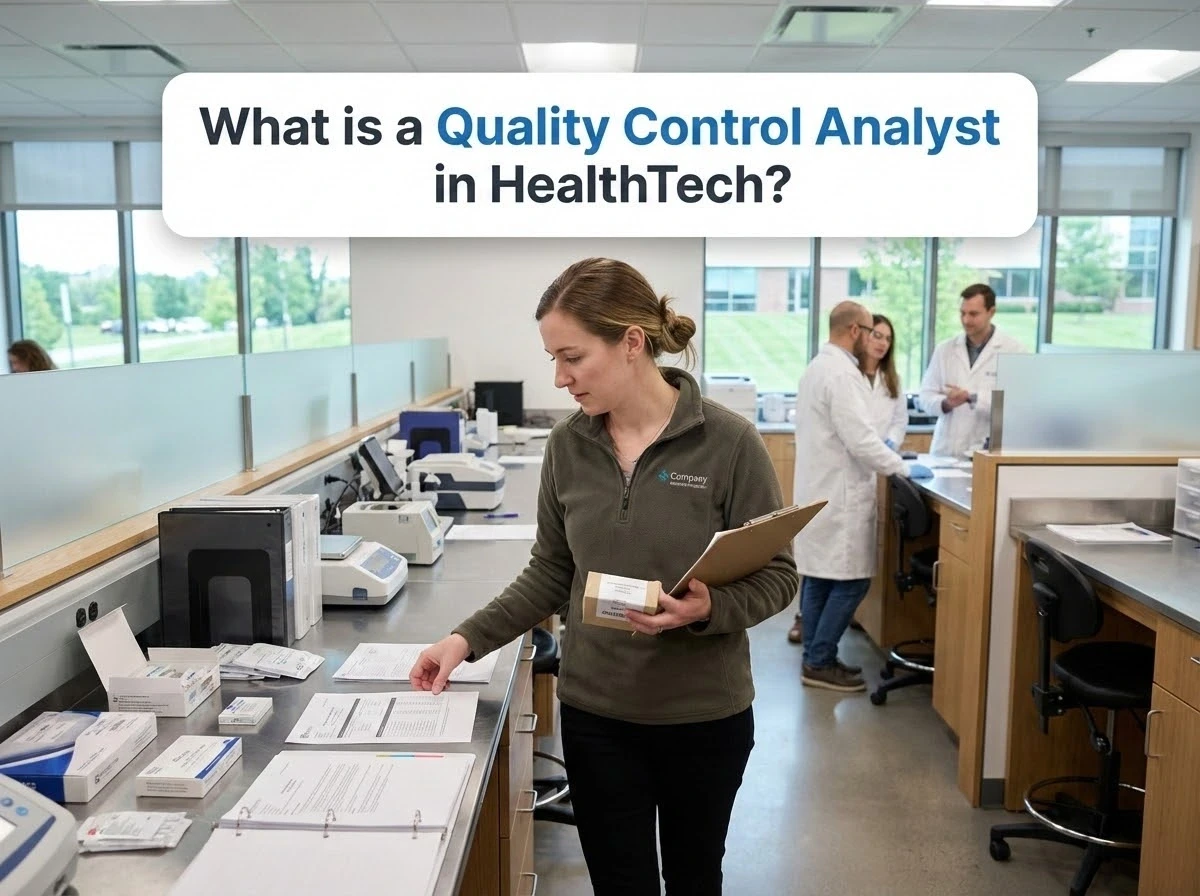
A Quality Control (QC) Analyst in HealthTech verifies that what the organisation ships, runs, or reports meets defined quality standards before it affects patients, clinicians, or operational decisions. In practical terms, they act as a gatekeeper, asking "is this acceptable to release or use?" and answering that question using evidence, documented criteria, and controlled processes.
This role exists because HealthTech products must be trusted, not just functional. When software influences care pathways, diagnostic workflows, medication safety, or clinical operations, a quality lapse can have real consequences. A QC Analyst helps the organisation prevent avoidable harm by making sure outputs are consistent, traceable, and fit for purpose, even under real constraints like tight deadlines, incomplete information, production pressure, and shifting requirements.
The job isn't simply "testing" or "checking boxes". It's about owning quality decisions: holding the line when something isn't ready, documenting what "good" looks like, and making sure evidence exists to support release decisions, especially when trade-offs are uncomfortable.
🔍 How this role differs in HealthTech
In many tech sectors, quality is framed as a user experience issue: bugs create churn, support tickets, or lost revenue. In HealthTech, quality is more tightly linked to risk, safety, and trust, because failures can affect clinical decisions, patient outcomes, regulated obligations, or contractual commitments with healthcare providers.
That changes day-to-day judgement. Data sensitivity is higher, audit expectations are stronger, and "we'll fix it next sprint" isn't always acceptable, particularly where changes alter clinical content, decision support, reporting accuracy, or the behaviour of integrations used in care settings. A QC Analyst in HealthTech is therefore more likely to work with formal acceptance criteria, traceability of changes, stricter documentation, and release controls than an equivalent role in consumer or general SaaS.
HealthTech also tends to involve more dependencies: suppliers, devices, laboratories, care settings, and legacy clinical systems. That means quality isn't only about what the product does in isolation; it's about reliability across interfaces, environments, and operational edge cases where failure modes can be subtle but serious.
🎯 Core responsibilities in HealthTech
A QC Analyst typically sits close to delivery, often partnering with product, engineering, and quality or compliance functions, to determine whether a change is suitable to release and whether it behaves as intended in the real context it will be used. Their accountability shows up in decisions: when evidence is insufficient, when a change creates a new risk, or when a release needs to be paused until the organisation can defend its quality position.
Day to day, that means interpreting requirements and translating them into verifiable acceptance standards, validating outputs against those standards, and making sure results are recorded in a way that can be understood later (by teammates, auditors, clients, or incident responders). They frequently arbitrate grey areas where the product "works" but not safely, not consistently, or not in a way that is supportable at scale.
In HealthTech, trade-offs are constant. Speed matters, but so does control. A QC Analyst helps teams decide what can be safely deferred versus what must be addressed before release, based on criticality, downstream impact, and operational realities such as deployment windows, customer environments, and incident history. When quality issues arise, they help drive containment (what to stop, what to roll back, what to monitor), and they support investigations that focus on preventing recurrence, not just assigning blame.
🧩 Skills and competencies for HealthTech
Core Skill | HealthTech specific requirement | Reason or Impact |
|---|---|---|
Risk-based judgement | Ability to distinguish "annoying defect" from "safety or clinical workflow risk", even when information is incomplete | Prevents teams from treating high-impact failures as routine bugs and supports defensible release decisions |
Quality ownership | Willingness to block or delay release when evidence is weak, while proposing a path to resolution | Protects patients and customers, and strengthens trust in the organisation's release discipline |
Traceability mindset | Comfort working with clear requirements, change rationale, and evidence trails that connect decisions to outcomes | Makes quality decisions explainable later during incidents, customer escalations, or audits |
Operational empathy | Understanding how clinicians, care administrators, or lab teams actually use systems under time pressure | Reduces "technically correct" releases that fail in real conditions, improving adoption and safety |
Clear written communication | Ability to document results, deviations, and release rationale in a way that others can act on | Enables efficient handovers, faster incident response, and consistent interpretation across teams |
Stakeholder management under pressure | Confidence to handle urgency from product or commercial teams without compromising standards | Keeps quality consistent during high-stakes launches, renewals, or customer go-lives |
System thinking | Awareness of integrations, data flows, and downstream reporting effects, not just UI-level correctness | Prevents silent errors that propagate into analytics, clinical reporting, or decision support pathways |
💷 Salary ranges in UK HealthTech
Compensation for a QC Analyst in UK HealthTech is primarily driven by how close the role sits to regulated or safety-critical releases, how much independent release authority the person holds, and how complex the environment is (multiple products, integrations, clinical customers, and formal documentation needs). Location still matters, but the biggest jumps typically come from scope: owning a release gate, running investigations, leading quality controls for higher-risk product areas, or managing teams and audit readiness.
Experience level | Estimated annual salary range | What drives compensation |
Junior | London & South East: £28,000–£35,000 | Entry-level verification work, close supervision, narrower product surface area, limited release authority |
Mid-level | London & South East: £35,000–£45,000 | Greater independence, ownership of test evidence and release checks, involvement in deviations and investigations |
Senior | London & South East: £45,000–£60,000 | Accountable for higher-risk changes, stronger judgement on trade-offs, cross-team influence, mentoring, improved audit readiness |
Lead | London & South East: £60,000–£80,000 | Owning the QC approach across a product line, standard-setting, coordinating release gates, leading investigations and process improvements |
Head / Director | London & South East: £85,000–£120,000 | Organisation-wide accountability (quality strategy, audit posture, risk governance), people leadership, stakeholder and customer assurance responsibility |
Beyond base salary, UK HealthTech QC roles commonly include an annual bonus (often tied to company or personal performance), pension and benefits, and sometimes equity, more likely in venture-backed companies. On-call allowances are not universal for QC Analysts, but can appear where quality support is needed during releases, incidents, or time-sensitive deployments; this increases total compensation most when the rotation is frequent and the responsibilities include decision-making rather than simple triage. Total pay also shifts with regulated constraints, customer scrutiny, and the cost of errors in the specific product area.
🚀 Career pathways
Many QC Analysts enter HealthTech from laboratory quality roles, manufacturing or regulated industries, clinical operations, or general software testing, especially if they already have strong documentation habits and an appetite for rigorous decision-making. Others come through graduate science routes and specialise into digital health by working on validation, data quality, or release controls.
Progression usually follows ownership. Early on, you prove you can produce reliable evidence and communicate clearly. At mid and senior levels, you expand into higher-risk areas: interpreting ambiguous requirements, preventing recurrence through investigations, and shaping release readiness. Lead roles are less about "doing more checks" and more about designing how quality works across teams, making it repeatable, auditable, and resilient under pressure. Head/Director progression comes when you can set standards at organisational level and be accountable for quality outcomes, not just quality activity.
❓ FAQ
Do I need a science or clinical background to become a QC Analyst in HealthTech?
Not always. It helps if the product touches clinical workflows, but many successful QC Analysts come from software QA or regulated quality environments. Hiring teams typically care most about judgement, documentation discipline, and your ability to explain and defend a release decision.
What does "good evidence" look like for a release in HealthTech QC?
It's evidence that matches the risk: clear acceptance criteria, reproducible results, and a record that shows what was tested, what changed, what was observed, and what was approved. In higher-risk areas, teams look for stronger traceability and clearer rationale for any residual risk.
Will I be expected to do on-call as a QC Analyst?
Sometimes, but it depends on how releases and incident response are organised. If QC is part of a release gate or supports urgent fixes, you may join a rotation, especially in smaller HealthTech organisations. If on-call exists, clarify whether it involves decision authority (release/no-release) or just escalation and coordination.
🔎 Find your next role
Ready to take ownership of quality in HealthTech? Search for Quality Control Analyst roles on Meeveem.
You might also like