Published Date: January 5, 2026
Updated Date: January 5, 2026
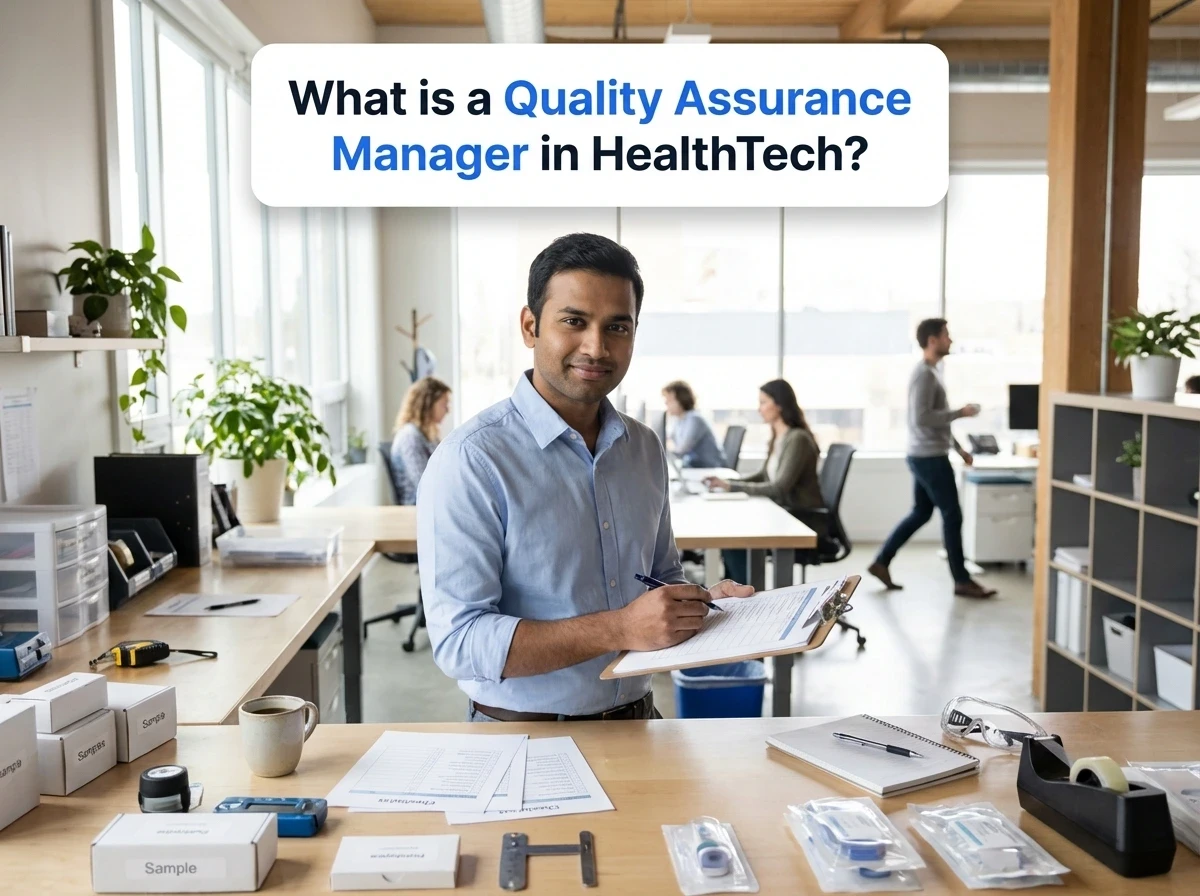
What is a Quality Assurance Manager in HealthTech?
A Quality Assurance (QA) Manager in HealthTech is the person accountable for whether the organisation can consistently release, operate, and improve healthcare products without compromising safety, clinical integrity, or trust. Their work sits at the intersection of product delivery and patient impact: they make sure quality is not a slogan or a test phase, but a measurable, governed outcome.
This role exists because "moving fast" in HealthTech can carry real-world consequences. Defects can affect clinical decisions, disrupt care pathways, or expose sensitive data. A QA Manager owns the framework that prevents that: from defining what "good" means for the product and the process, to having the authority to stop a release, escalate risk, and require corrective action when quality is trending the wrong way.
More than anything, a QA Manager is accountable for the quality system around the product: the standards, evidence, controls, and decisions that make quality repeatable under pressure.
🔍 How this role differs in HealthTech
In many software industries, QA can be framed as a delivery function: optimise pipelines, improve coverage, reduce regressions, ship faster. In HealthTech, QA is closer to a risk-management leadership role. The same defect severity scale changes when the product influences real clinical workflows, handles sensitive health data, or supports regulated claims.
HealthTech QA Managers typically operate with tighter constraints and a longer memory. You can't rely on "we'll fix it next sprint" when the issue could affect patient safety, continuity of care, or audit readiness. Decisions are shaped by traceability expectations, incident response maturity, and the need to demonstrate control, not just achieve outcomes.
The result is a role with a different centre of gravity: less about tools and testing tactics, more about governance, evidence, cross-functional decision-making, and knowing when "acceptable risk" is genuinely acceptable.
🎯 Core responsibilities in HealthTech
Day to day, a QA Manager in HealthTech is accountable for the reality behind the release notes: whether changes were built and verified in a way that can be defended, repeated, and trusted. They translate broad expectations (safe care, privacy, reliability) into concrete quality gates and decision forums that product, engineering, clinical, and operations can actually follow.
They spend a lot of time making trade-offs explicit. A release might improve user experience but introduce uncertainty in a critical workflow; a hotfix might reduce harm quickly but create documentation debt that becomes dangerous later. The QA Manager's job is to ensure those decisions are made deliberately, with the right people in the room, the right evidence captured, and the right mitigations in place.
When something goes wrong, they lead or heavily shape the response: not just the immediate containment, but the corrective and preventive actions that stop recurrence. In mature HealthTech organisations, they also influence supplier quality, third-party assurance, complaint handling, and the operational quality signals that sit beyond pure software testing, because healthcare outcomes depend on the full system, not just code.
🧩 Skills and competencies for HealthTech
Core Skill | HealthTech specific requirement | Reason or Impact |
|---|---|---|
Risk-based judgement | Ability to calibrate quality controls to clinical and operational criticality, not just defect counts | Prevents both under-control (unsafe releases) and over-control (paralysing delivery) by aligning effort to real patient and service risk |
Release authority and decision-making | Confidence to block, delay, or constrain releases when evidence is insufficient | Protects patients and customers from "hope-driven" launches and forces the organisation to treat quality evidence as non-negotiable |
Quality system thinking | Understanding how processes, records, training, and governance create repeatable quality under audit and incident pressure | Ensures quality survives team changes, growth, and outages, because it's built into how work happens, not who happens to be on shift |
Cross-functional leadership | Ability to align engineering, product, clinical/SME stakeholders, and operations around shared acceptance criteria | Avoids "QA vs delivery" dynamics and turns quality into a joint responsibility with clear accountability |
Evidence discipline | Knowing what to document, how much, and how to keep it usable rather than performative | Produces defensible assurance without drowning teams in paperwork, and speeds up investigations when incidents occur |
Incident learning and CAPA mindset | Turning production issues, complaints, and near-misses into systemic fixes with tracked follow-through | Reduces repeat failures and builds trust with customers by showing control, transparency, and measurable improvement |
Stakeholder communication under pressure | Clear, precise explanation of risk, impact, and mitigations to non-technical audiences | Helps leaders make informed go/no-go calls and prevents reputational damage caused by vague or minimising narratives |
💷 Salary ranges in UK HealthTech
QA Manager pay in HealthTech typically follows accountability rather than job title alone. Compensation moves with the criticality of the product (clinical impact and service reliance), the depth of assurance expected (governance, evidence, audit readiness), the scope of ownership (single team vs multi-product, suppliers, operational quality), and the intensity of release and incident cadence. Location still matters, but in HealthTech it's often secondary to how "close to patient impact" the role sits and how much authority the person is expected to exercise.
Experience level | Estimated annual salary range | What drives compensation |
Junior | London & South East: £35,000–£45,000 | Supporting a QA programme with limited release authority; compensation rises with exposure to regulated constraints, incident participation, and ownership of a defined quality area |
Mid-level | London & South East: £45,000–£60,000 | Managing quality for a product area or squad; pay varies with responsibility for assurance evidence, operational quality signals, and the ability to influence go/no-go decisions |
Senior | London & South East: £60,000–£80,000 | Broad ownership across teams, higher-stakes releases, incident leadership, supplier/third-party assurance, and stronger expectation to shape governance rather than follow it |
Lead | London & South East: £75,000–£95,000 | Accountable for a quality strategy across multiple teams or products; pay increases when leading audits/assessments, standardising controls, and holding firm release authority |
Head / Director | London & South East: £95,000–£130,000 | Enterprise-wide quality accountability, executive stakeholder management, budgets and hiring, multi-supplier risk, and responsibility for whether the organisation can scale without losing control |
Typical add-ons beyond base include performance bonus (often tied to company and delivery goals), private healthcare and pension, and, more commonly in venture-backed HealthTech, equity options that can materially change total compensation. On-call allowances are not universal for QA Managers, but can appear when the role is tightly coupled to release control, incident response leadership, or regulated operational assurance; total pay shifts upward with higher incident intensity, broader scope, and stronger personal accountability for go/no-go decisions.
🚀 Career pathways
Most QA Managers in HealthTech enter through one of three realistic routes: software QA/testing and then expanding into governance; operational quality/compliance roles moving closer to product delivery; or engineering/product backgrounds where the person becomes the "quality owner" and formalises that responsibility. Early progression tends to come from owning a slice of quality end to end, such as release readiness, incident learning, supplier assurance, or evidence management, rather than accumulating more test execution.
Over time, responsibility expands from "Is this feature ready?" to "Is this product safe and controlled at scale?" Senior QA Managers are trusted to define quality gates, escalate risk, and enforce corrective action without relying on hierarchy. Lead and Head/Director progression comes from building durable systems: scalable governance, predictable audits/assessments, measurable quality signals, and a culture where quality is shared but accountability is clear.
❓ FAQ
Do HealthTech QA Managers still do hands-on testing, or is it mainly governance?
It depends on team size and maturity. In smaller HealthTech companies, QA Managers often stay close to hands-on assurance whilst also owning processes and release decisions. In larger organisations, the role shifts towards governance, evidence quality, and cross-team risk decisions, with hands-on work delegated to QA engineers or embedded teams.
How do employers assess QA Managers in HealthTech during interviews?
Expect scenario-based evaluation: release under uncertainty, handling a high-severity incident, or deciding how much evidence is "enough" when timelines are tight. Strong candidates explain trade-offs, who they would involve, what they would document, and how they would prevent recurrence, without defaulting to tool-led answers.
Will I be expected to be on-call as a QA Manager in HealthTech?
Not always, but you may be expected to participate in incident response, especially if you own release gates or operational assurance. Where on-call exists, it's typically driven by production criticality and how central QA is to go/no-go decisions and post-incident corrective action. Clarify expectations early: frequency, compensation, and whether you're the decision-maker or a supporting responder.
🔎 Find your next role
Ready to take on quality ownership in HealthTech? Search Quality Assurance Manager roles on Meeveem and find a scope that matches your level of accountability.
You might also like