Published Date: January 5, 2026
Updated Date: January 5, 2026
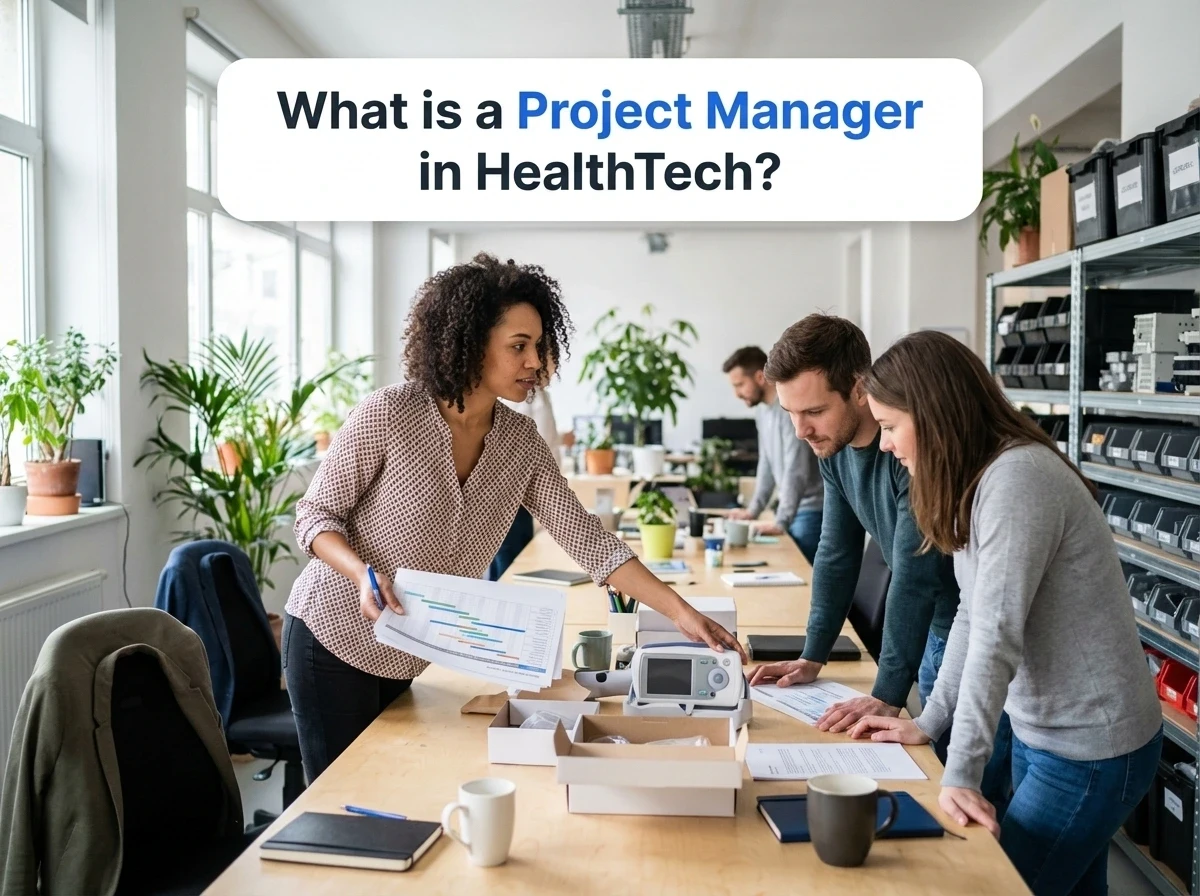
What is a Project Manager in HealthTech?
A Project Manager in HealthTech is the person accountable for turning a defined healthcare change into a delivered outcome: safely, on time, and in a way that stands up to clinical, operational, and governance scrutiny. That change might be a new digital pathway, a patient-facing app rollout, a data integration with clinical systems, or the implementation of a vendor product across multiple sites.
This role exists because HealthTech work is rarely just "ship software." It's about coordinating across clinicians, operations, information governance, suppliers, and technology teams, often with hard constraints around patient safety, service continuity, and sensitive data. Someone must hold the delivery line: clarifying what success means, keeping decisions made, managing dependencies, and making sure risk is surfaced early rather than discovered late.
In practice, a Project Manager's value is ownership. They don't merely schedule work; they own the delivery commitment and the conditions that make delivery possible: scope control, stakeholder alignment, credible plans, and escalation when reality diverges from expectations.
🔍 How this role differs in HealthTech
In many tech industries, a delay might mean lost revenue or a missed market window. In HealthTech, delivery decisions can affect clinical workflows, patient access, and operational resilience. That changes what "good" looks like: cautious sequencing can beat speed, and "done" includes adoption, training, governance, and auditability, not just a deployed feature.
HealthTech also amplifies the cost of ambiguity. Data sensitivity is higher, approvals are more layered, and the people you need to collaborate with (clinical, operational, and governance leaders) have priorities that cannot be shifted by sprint cadence. As a result, a Project Manager is often more central to translating between professional worlds, ensuring technical delivery remains aligned with real service constraints and the organisation's duty of care.
Finally, supplier dependence is common. Many HealthTech programmes are delivered through third parties, frameworks, or clinical system vendors. That makes commercial terms, milestones, acceptance criteria, and service transition planning part of day-to-day delivery reality, not occasional admin.
🎯 Core responsibilities in HealthTech
Day to day, the Project Manager is accountable for keeping a complex delivery legible: what is being delivered, by whom, by when, at what risk, and with what operational impact. They translate a broad clinical or operational goal into deliverables that can be funded, governed, built or configured, tested, trained, and adopted, without losing sight of safety, data handling, and continuity of service.
A typical week involves resolving collisions between constraints: a clinical team can only engage at specific times; a supplier needs decisions to hit a build window; information governance needs evidence to approve a data flow; the service can't tolerate downtime; and the budget is fixed. The Project Manager's job is to force clarity, create workable options, and make trade-offs explicit so senior stakeholders choose knowingly rather than by default.
In HealthTech, delivery also includes "landing" the change. That means coordinating go-lives, rehearsing cutovers, managing stakeholder communications, and setting up the handover into support or BAU ownership. When issues occur, the Project Manager drives structured triage and escalation, ensuring the organisation responds proportionately and documents decisions in a way that can be defended later.
🧩 Skills and competencies for HealthTech
Core Skill | HealthTech specific requirement | Reason or Impact |
|---|---|---|
Accountability under ambiguity | Progress delivery even when requirements evolve due to clinical feedback, governance review, or operational constraints | Prevents drift and "perpetual discovery," whilst keeping stakeholders aligned on what is safe and achievable |
Risk judgement | Distinguish delivery risk from patient/service risk and escalate appropriately | Avoids treating clinical-impact risks as ordinary project issues and reduces the chance of unsafe go-lives |
Stakeholder leadership | Influence across clinicians, operations, IT, governance, and suppliers without formal authority | Enables decisions that stick, reduces rework, and protects scarce clinical time |
Dependency management | Orchestrate cross-organisation dependencies (sites, vendors, infrastructure, approvals, training) | Keeps delivery credible in environments where blockers rarely sit in one team |
Governance discipline | Maintain decision trails, approvals, and evidence suitable for scrutiny | Supports auditability and reduces "we didn't know" failure modes during incidents or reviews |
Commercial and supplier control | Hold vendors to outcomes through clear milestones, acceptance criteria, and service transition planning | Prevents late surprises, protects budget, and improves delivery quality when execution is partly externalised |
Change landing and adoption thinking | Plan for training, comms, operational readiness, and post-go-live support ownership | Increases real-world uptake and reduces the risk of clinical workarounds or service degradation |
💷 Salary ranges in UK HealthTech
Pay for Project Managers in HealthTech is primarily driven by scope (single project vs multi-stream programme), risk and criticality (clinical workflow impact, data sensitivity, service continuity), stakeholder complexity (single team vs multiple sites), supplier responsibility, and whether you're expected to lead go-lives and incident-style escalations. Location still matters (London and South East typically pays a premium), whilst regulated constraints and high assurance environments often shift roles upward even at the same "title."
Experience level | Estimated annual salary range | What drives compensation |
Junior | London & South East: £32,000–£42,000 | Coordination-heavy roles, supporting governance, reporting, and smaller workstreams; pay rises with exposure to healthcare settings, suppliers, and go-live support |
Mid-level | London & South East: £42,000–£58,000 | Owning end-to-end delivery of a defined project, managing stakeholders across clinical/ops/tech, and running go-lives with clear risk controls |
Senior | London & South East: £58,000–£75,000 | Multiple concurrent projects or high-impact delivery, complex vendor landscapes, heavier governance, and responsibility for service continuity during deployment |
Lead | London & South East: £75,000–£95,000 | Leading a portfolio or a major programme workstream, setting delivery standards, coaching other PMs, and owning high-stakes escalations and executive reporting |
Head / Director | London & South East: £95,000–£135,000 | Accountability for a delivery function (PMO or transformation delivery), strategic prioritisation, budget ownership, vendor strategy, and outcomes across multiple services or organisations |
Typical add-ons vary by employer type. Bonus is more common in commercial HealthTech firms than in public sector settings; equity (or options) is mainly seen in venture-backed companies and may be meaningful but higher risk. On-call is not universal for Project Managers, but some roles include out-of-hours go-live cover or escalation availability; where present, this can add an allowance or be reflected in a higher base for roles tied to critical deployments. Total compensation shifts most with programme criticality, supplier leverage, and the extent to which you're accountable for delivery during high-pressure go-live periods.
🚀 Career pathways
Common entry points include project coordination or PMO roles in healthcare environments, implementation roles with vendors, operational change roles, or moving laterally from clinical or service operations into delivery ownership. Early progression often comes from learning the "healthcare reality": how decisions get made, how governance works, and what safe change management looks like in practice.
As responsibility expands, you move from coordinating tasks to owning outcomes: defining scope boundaries, negotiating trade-offs, and protecting delivery against unmanaged risk. Senior progression typically reflects the ability to lead across multiple sites or organisations, manage suppliers with confidence, and run go-lives without drama because the groundwork was done properly.
At the top end, the pathway is less about more projects and more about systems: building delivery capability, setting standards, deciding what not to do, and ensuring the organisation can deliver change repeatedly without exhausting clinical teams or destabilising services.
❓ FAQ
Do I need healthcare experience to become a Project Manager in HealthTech, or can I transition from general tech?
You can transition, but you'll be assessed on how quickly you can adapt to clinical and operational constraints. Interviewers often look for evidence that you can manage governance, stakeholder complexity, and safety-minded delivery, not just ship to deadlines. Demonstrating thoughtful risk handling and strong change "landing" experience helps.
What does "delivery" include in HealthTech beyond project plans and meetings?
Delivery usually includes readiness for real-world use: training, comms, operational sign-off, go-live planning, cutover coordination, and handover to support. You're often judged on adoption quality and stability after launch, not just whether a system technically went live.
Will I be expected to do on-call or out-of-hours work as a Project Manager?
Not always, but some roles expect out-of-hours coverage during go-lives or major cutovers, especially when service disruption must be minimised. Clarify expectations in interviews: frequency of go-lives, escalation duties, and whether time off in lieu or allowances apply. Even without formal on-call, senior PM roles may require availability during critical deployment windows.
🔎 Find your next role
Ready to take ownership of real-world delivery in HealthTech? Search Project Manager roles on Meeveem and find a team where your judgement and delivery discipline will matter.
You might also like