Published Date: December 31, 2025
Updated Date: December 31, 2025
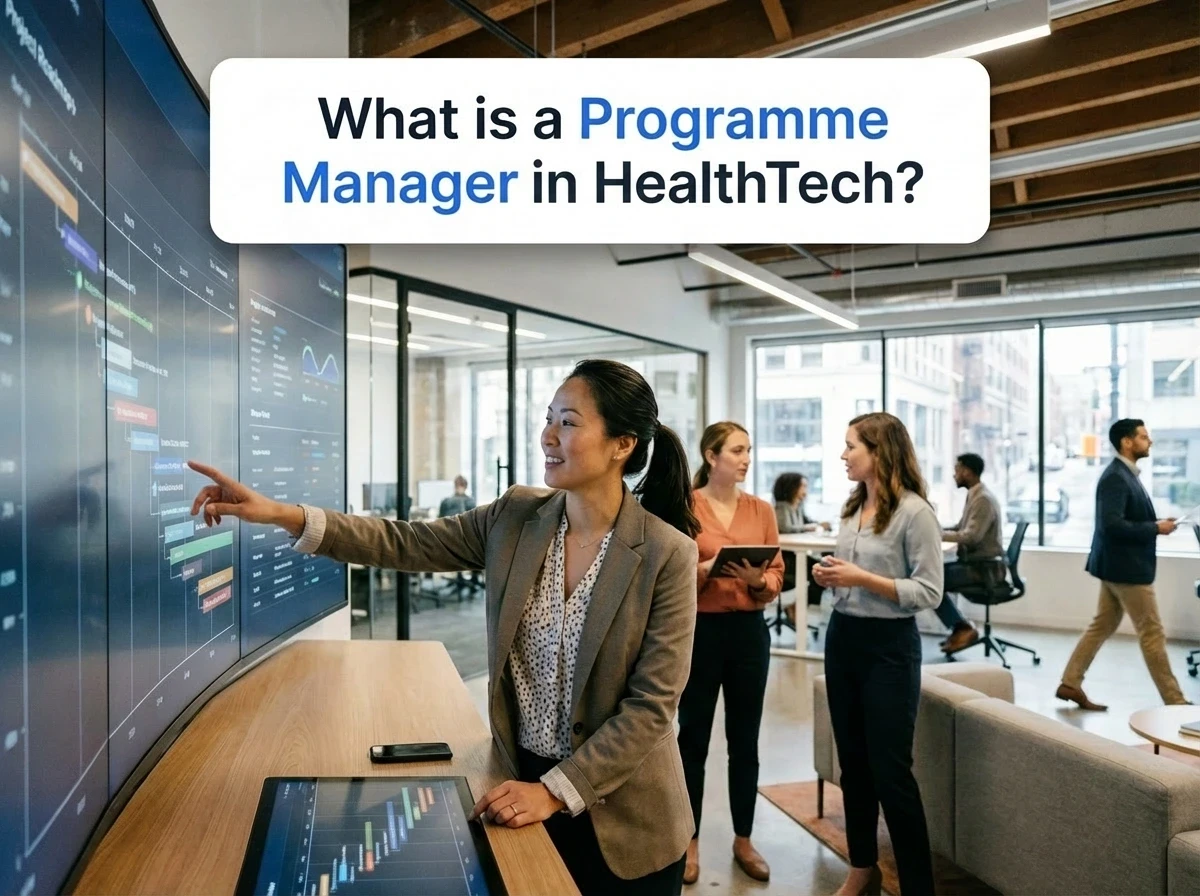
What is a Programme Manager in HealthTech?
A Programme Manager in HealthTech is the person accountable for delivering a coordinated set of related initiatives that must land safely in real care settings, not just "ship software." Their job is to keep a programme coherent as it moves from intent to measurable outcomes: aligning clinical, operational, technical, commercial, and governance expectations into a single delivery path.
This role exists because HealthTech change rarely happens through one project at a time. Multiple workstreams move together: product changes, integrations, data flows, clinical safety activities, procurement, training, rollout planning, service transition, and benefits realisation. A Programme Manager owns the joined-up outcome across that landscape, making sure dependencies are managed, decisions are escalated to the right governance, and delivery remains safe, compliant, and achievable.
More than methods, the core of the job is responsibility: responsibility for sequencing work, surfacing risk early, protecting patient-facing services, and ensuring the organisation can actually adopt what's being delivered.
🔍 How this role differs in HealthTech
In many tech sectors, programme management can be heavily centred on delivery cadence, portfolio visibility, and aligning teams to a commercial roadmap. In HealthTech, those still matter, but decisions are shaped by a tighter risk envelope and higher consequences of failure.
Health data sensitivity changes how work is planned and approved. Integration with clinical systems and workflows introduces operational fragility: downtime, user adoption, and training become first-class delivery constraints, not "later." The reality of multi-stakeholder decision-making is also sharper: clinical leadership, information governance, security, operations, suppliers, and external partners often need to align before a change is allowed to go live.
The result is a role that is less about running ceremonies and more about holding accountability across uncertainty, balancing speed with safety, and progress with auditability.
🎯 Core responsibilities in HealthTech
Day to day, a Programme Manager is making delivery real under constraints that don't go away just because a timeline is ambitious. They translate strategy into an executable plan that respects clinical operations, information governance, supplier dependencies, and internal capacity, then continuously re-plan as reality shifts.
A typical week involves resolving "competing truths": engineering wants to reduce scope, clinical stakeholders want assurance and usability, operations want minimal disruption, and leadership wants measurable impact. The Programme Manager's accountability is to create a decision environment where trade-offs are explicit: what will change, what risk is introduced, what controls exist, what will be measured, and who is signing off.
They also act as the connective tissue of governance: ensuring risks, issues, and decisions are documented and routed to the right forums; ensuring benefits are defined in a way that can be evidenced; and ensuring the organisation is prepared for adoption (training, comms, service transition, supplier readiness). In HealthTech, delivery isn't "done" at release. It's done when the change is safely used, supported, and producing the intended outcomes.
🧩 Skills and competencies for HealthTech
Core Skill | HealthTech specific requirement | Reason or Impact |
|---|---|---|
Accountability under ambiguity | Owning outcomes when clinical, technical, and governance constraints evolve mid-delivery | Prevents delivery from stalling in "waiting for clarity" while still protecting safety and compliance |
Stakeholder decision shaping | Working with clinical, operational, security, and commercial stakeholders who don't share the same incentives | Reduces churn, shortens decision cycles, and keeps the programme aligned to real-world adoption needs |
Risk judgement and escalation | Knowing what must be controlled, what can be accepted, and what must be escalated through governance | Protects patient-facing services and reduces late-stage surprises that trigger delays or reversals |
Dependency and integration thinking | Planning for complex system and supplier dependencies that affect go-live, data flows, and support | Avoids "locally done, globally broken" outcomes where one workstream blocks the whole programme |
Benefits realisation discipline | Defining measurable outcomes that reflect care delivery and operational reality, not vanity metrics | Helps leadership fund and defend the programme, and proves value beyond successful delivery activity |
Communication under scrutiny | Producing clear, auditable narratives for progress, decisions, and controls | Builds trust with governance forums and creates a defensible record when priorities or risks are challenged |
Change and adoption ownership | Treating training, workflow fit, and operational readiness as core delivery scope | Increases uptake and reduces post-go-live disruption, rework, and support burden |
Commercial and supplier management | Managing third-party delivery, contracts, and service expectations without losing outcome ownership | Prevents vendor-driven timelines from dictating risk, quality, or operational feasibility |
💷 Salary ranges in UK HealthTech
Programme Manager pay in UK HealthTech is primarily driven by scope and criticality: how many workstreams you own, the operational risk of change, the complexity of integrations and suppliers, and the strength of governance and reporting expected. Location matters (especially London and South East), but it is often secondary to responsibility level, particularly when programmes touch patient-facing systems, regulated environments, or multi-site rollouts. On-call expectations are less common for pure programme roles, but some organisations expect out-of-hours support during deployments or major cutovers, which can influence pay.
Experience level | Estimated annual salary range | What drives compensation |
Junior | London & South East: £40,000–£52,000 | Usually supporting a Programme Manager or owning a small, well-bounded workstream; pay rises with stakeholder exposure, governance responsibility, and delivery autonomy |
Mid-level | London & South East: £52,000–£70,000 | Owning a defined programme or multiple projects with dependencies; variation driven by supplier complexity, data/integration scope, and whether the programme is operationally disruptive |
Senior | London & South East: £70,000–£90,000 | Accountable for high-impact programmes, multi-team coordination, and senior governance; higher ranges align to patient-critical change, complex environments, and stronger line-management expectations |
Lead | London & South East: £90,000–£115,000 | Leading multiple programmes or a major transformation portfolio; compensation reflects organisational criticality, executive-level reporting, multi-supplier control, and responsibility for financial/budget outcomes |
Head / Director | London & South East: £115,000–£160,000 | Portfolio ownership, strategy-to-delivery accountability, and leadership of programme delivery functions; pay moves with scale (organisation size, number of programmes), external scrutiny, and breadth of operational risk |
Typical add-ons beyond base include performance bonus (more common in venture-backed and commercial HealthTech than in public-sector aligned organisations), pension and enhanced benefits, and sometimes equity for senior roles in growth-stage companies. Total compensation varies most with programme criticality (patient-facing impact, downtime risk), breadth of accountability (budget ownership, line management), deployment intensity (evening/weekend cutovers), and the complexity of governance and assurance required.
🚀 Career pathways
Common entry points include project management, delivery management, operations roles in healthcare environments, PMO roles, implementation leadership (especially for clinical systems), or product operations in HealthTech companies. Many Programme Managers also transition from consulting or transformation roles where they've learned to manage stakeholders, governance, and delivery planning at pace.
Progression is typically driven by ownership: moving from coordinating tasks to owning dependencies, then owning outcomes across multiple teams, and eventually owning portfolio-level trade-offs that affect investment, sequencing, and organisational capacity. Over time, the role expands from "ensuring delivery happens" to "ensuring the right delivery happens safely," including shaping governance, improving delivery systems, and mentoring other delivery leaders.
The strongest progression signal is not the number of projects delivered, but the ability to land complex change that sticks: measured, adopted, and supported without destabilising care or operations.
❓ FAQ
Do I need a clinical background to be a Programme Manager in HealthTech?
No, but you do need credibility with clinical and operational stakeholders. Employers typically look for evidence you can understand workflow impact, handle safety-conscious decision-making, and communicate clearly under scrutiny. You can build this through implementation, transformation, or digital change roles that sit close to service delivery.
What will I be assessed on in interviews for HealthTech programme roles?
Expect scenario questions about trade-offs: what you would do when timelines conflict with safety controls, or when stakeholder priorities are incompatible. You'll often be assessed on how you structure governance, how you surface and escalate risk, and how you prove benefits rather than just reporting activity.
Is on-call part of the job for a Programme Manager in HealthTech?
It's not typically "on-call" in the engineering sense, but many organisations expect availability around major deployments, cutovers, or incident-led changes. This can mean evening/weekend work during go-live windows and a higher expectation of responsiveness when delivery risk increases. Clarify this early, because it can materially change workload and total compensation.
🔎 Find your next role
If you're ready to take ownership of complex, high-impact change, search Programme Manager roles in HealthTech on Meeveem.
You might also like