Published Date: January 1, 2026
Updated Date: January 1, 2026
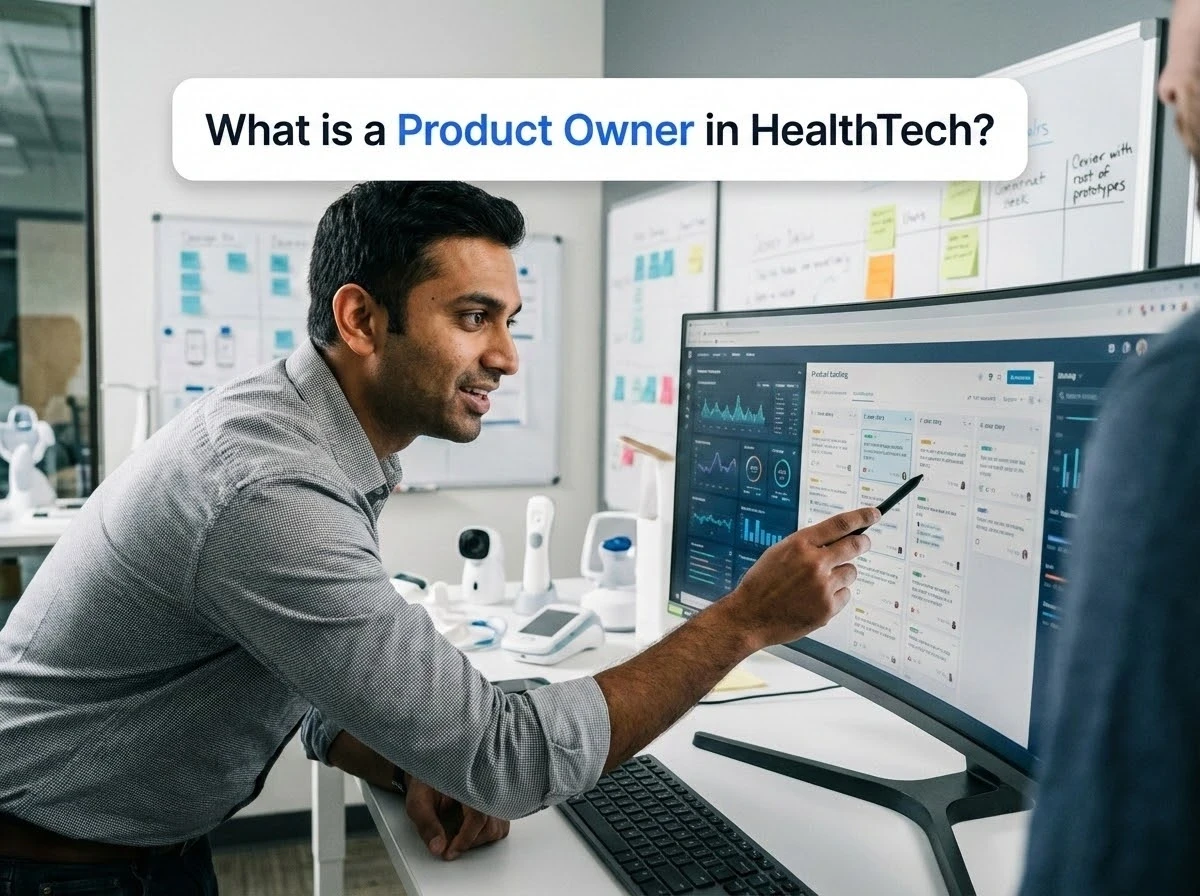
What is a Product Owner in HealthTech?
A Product Owner in HealthTech is the person accountable for turning a clinical or operational problem into a product that is safe, useful, and deliverable, then making the calls that keep it moving. They hold ownership of "what we build next" and "why that matters", balancing patient impact, customer value, and engineering reality.
This role exists because healthcare products sit at the intersection of complex users (clinicians, patients, carers, administrators), sensitive data, and high consequences. Without a single accountable owner, teams either ship features that don't work in real care settings or move so cautiously that outcomes never improve. A Product Owner creates focus: they decide priorities, define boundaries, and accept the responsibility that comes with trade-offs, not just the mechanics of a delivery process.
🔍 How this role differs in HealthTech
In many tech sectors, a Product Owner can optimise primarily for growth, convenience, and speed to market. In HealthTech, the same decisions are shaped by a different gravity: risk is more tangible, data is more sensitive, and errors can affect real-world care, not just user experience.
HealthTech also changes how "good" is measured. It's not only engagement or conversion; it's whether a workflow reduces clinical burden, whether outcomes are defensible, and whether the product behaves safely under edge cases. Evidence, auditability, and clear accountability matter more than persuasive roadmaps. The Product Owner is often the person who translates these constraints into day-to-day decisions the team can actually execute.
🎯 Core responsibilities in HealthTech
A HealthTech Product Owner lives in the space between clinical reality, organisational goals, and technical delivery. On a typical day, they're aligning multiple stakeholders who often disagree (because their incentives differ) and then making a prioritisation decision that still holds up when scrutinised later. They define what "done" means in a way that includes safety, privacy, and operational viability, not just functional completion.
Instead of treating constraints as blockers, they treat them as design inputs. They work with engineering to shape options, with clinical and operational partners to validate what will work in practice, and with assurance or governance functions to ensure the product can be deployed responsibly. Trade-offs are constant: shipping a smaller change that reduces risk, deferring a feature because it increases clinical workload, or slowing down to harden reliability for critical workflows. Their accountability isn't "running sprints"; it's owning the decisions that determine whether the product is fit for healthcare.
🧩 Skills and competencies for HealthTech
Core Skill | HealthTech specific requirement | Reason or Impact |
|---|---|---|
Accountability and decision ownership | Comfort being the named decision-maker when uncertainty remains (clinical ambiguity, incomplete data, evolving guidance) | Prevents "design by committee" and ensures someone owns outcomes, not just outputs |
Risk-based prioritisation | Ability to weigh patient safety, service continuity, and data sensitivity alongside commercial value | Keeps roadmaps realistic and defensible when consequences of failure are high |
Stakeholder alignment under tension | Managing clinicians, operations, security, and engineering where priorities naturally conflict | Reduces delivery churn and avoids late-stage objections that derail releases |
Clinical and operational empathy | Understanding how care is delivered day-to-day, including workload, handovers, and exceptions | Produces workflows that people can actually adopt without creating hidden risk |
Clarity of outcomes and acceptance criteria | Defining "done" to include auditability, reliability, and safe failure modes where relevant | Improves quality and reduces rework, especially for high-impact pathways |
Data judgement and governance awareness | Knowing what data is necessary, proportionate, and protectable, and designing with privacy in mind | Lowers compliance risk and builds trust with customers and end users |
Communication with precision | Writing and speaking in a way that stands up to scrutiny across technical and non-technical audiences | Enables faster execution and fewer misunderstandings in regulated, high-stakes contexts |
Delivery pragmatism | Making progress through incremental releases without undermining safety or operational readiness | Avoids "big bang" risk while still delivering measurable value |
💷 Salary ranges in UK HealthTech
Product Owner compensation in UK HealthTech tends to reflect the breadth of ownership (single team vs multiple squads), the criticality of the product (patient-facing or care-delivery impact vs internal tooling), and the level of accountability for safety, data, and uptime. Location still matters, particularly London and the South East, though remote and hybrid norms can blur the edges. Where on-call exists (more common for platform, integration, and operationally critical services), it can meaningfully affect total compensation.
Experience level | Estimated annual salary range | What drives compensation |
Junior | London & South East: £38,000–£48,000 | Often supporting a senior PO/PM; narrower scope, lower blast radius, less autonomy in prioritisation |
Mid-level | London & South East: £50,000–£68,000 | Owning a product area end-to-end; stakeholder complexity increases; stronger expectation of independent trade-offs |
Senior | London & South East: £70,000–£90,000 | High autonomy; ambiguity management; cross-team dependencies; greater responsibility for risk, reliability, and adoption |
Lead | London & South East: £90,000–£115,000 | Multi-squad ownership, coaching, operating model influence, and accountability for outcomes across a larger domain |
Head / Director | London & South East: £115,000–£150,000 | Strategic accountability, portfolio prioritisation, executive stakeholder management, and governance across multiple products |
Beyond base salary, total compensation commonly includes a performance bonus (more typical in larger or more commercially driven organisations) and equity or options (more typical in venture-backed HealthTech). On-call or out-of-hours allowances can appear in roles tied to operationally critical services, integrations, or platforms, and the value varies with frequency and severity of incidents. Total compensation also shifts with company stage, funding, regulated burden, product criticality, and whether the role blends Product Ownership with delivery management responsibilities.
🚀 Career pathways
Entry into HealthTech Product Ownership is often through adjacent roles that already involve translating user needs into delivery decisions: business analysis, clinical informatics, implementation, delivery, or customer-facing product roles in healthcare settings. Some Product Owners come from clinical or operational backgrounds and build product capability over time; others come from tech and develop healthcare context through deep exposure to workflows, assurance, and stakeholder environments.
Progression tends to follow ownership, not job titles. Early on, responsibility expands from "a set of tickets" to a coherent problem space with measurable outcomes. Later, it becomes the ability to lead prioritisation across competing product areas, handle higher-stakes trade-offs, and shape how teams make decisions (not just what they build). The strongest signal of readiness for the next step is consistent judgement under constraints: shipping value whilst keeping safety, trust, and service continuity intact.
❓ FAQ
Do I need a clinical background to be a Product Owner in HealthTech? No, but you do need credible clinical and operational understanding. Hiring teams look for how you learn workflows, test assumptions with real users, and make safe trade-offs. A strong partnership style with clinical experts is often as valuable as prior healthcare employment.
What will interviews test that's unique to HealthTech Product Ownership? Expect scenario-based questions about prioritising under risk, handling sensitive data, and navigating stakeholder disagreement. You may be assessed on how you define "done" beyond functionality (think reliability, auditability, and safe rollout). Clear reasoning and calm decision-making matter more than buzzwords.
Is on-call common for Product Owners in HealthTech? It depends on the product and operating model. Many Product Owners are not formally on-call, but those aligned to platforms, integrations, or critical services may share escalation responsibilities during incidents. If it exists, clarify expectations early: frequency, decision authority during incidents, and how it's compensated.
🔎 Find your next role
Ready to take ownership of meaningful healthcare products? Search Product Owner roles on Meeveem and find a scope that matches your judgement, ambition, and domain interest.
You might also like