Published Date: January 5, 2026
Updated Date: January 5, 2026
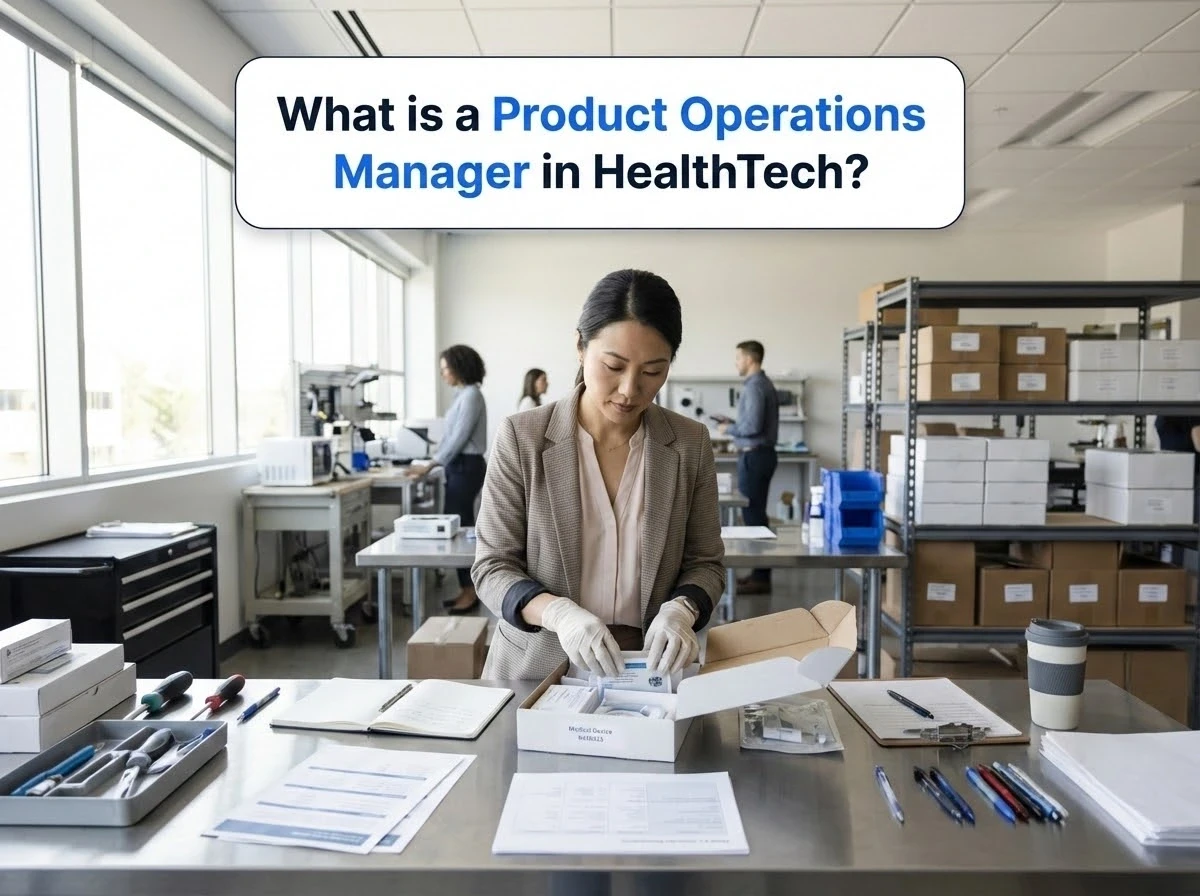
What is a Product Operations Manager in HealthTech?
A Product Operations Manager in HealthTech is the person accountable for keeping the "product system" working end-to-end: how customer and clinical reality becomes product decisions, how releases land safely, and how the product organisation operates predictably under real-world constraints. It sits close to Product leadership, but it is not a "junior PM" role. It is an operational ownership role that makes product outcomes repeatable at scale.
This role exists because HealthTech products don't succeed on roadmap quality alone. They succeed when adoption, safety, reliability, and feedback loops are managed deliberately across teams that often carry conflicting incentives: product, engineering, support, clinical, commercial, implementation, and compliance. Without clear operational ownership, teams drift into one-off heroics. Releases become risky, customer impact becomes hard to see, and "what we shipped" diverges from "what changed in patient or clinician reality".
In practice, a Product Operations Manager owns the mechanisms that let teams move quickly without losing control: decision pathways, release readiness, escalation handling, measurement discipline, and cross-functional alignment. The methods can vary by company. The accountability is consistent: making product delivery and product learning dependable.
🔍 How this role differs in HealthTech
In many SaaS or consumer environments, product operations is often optimised around speed, standardisation, and growth efficiency. In HealthTech, the same operating discipline is needed, but the consequences of failure are sharper and the tolerance for ambiguity is lower.
HealthTech adds layers of complexity that change everyday judgement: sensitive data, higher expectations of auditability, and workflows that must fit into time-pressured clinical or care delivery contexts. "Move fast" is still a goal, but it's bounded by patient safety, service reliability, and the reality that frontline users can't absorb constant change.
This shifts the role from "process improvement" to "risk-aware product enablement". A Product Operations Manager in HealthTech is often the person ensuring that decisions are made with the right evidence, that releases are introduced in a way that protects care delivery, and that feedback isn't just collected but translated into actionable product learning with traceability and clear ownership.
🎯 Core responsibilities in HealthTech
Day to day, the Product Operations Manager is accountable for how product work travels through the organisation: what gets prioritised, what gets shipped, how it gets adopted, and how impact is understood. They create clarity in messy spaces: when support reports rising ticket volume, when customers ask for urgent changes, when engineering flags reliability risks, or when clinical stakeholders push for safeguards that add friction.
A large part of the job is decision-making under constraints. In HealthTech, trade-offs are rarely "feature vs feature". They're often "new capability vs operational risk", "adoption speed vs clinical confidence", or "short-term workaround vs long-term maintainability". Product operations owns the structure around those trade-offs: what evidence is required, who must be involved, what "good" looks like, and when to stop shipping and stabilise.
They also tend to own the operational backbone of launches and releases: readiness criteria, rollout sequencing, internal enablement, external comms, and escalation paths when something goes wrong. In many HealthTech teams, product operations becomes the connective tissue between product and the teams closest to real-world impact (implementation, customer success, support, and sometimes clinical operations) so that learnings are systematic rather than anecdotal.
🧩 Skills and competencies for HealthTech
Core Skill | HealthTech specific requirement | Reason or Impact |
|---|---|---|
Risk-aware judgement | Ability to weigh product value against patient safety, service continuity, and data sensitivity without paralysing delivery | Prevents "safe but unusable" outcomes and avoids avoidable incidents that damage trust and adoption |
Operational ownership | Comfort owning end-to-end mechanisms (intake, prioritisation inputs, release readiness, escalation) across teams that don't report into you | Creates reliability in delivery and ensures accountability doesn't vanish between functions |
Stakeholder alignment under pressure | Credibility with clinical, technical, and commercial stakeholders when priorities collide and timelines are tight | Reduces last-minute reversals and makes decisions stick, which is crucial in regulated or high-trust environments |
Systems thinking | Understanding how small changes affect downstream workflows (support load, training, onboarding, reporting, integrations) | Avoids shipping features that increase operational burden or create hidden failure modes in care workflows |
Clarity of communication | Translating complex product changes into plain-language guidance for frontline and customer-facing teams | Improves safe adoption, reduces misunderstanding-driven incidents, and speeds up feedback cycles |
Measurement discipline | Defining what "impact" means in a way that is measurable and ethically appropriate (adoption, outcomes proxies, reliability, safety signals) | Prevents product teams optimising vanity metrics and supports defensible prioritisation decisions |
💷 Salary ranges in UK HealthTech
Compensation for Product Operations Managers in UK HealthTech typically reflects the mix of responsibility and risk carried by the role: breadth of cross-functional ownership, criticality of the product (and consequences of downtime), complexity of delivery environments, and expectations around incident response or after-hours support. Location matters, but so does the operating model. Organisations with frequent releases, heavy enterprise implementation, or safety-critical workflows tend to pay toward the top of ranges.
Experience level | Estimated annual salary range | What drives compensation |
Junior | London & South East: £40,000–£55,000 | Often closer to product coordination and insight generation. Pay rises with exposure to release ownership, stakeholder management, and measurable impact |
Mid-level | London & South East: £55,000–£75,000 | Scope across multiple squads or a full product area. Higher pay when owning launch readiness, operational KPIs, and cross-functional decision pathways |
Senior | London & South East: £70,000–£95,000 | Compensation increases with autonomy, ownership of operating cadence, and responsibility for escalations, adoption outcomes, and reliability trade-offs |
Lead | London & South East: £90,000–£120,000 | Leading a product ops function or platform-wide operating model. Pay driven by org-wide influence, complexity, and the cost of failure (commercial and clinical) |
Head / Director | London & South East: £110,000–£160,000 | Accountability for product operating system across multiple products/teams. Higher ranges where roles include governance, strategic planning, and incident/operational ownership |
Beyond base salary, typical add-ons include performance bonus (often tied to company and product outcomes), equity in venture-backed organisations, and enhanced pension/benefits. On-call allowances are less universal than in engineering, but can apply where product operations formally owns release coordination, incident triage, or after-hours customer escalations, especially for products used in time-sensitive care settings. Total compensation varies most with product criticality, enterprise complexity (implementations and integrations), and how explicitly the role is accountable for service reliability and escalation response.
🚀 Career pathways
Entry points are usually adjacent to the "edges" of product: implementation, customer success operations, support leadership, clinical operations, delivery management, or analytics roles that already sit close to customer reality. People also move in from project/programme management when they demonstrate they can shape product decisions, not just track delivery.
Progression is less about title changes and more about widening ownership. Early on, you're trusted with a slice of the operating model: release readiness, intake triage, or product insights. As you grow, you own the system across multiple teams: how priorities are set using evidence, how launches are executed safely, how adoption is enabled, and how feedback becomes roadmap decisions with traceability.
At senior levels, the pathway typically splits. Some move into product leadership (because they deeply understand how product strategy becomes execution). Others build a broader operations leadership track, owning operating cadence across the product org, reliability governance, or scaling mechanisms across multiple products and markets.
❓ FAQ
1) Will I be judged like a Product Manager, or like an Operations Manager?
You're usually evaluated on outcomes that sit between the two: whether product delivery and learning become more reliable, whether launches land cleanly, and whether teams can make better decisions with clearer evidence. You won't typically own the product vision, but you will be accountable for whether the organisation can execute that vision safely and consistently.
2) How "technical" do I need to be for HealthTech product operations?
You generally need enough technical fluency to understand system constraints, release risk, integrations, and how incidents happen, even if you're not writing code. The goal is credible judgement: asking the right questions, understanding trade-offs, and ensuring operational mechanisms work in the real delivery environment.
3) Should I expect on-call or after-hours work in this role?
Not always, but it can occur where the organisation expects product operations to coordinate releases, manage high-severity escalations, or support incident response alongside engineering and support teams. The best way to assess this is to ask who owns release go/no-go decisions, who leads customer communications during incidents, and whether there's a formal rota with compensation.
🔎 Find your next role
Ready to move into (or level up within) Product Operations in HealthTech? Search roles on Meeveem and focus on postings that are explicit about ownership, cross-functional scope, and how success is measured.
You might also like