Published Date: January 3, 2026
Updated Date: January 3, 2026
What is a Product Marketing Manager in HealthTech?
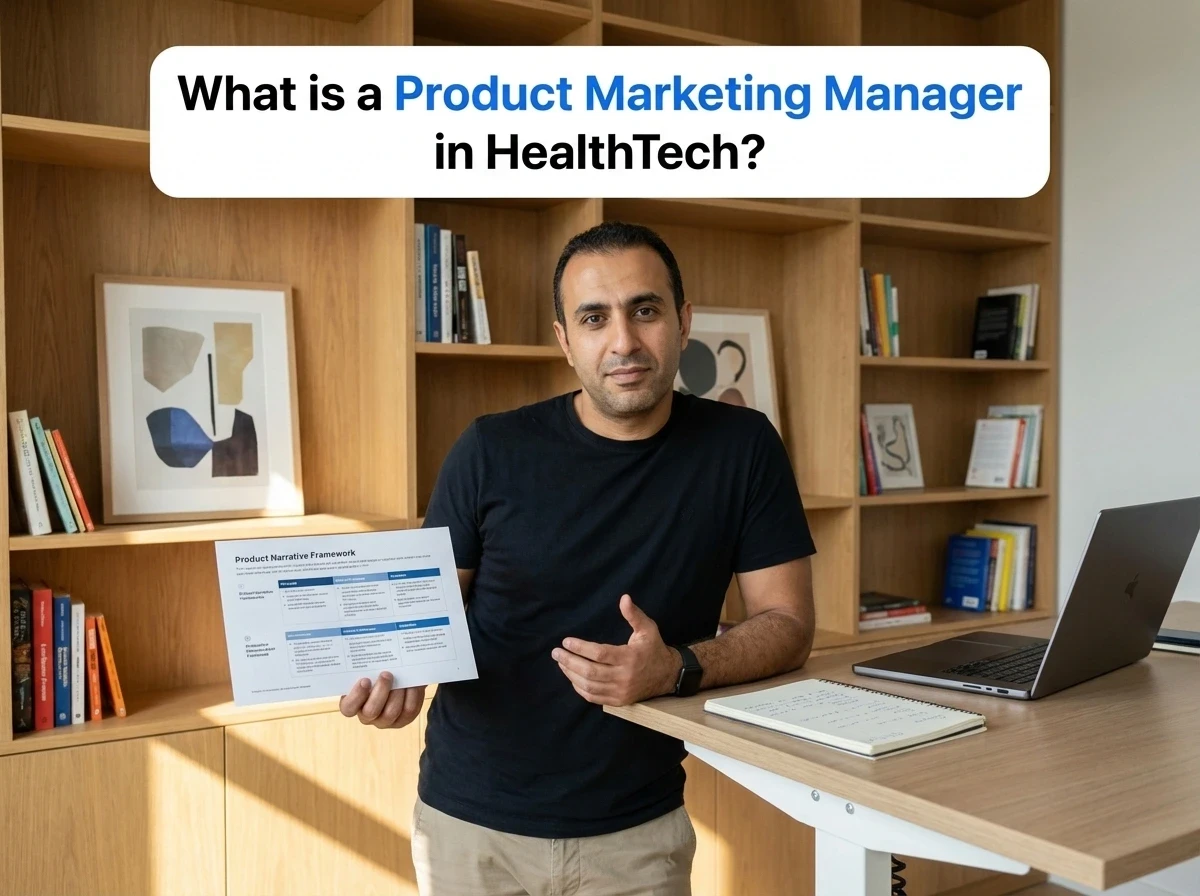
A Product Marketing Manager (PMM) in HealthTech is the person accountable for how a health product is understood, trusted, chosen, and successfully adopted in the real world. They own the "market-facing truth" of the product: what it is, who it's for, why it's safe and credible, how it fits into care delivery or operational workflows, and what proof is needed for buyers and users to say yes.
This role exists because building the right product is not the same as getting it used. In HealthTech, adoption is rarely a single-user decision; it often involves clinicians, operations, procurement, information governance, and executive sponsors. A PMM provides the connective tissue between product reality and market reality, ensuring that launches, messaging, evidence, and enablement all reflect the constraints and stakes of healthcare.
Above all, the job is ownership: owning the go-to-market narrative, owning the readiness of internal teams to sell and support, and owning the feedback loop that turns market signals into product decisions.
🔍 How this role differs in HealthTech
In many tech sectors, product marketing can lean heavily on speed, growth loops, and experimentation. HealthTech is different because risk and trust dominate the decision-making. The "buyer" is often managing clinical risk, patient outcomes, data sensitivity, and reputational exposure, not just price and feature comparisons.
That changes what good looks like. Claims must be precise, evidence-backed, and aligned with how healthcare organisations evaluate solutions. The go-to-market motion also tends to be multi-stakeholder and slower: procurement scrutiny, information governance questions, workflow impact assessments, and implementation capacity can matter as much as product capability.
A HealthTech PMM therefore spends less time optimising superficial conversion and more time ensuring that the market story is accurate, defensible, and usable in real settings, where ambiguity can cause delayed decisions, failed pilots, or loss of trust.
🎯 Core responsibilities in HealthTech
Day to day, a HealthTech PMM is accountable for making the product "land" with the right audience. That means translating what the product does into a clear promise that stands up under clinical, operational, and technical scrutiny, then ensuring every touchpoint reinforces that promise, from the website and pitch deck through to implementation materials and customer communications.
They make judgement calls under constraints. If evidence is still emerging, they decide what can be responsibly claimed and what must be positioned as "in progress," balancing commercial urgency with credibility and safety. If the product serves multiple pathways or user groups, they decide which segment to prioritise and how to tailor messaging without creating fragmentation or overpromising.
They also carry the burden of internal alignment. When Sales pushes for broader claims, or Product wants to launch before documentation is ready, the PMM is often the person who forces the trade-off into the open: what risk are we taking, what will it cost us in trust, and what needs to be true before we scale distribution? In mature organisations, they may also own launch governance, ensuring enablement, support readiness, and customer-facing artefacts are coherent enough to protect outcomes and reputation.
🧩 Skills and competencies for HealthTech
Core Skill | HealthTech specific requirement | Reason or Impact |
|---|---|---|
Positioning and messaging judgement | Communicate value without overstating clinical impact, safety, or outcomes | Credibility is a growth lever in healthcare; inaccurate claims create adoption drag and can trigger formal escalation from stakeholders |
Stakeholder empathy and translation | Interpret needs across clinical users, operations, procurement, and technical governance | Adoption depends on satisfying multiple "definitions of value," not a single persona's preference |
Evidence-led storytelling | Frame proof appropriately (what's validated, what's indicative, what's not yet demonstrated) | Buyers often require defensible justification; weak evidence narratives can stall pilots or renewals |
Commercial and procurement literacy | Understand how organisations buy, pilot, and scale solutions, including risk sign-off and implementation capacity | The best product story fails if it doesn't match how decisions are actually made and approved |
Launch discipline under constraints | Coordinate readiness across Sales, Support, Implementation, and Product while respecting regulated or high-trust expectations | Inconsistent launches damage trust and increase support load, especially when workflows are complex |
Crisis-proof communication | Anticipate how messaging behaves when things go wrong (incidents, downtime, change in guidance, customer scrutiny) | In HealthTech, poor comms during friction can become a trust event that outlasts the incident itself |
Cross-functional influence | Drive alignment without formal authority across product, clinical, and commercial leaders | Decisions often require consensus; PMMs who can't influence end up producing assets that don't change outcomes |
💷 Salary ranges in UK HealthTech
Salary in HealthTech product marketing is usually a function of scope and risk rather than just years of experience. The biggest drivers are: whether you own a single product vs a portfolio, whether the product sits in higher-trust or higher-scrutiny contexts, the commercial model (SMB vs enterprise healthcare), the weight of implementation/change management, and how directly you carry revenue accountability through launches and enablement. On-call is uncommon for pure product marketing, but some HealthTech businesses expect PMMs to support time-sensitive launches, incident communications, or major customer escalations, which can influence compensation.
Experience level | Estimated annual salary range | What drives compensation |
Junior | London & South East: £35,000–£45,000 | Usually supports one product area; compensation rises with ability to own messaging, run small launches, and work confidently with clinical/technical stakeholders |
Mid-level | London & South East: £45,000–£60,000 | Owning a product line or segment, building core narratives, and being reliable on enablement and launches; higher pay where sales cycles are enterprise and scrutiny is high |
Senior | London & South East: £65,000–£90,000 | Autonomous ownership across strategy, launches, competitive positioning, and cross-functional alignment; compensation increases with commercial impact and stakeholder complexity |
Lead | London & South East: £85,000–£110,000 | Portfolio ownership and/or people leadership; shaping GTM standards, coaching others, and influencing product direction through market insight in constrained environments |
Head / Director | London & South East: £100,000–£140,000 | Organisation-level accountability for positioning, launches, and revenue support; higher pay where the function owns major pipeline impact, enterprise credibility, and multi-product complexity |
Typical add-ons beyond base include a performance bonus (often tied to company growth, pipeline contribution, or launch outcomes), pension and benefits, and equity or share options, more common in venture-backed HealthTech. Total compensation varies most by company stage (early vs scaled), how directly product marketing is measured against revenue outcomes, and the level of reputational or operational risk the product carries. On-call allowance is not typical for PMMs, but where a role explicitly includes out-of-hours launch support or critical communications cover, some employers compensate via allowance or enhanced bonus.
🚀 Career pathways
Entry points are often from adjacent roles where you've learned to translate complex products into outcomes: marketing roles in regulated or technical sectors, customer success in healthcare-facing products, clinical training/education functions, or even product roles where you've owned launches and stakeholder narratives. What matters early is demonstrating that you can take ownership of a defined slice of the story (one segment, one message set, one launch) and make it land with measurable adoption or sales enablement outcomes.
Progression usually expands along three dimensions: breadth (from one product to a portfolio), depth (from assets to strategy and market choices), and influence (from execution to cross-functional governance). The strongest PMMs move up by becoming trusted "truth owners" for the product: the person leadership relies on to make a credible call on what the market will accept, what evidence is needed, and what trade-offs are safe to take.
At senior levels, career paths split: some become multi-product GTM leaders shaping strategy and teams, whilst others become domain specialists in higher-scrutiny products where credibility, evidence, and stakeholder management are the differentiators.
❓ FAQ
Do HealthTech PMMs need clinical experience to get hired?
Not always. Many teams value strong product marketing fundamentals plus evidence that you can work respectfully with clinicians and operational leaders. Clinical experience helps most when the product is deeply workflow-embedded or the buyer expects high domain fluency from day one.
What will I be assessed on in interviews beyond "marketing skills"?
Expect deep probing on judgement: how you avoid overclaiming, how you handle missing evidence, and how you manage conflicting stakeholder demands. You may be asked to position a product for a specific care setting, write compliant messaging, or explain how you'd enable a sales team for a complex buying group.
Is on-call ever part of a Product Marketing Manager role in HealthTech?
It's uncommon as a formal rotation. However, some companies expect responsiveness around launches, major customer escalations, or sensitive communications, especially if you own customer-facing narratives. If this is likely, clarify expectations on out-of-hours work and how it's recognised in compensation.
🔎 Find your next role
Ready to apply your skills in a sector where trust and outcomes matter? Search Product Marketing Manager roles on Meeveem.
You might also like