Published Date: January 3, 2026
Updated Date: January 3, 2026
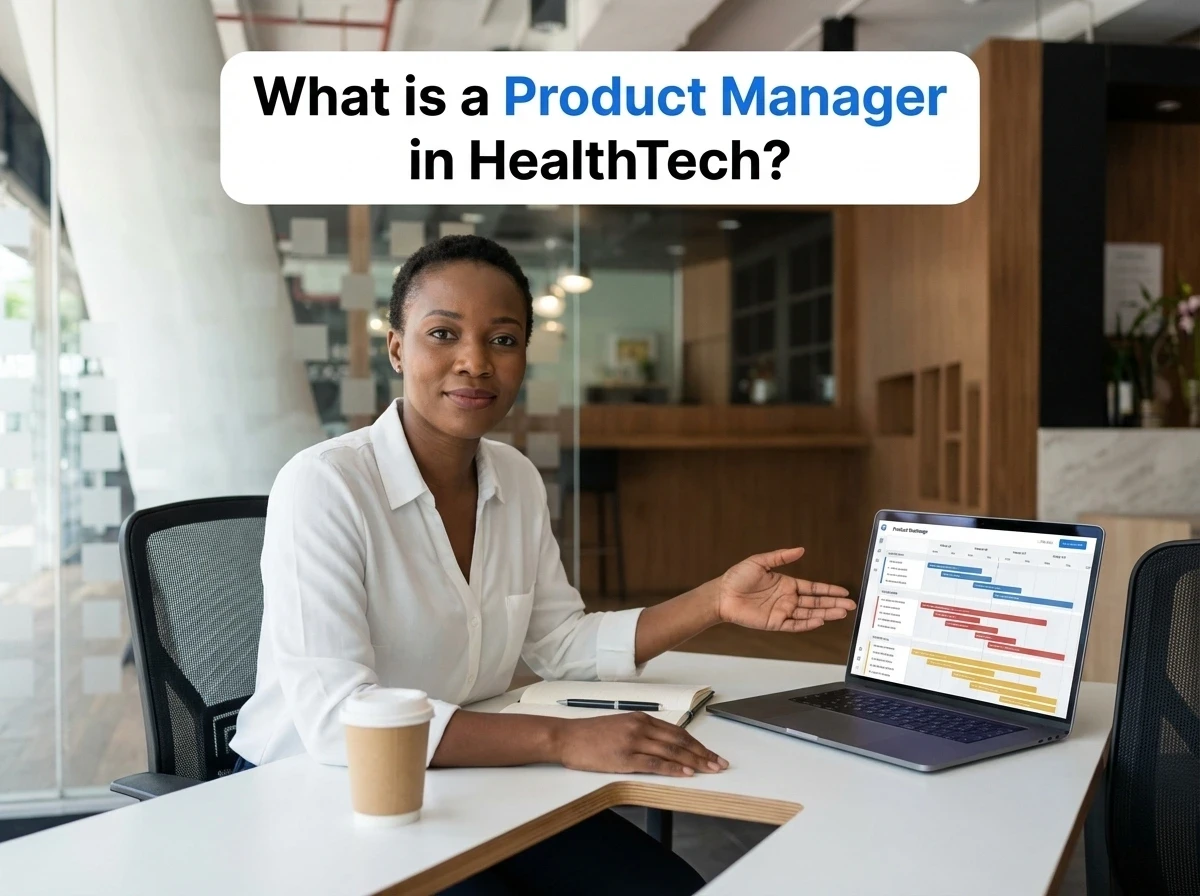
What is a Product Manager in HealthTech?
A Product Manager in HealthTech is the person accountable for a healthcare product's outcomes: what gets built, why it matters, who it serves, and how it performs once it's used in real-world clinical and operational settings. They translate a clinical or organisational problem into a clear product direction that teams can execute, and they remain responsible for the consequences of those choices, not just the process used to reach them.
This role exists because HealthTech products operate at the intersection of patient impact, clinical workflows, safety considerations, data sensitivity (where applicable), and commercial or organisational constraints. Someone has to hold the whole picture: aligning clinicians, operations, engineering, design, data, and compliance around a coherent product strategy, then making trade-offs when priorities conflict.
In practice, a Product Manager is an owner more than a coordinator. They're expected to take responsibility for risk-weighted decisions, define what "good" looks like in terms of outcomes and evidence, and ensure the product evolves safely and sustainably across its lifecycle, whether that lifecycle is primarily software-led, hardware-constrained, or a combination of both.
🔍 How this role differs in HealthTech
In many technology sectors, product management can focus heavily on speed, iteration, and optimisation. In HealthTech, the primary constraint is rarely velocity alone. The cost of being wrong is higher. Decisions can affect patient safety, clinical efficiency, regulatory exposure, or organisational trust. This changes how Product Managers assess trade-offs, sequence delivery, and define acceptable risk.
HealthTech Product Managers also operate in environments with more legitimate veto power than typical consumer or enterprise tech. Clinical leaders, regulatory or compliance functions, operations, IT, procurement, and commercial teams may all influence whether a product direction is viable. The Product Manager must integrate these perspectives into a single direction without defaulting to consensus or deferring responsibility.
As a result, strong Product Managers in HealthTech aren't judged only on outputs or delivery cadence, but on decision quality: whether problems are correctly framed, risks are surfaced early, constraints are respected, and the product can be adopted, maintained, and trusted over time.
🎯 Core responsibilities in HealthTech
Day to day, a HealthTech Product Manager is accountable for keeping the product pointed at the right problem and moving in a direction that remains safe, compliant, and deliverable. That means defining the product's intended outcomes, making prioritisation decisions that balance patient impact with operational feasibility, and ensuring delivery teams understand not just what to build, but the consequences of building it incorrectly.
A typical week involves navigating decisions under constraint: a feature that improves user experience might introduce clinical risk; a faster release might increase incident likelihood; a data integration might unlock value but create governance complexity. The Product Manager is expected to make these calls transparently, document rationale where required, and put appropriate controls around change, especially when the product touches regulated or safety-critical workflows.
They also carry accountability beyond launch. HealthTech products must be monitored, supported, and iterated with care: handling incidents, learning from complaints, reviewing metrics that indicate harm or inequity, and coordinating improvements without destabilising services that people rely on.
🧩 Skills and competencies for HealthTech
Core Skill | HealthTech specific requirement | Reason or Impact |
|---|---|---|
Outcome ownership | Define success in terms that reflect patient, clinical, and operational outcomes, not only engagement metrics | Prevents "busy work" roadmaps and keeps decisions anchored to real-world impact and service performance |
Risk-based decision-making | Weigh product value against clinical, safety, and reputational risk, and know when "do nothing" is the safer choice | Reduces avoidable harm and supports defensible prioritisation when stakeholders disagree |
Evidence and evaluation mindset | Treat changes as hypotheses, use meaningful measures, and align evaluation to clinical/operational reality | Improves credibility with clinical and operational partners and reduces the chance of shipping unproven interventions |
Stakeholder leadership | Work with groups who may have statutory, governance, or operational authority rather than optional influence | Enables progress without bypassing necessary approvals, and avoids late-stage blockers that stall delivery |
Data stewardship judgement | Make careful calls on data minimisation, access, retention, auditability, and consent expectations | Protects trust, reduces compliance exposure, and avoids downstream rework caused by poor early decisions |
Systems thinking | Understand pathways and dependencies across providers, teams, integrations, and environments | Prevents local optimisations that break workflows upstream/downstream and supports safer scaling |
Clarity under ambiguity | Turn complex domain inputs into a coherent product direction and communicate trade-offs plainly | Keeps delivery focused, improves alignment, and reduces "silent misinterpretation" in high-stakes contexts |
💷 Salary ranges in UK HealthTech
Salary in UK HealthTech product roles is mostly driven by scope and risk rather than the job title alone. The biggest levers are: how safety-critical the product is, the size and maturity of the organisation, whether the role owns a full product line versus a bounded area, responsibility for clinical or governance-heavy change, and the expectation to support live services (including incident response). Location still matters (London and South East roles tend to price higher) but the gap narrows for specialist HealthTech experience and senior accountability.
Experience level | Estimated annual salary range | What drives compensation |
Junior | London & South East: £35,000–£50,000 | Entry scope, support vs ownership, exposure to regulated workflows, and whether the role is closer to delivery support or true product accountability |
Mid-level | London & South East: £50,000–£70,000 | Owning a product area end-to-end, independence in prioritisation, stakeholder complexity, and accountability for measurable outcomes |
Senior | London & South East: £70,000–£95,000 | Autonomy, risk-weighted judgement, influence across multiple teams, and responsibility for live performance, incidents, and longer-term roadmap |
Lead | London & South East: £95,000–£120,000 | Leading a product domain or multiple PMs, portfolio prioritisation, higher governance burden, and ownership of strategy with delivery accountability |
Head / Director | London & South East: £120,000–£170,000Rest of UK: £105,000–£155,000 | Organisational-level accountability, investment decisions, managing multiple product lines, clinical/operational executive stakeholder management, and responsibility for product operating model |
Beyond base salary, HealthTech compensation commonly includes a performance bonus (often tied to company or service outcomes), equity (more typical in venture-backed organisations), and enhanced pension/benefits in public or public-adjacent settings. On-call isn't universal for Product Managers, but where roles are tightly coupled to live, safety-relevant services, compensation may be influenced by incident participation expectations, product criticality, and how frequently the organisation runs major releases or handles production incidents.
🚀 Career pathways
Many HealthTech Product Managers enter from adjacent roles where they already understand the domain's constraints: clinical operations, implementation, health data, service delivery, quality and safety, business analysis, or customer-facing roles within HealthTech suppliers. Others transition from general tech product management and add domain depth by working closely with clinical and governance partners, learning how value is measured in care settings, and developing comfort with risk-led decisions.
Progression is less about collecting bigger titles and more about expanding ownership. Early on, you may own a small feature area with clear boundaries; later, you own an end-to-end journey, then a product line with multiple teams, and eventually a portfolio where trade-offs are strategic, multi-year, and resource-constrained. The strongest signal of readiness for the next step is consistent judgement under constraint: making difficult prioritisation calls, handling incidents calmly, and improving outcomes without increasing risk.
❓ FAQ
Do I need a clinical background to be a Product Manager in HealthTech?
No, but you do need respect for clinical realities and the ability to learn them quickly. Hiring teams typically look for evidence you can work credibly with clinicians, handle safety-sensitive trade-offs, and translate complex workflows into product decisions without oversimplifying.
How do interviews assess "HealthTech judgement" rather than generic product skills?
Expect scenario-heavy questions: prioritising when a change could affect safety, responding to incidents, or shipping under governance constraints. Strong candidates explain their decision logic, what evidence they'd seek, and how they'd involve clinical, operational, and governance stakeholders without losing momentum.
Will I be on-call as a Product Manager in HealthTech?
Often not in the formal rota sense, but you may be expected to support incident response for your product, especially if it underpins care delivery or patient communications. The expectation varies with product criticality, organisational maturity, and whether the service operates with strict uptime and safety monitoring requirements.
🔎 Find your next role
Ready to take ownership of meaningful products in HealthTech? Search Product Manager roles on Meeveem and find a position that matches your scope, impact, and level.
You might also like