Published Date: December 30, 2025
Updated Date: December 30, 2025
What is a Product Designer in HealthTech?
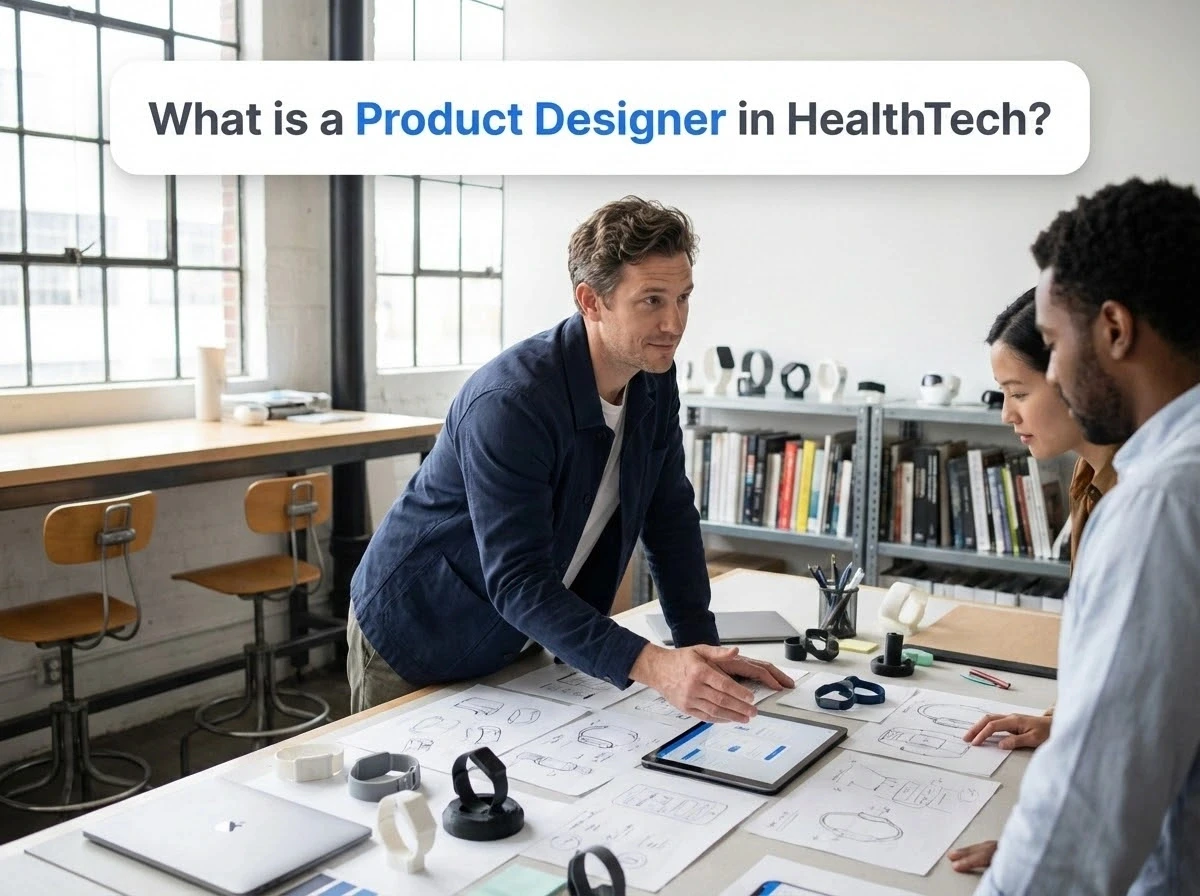
A Product Designer in HealthTech shapes how digital health products work for real people: patients, clinicians, carers, and administrators. Their job is to make sure these products are usable, safe, accessible, and effective in the places where care actually happens. They don't just "make screens." They own the quality of the user experience as a product outcome, from first use through to long-term adoption, and they're expected to defend decisions that affect behaviour, risk, and trust.
This role exists because HealthTech products sit at the intersection of complex human situations (stress, urgency, vulnerability), operational realities (clinical workflows, constrained time, handovers), and sensitive data. Someone has to hold the line on what the product is asking users to do, what can go wrong, and what the organisation is implicitly promising when it ships a feature. The Product Designer carries that ownership, working across product, engineering, clinical stakeholders, and research, so the product doesn't just function but functions responsibly.
🔍 How this role differs in HealthTech
In many industries, product design can optimise for convenience, delight, conversion, or speed to market with relatively contained downside. In HealthTech, the same design decision can influence clinical workload, patient comprehension, adherence, and escalation behaviours, sometimes with real-world consequences. That changes what "good" looks like: clarity often beats cleverness, and reliability often beats novelty.
HealthTech also raises the bar on data sensitivity and consent. Users may be navigating highly personal information, and the product may sit inside ecosystems that include clinical systems, operational processes, and governance. A Product Designer therefore makes decisions with stronger constraints: accessibility expectations are non-negotiable, content must withstand scrutiny, and designs must be robust across a wider range of user capability, stress levels, and environments (e.g. busy wards, low connectivity, shared devices).
Finally, the organisational context is often more multidisciplinary. Designers regularly collaborate with clinicians, clinical safety, information governance, and service teams, not as occasional reviewers but as ongoing partners who shape what is acceptable, defensible, and supportable.
🎯 Core responsibilities in HealthTech
Day to day, a Product Designer in HealthTech is accountable for turning messy reality into a coherent product experience without misrepresenting what the system can do. That means owning user journeys end to end, aligning with product strategy, and making sure design choices remain consistent as features evolve across multiple squads, services, or platforms.
Much of the work is decision-making under constraints: incomplete evidence, competing stakeholder priorities, and strict operational requirements. The designer is expected to navigate trade-offs transparently, protecting user safety and comprehension, minimising clinical burden, and still enabling the organisation to ship value. They translate user needs into product decisions that engineering can build, that clinical stakeholders can support, and that users can understand without specialist knowledge.
A strong HealthTech Product Designer also spends time reducing ambiguity: clarifying definitions (what counts as "urgent"), preventing harmful misinterpretation, and ensuring the product behaves predictably when things go wrong (errors, missing data, edge cases, and handoffs). In practice, they become a custodian of trust: if the product confuses or misleads, adoption collapses, and in HealthTech, confusion can be more than a UX issue.
🧩 Skills and competencies for HealthTech
Core Skill | HealthTech specific requirement | Reason or Impact |
|---|---|---|
Judgement under risk | Ability to prioritise safety, clarity, and defensibility when evidence is partial and constraints are heavy | Prevents designs that "work in a demo" but fail in real care settings, where mistakes and ambiguity carry higher consequences |
Workflow empathy | Understanding how clinical and operational workflows actually run (handoffs, time pressure, interruptions, documentation) | Reduces friction and rework, avoids shifting burden onto frontline teams, and improves sustained adoption |
Accessible communication | Designing for varied literacy, stress, disability, language needs, and device constraints | Improves comprehension and equity, and lowers the chance that users misinterpret instructions or status |
Stakeholder leadership | Confidence to align product, engineering, clinical, and governance stakeholders around a clear decision | Prevents slow "design by committee" outcomes and ensures the team can ship with shared accountability |
Systems thinking | Mapping dependencies across services, data flows, permissions, and edge cases | Avoids brittle experiences and helps the product behave consistently across complex ecosystems |
Evidence discipline | Ability to weigh qualitative insight, analytics, operational feedback, and safety considerations together | Produces decisions that are explainable and auditable, not based on preference or the loudest voice |
Boundary-setting | Holding a clear bar for what is safe, usable, and supportable, even when delivery pressure rises | Protects users and the organisation from avoidable incidents, churn, and reputational damage |
💷 Salary ranges in UK HealthTech
Pay for Product Designers in UK HealthTech typically reflects the breadth of ownership more than the craft alone. The biggest drivers are: the criticality of the product (patient-facing vs internal tooling), the complexity of clinical workflows, the strength of regulated constraints, the degree of autonomy (single squad vs portfolio), and whether the role includes line management or org-wide standards. Location still matters, especially London and the South East, although some HealthTech employers benchmark nationally for remote roles.
Experience level | Estimated annual salary range | What drives compensation |
Junior | London & South East: £30,000–£40,000 | Level of supervision, scope of features owned, and how quickly the designer can work with evidence and constraints without heavy guidance |
Mid-level | London & South East: £45,000–£65,000 | Ownership of end-to-end journeys, ability to handle complex stakeholders, and responsibility for decision quality (not just delivery throughput) |
Senior | London & South East: £65,000–£95,000 | Leading ambiguous problem spaces, shaping product direction, mentoring, and delivering defensible trade-offs in sensitive user contexts |
Lead | London & South East: £80,000–£110,000 | Multi-squad influence, design strategy, quality governance, and the ability to raise organisational standards while keeping delivery moving |
Head / Director | London & South East: £95,000–£140,000Rest of UK: £85,000–£125,000 | Org-wide accountability (design function, hiring, operating model), portfolio outcomes, executive stakeholder management, and risk ownership |
Beyond base salary, total compensation commonly includes pension contributions and standard benefits. Some employers add performance bonuses, and venture-backed HealthTech companies may offer equity (with value varying widely by stage and terms). On-call allowances are uncommon for Product Designers specifically. Where they exist, it's usually tied to incident response expectations in smaller teams or highly operational services, and it tends to be modest compared with engineering on-call. Total compensation moves most with company stage, scarcity of domain experience, leadership scope, and how close the role sits to high-impact clinical or patient-facing pathways.
🚀 Career pathways
Common entry points include generalist product design roles, UX/UI roles moving into product ownership, or service/interaction design backgrounds transitioning into longer-term product accountability. In HealthTech, it's also realistic to enter via adjacent domains like research, content, or clinical-facing operations, then grow into product design once you can demonstrate strong judgement and user advocacy.
Progression is typically marked by expanding ownership: from well-scoped components to end-to-end journeys to complex cross-service experiences that require alignment across teams and governance. Seniority grows when you're trusted to make decisions that hold up under scrutiny, when you can explain trade-offs, anticipate failure modes, and protect users while still enabling the organisation to ship.
At Lead level, responsibility broadens again. You're no longer only responsible for your product area's experience but for the design system, decision quality, and how design scales across squads. Head/Director progression is less about designing artefacts and more about building the conditions for good design: team structure, standards, hiring, stakeholder alignment, and measurable product outcomes.
❓ FAQ
Do I need clinical experience to be hired as a Product Designer in HealthTech?
No, but you do need evidence that you can learn domain constraints quickly and make responsible decisions under them. Hiring teams tend to look for clear reasoning, strong collaboration with specialists, and humility about what you don't yet know. The best signal is a portfolio that shows how you handled risk, ambiguity, and stakeholder tension.
What will my portfolio be judged on for HealthTech roles, beyond visuals?
Expect scrutiny on decision-making: what you chose not to do, how you handled safety/clarity trade-offs, and how you validated understanding for diverse users. Teams also look for how you partnered with product and engineering to ship, and how you responded when evidence conflicted or timelines tightened.
Will I be expected to do on-call or incident support as a Product Designer?
Usually not as a formal rota, but some HealthTech teams expect designers to participate in incident reviews or post-incident fixes, especially when issues relate to user misunderstanding or workflow breakdown. If a role mentions operational responsibilities, ask exactly what "support" means, how often it occurs, and whether it is compensated.
🔎 Find your next role
Ready to apply your product judgement to real-world health outcomes? Search Product Designer roles in HealthTech on Meeveem.
You might also like