Published Date: January 1, 2026
Updated Date: January 1, 2026
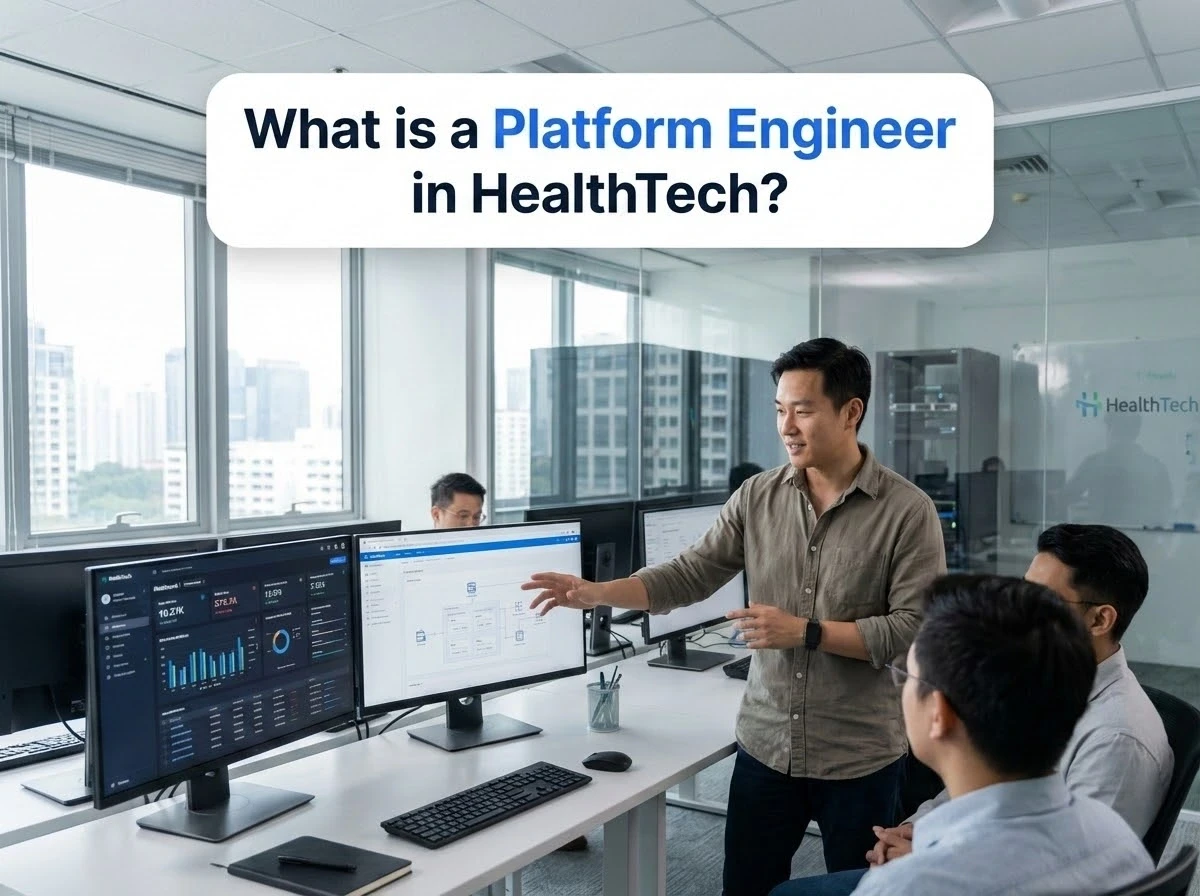
What is a Platform Engineer in HealthTech?
A Platform Engineer in HealthTech owns the "paved road" that product teams rely on to build, deploy, and operate clinical or patient-facing software safely and reliably. Rather than shipping end-user features directly, they're accountable for the internal platform capabilities: runtime environments, delivery workflows, guardrails, and operational patterns that make multiple product teams faster without increasing risk.
This role exists because modern HealthTech systems are complex by default. You're dealing with sensitive data, high availability expectations, multiple environments, and the need to prove how systems are controlled and changed. A Platform Engineer reduces that complexity for other engineers by turning hard operational requirements into repeatable, supported platform choices so teams can deliver confidently while staying inside security, reliability, and governance boundaries.
The defining characteristic is ownership. You own production outcomes, you own the constraints, and you own the experience of the engineers who consume the platform. Tools and practices matter, but only as a consequence of that responsibility.
🔍 How this role differs in HealthTech
In many SaaS or consumer environments, platform decisions can optimise heavily for speed and developer convenience, and the cost of a mistake is often "just" revenue, reputation, or churn. In HealthTech, the blast radius is different. Service disruption can affect clinical workflows, patient access, triage pathways, or decision-making. Data mishandling can create serious privacy and safety consequences. And proving you run a controlled environment can matter as much as the technology itself.
That changes the default posture of platform engineering. You spend more time balancing delivery speed with demonstrable controls, reducing variability between teams, and building platforms that are operable by people who rotate on-call. "Good enough" infrastructure is rarely good enough if it can't be explained, audited, recovered, and consistently reproduced.
HealthTech also tends to have more integration surfaces: downstream partners, legacy environments, and organisational boundaries. This means a Platform Engineer often acts as a pragmatic translator between product engineering, security, operations, and compliance, keeping the platform usable whilst making risk visible and manageable.
🎯 Core responsibilities in HealthTech
Day to day, a Platform Engineer is accountable for the reliability and usability of the shared platform that product teams build on. That includes setting sensible defaults (so teams don't have to reinvent delivery and operations), deciding where self-service is safe, and where tighter controls are necessary. You make decisions under constraints: limited change windows, strict identity and access expectations, segregated environments, and clear recovery requirements.
A typical week blends proactive work and operational reality. You might improve the "golden path" for releasing a service, then spend time validating that the change management and access model still holds under real usage. You respond to incidents and near-misses not as isolated fixes, but as signals that the platform needs better guardrails, better observability, or clearer ownership boundaries. Trade-offs are constant: standardisation versus flexibility, tight governance versus developer friction, and "move fast" versus "don't create a new class of failure."
Crucially, you don't just build platform components. You run them. In HealthTech, that often means being directly responsible for platform uptime, upgrade risk, operational readiness, and how quickly teams can recover when something goes wrong.
🧩 Skills and competencies for HealthTech
Core Skill | HealthTech specific requirement | Reason or Impact |
|---|---|---|
Operational ownership | Treat reliability and recovery as first-class deliverables, not "ops work" | HealthTech platforms are often business-critical. Sustained instability erodes trust and can disrupt care pathways and service access. |
Risk-based decision making | Make and document trade-offs that account for data sensitivity, availability, and change risk | The best solution is the one that is safe, repeatable, and explainable, not merely the most elegant technically. |
Secure-by-default thinking | Design access, environment boundaries, and deployment paths so the safe option is the easy option | Reduces accidental exposure and makes day-to-day engineering compatible with strict security expectations. |
Systems thinking | Optimise the whole delivery and runtime system across teams, not a single service | HealthTech outcomes depend on end-to-end reliability across multiple components, integrations, and operational handoffs. |
Stakeholder fluency | Communicate platform constraints and capabilities clearly to security, product engineering, and leadership | Misalignment creates shadow platforms and inconsistent controls. Clarity keeps teams on one paved road. |
Incident literacy | Run calm, structured response and convert learning into platform improvements | High-severity incidents demand predictable execution. Learning loops reduce repeat failures and improve safety and resilience. |
Pragmatic standardisation | Create standards with escape hatches and clear ownership rules | Overly rigid platforms get bypassed. Overly flexible ones become ungovernable, increasing operational risk. |
Evidence and audit readiness | Build ways to show "what changed, who approved it, and how it's controlled" | In HealthTech, being able to demonstrate controls can be as important as the controls themselves. |
💷 Salary ranges in UK HealthTech
Platform engineering pay in HealthTech is primarily driven by scope and accountability: how many teams and services you enable, how critical the systems are, how strong the security and governance constraints are, and whether the role carries meaningful out-of-hours responsibility. Location still matters (especially London and the South East), but seniority and the operational criticality of the platform often outweigh pure geography. Roles that own production reliability and a well-defined on-call rotation usually command higher compensation than roles focused on build-only enablement.
Experience level | Estimated annual salary range | What drives compensation |
Junior | London & South East: £45,000–£60,000 | Depth of supported stack, exposure to production responsibility, and how quickly you can operate safely under supervision. |
Mid-level | London & South East: £60,000–£85,000 | Ownership of platform components end-to-end, ability to standardise workflows, and confidence operating production services. |
Senior | London & South East: £85,000–£110,000 | Leading reliability improvements, designing guardrails, handling complex incidents, and setting practical platform standards. |
Lead | London & South East: £105,000–£135,000 | Owning platform direction, influencing multiple teams, defining operating model (including on-call), and reducing organisational risk. |
Head / Director | London & South East: £125,000–£170,000 | Accountability for platform outcomes across the organisation: reliability, security posture, cost governance, and delivery effectiveness. |
Beyond base salary, total compensation in UK HealthTech commonly includes some mix of bonus (often tied to company and delivery outcomes), equity (more common in venture-backed firms), and an on-call allowance where platform engineers carry pager duty for critical services. Variation is driven by how intense on-call is (frequency, severity, recovery expectations), how regulated and high-stakes the environment is, whether the platform spans multiple products and environments, and whether you're expected to be the final escalation point for outages.
🚀 Career pathways
Many Platform Engineers enter HealthTech from DevOps, SRE, infrastructure engineering, or backend engineering roles where they've taken real responsibility for production. A common entry point is owning CI/CD reliability, environment provisioning, or observability for a product team, then gradually shifting from "helping one team" to "building the shared road for many teams."
Progression tends to follow expanding ownership boundaries. Early on, you're trusted with a component. Later, you're trusted with a capability (for example, how all services are released, monitored, or recovered). Senior progression often comes from reducing risk whilst increasing speed: fewer bespoke pathways, clearer guardrails, stronger operational readiness, and measurable improvements in developer experience.
At Lead and Head/Director levels, the work becomes as much about operating model as technology: setting the contract between platform and product teams, defining sensible standards, building sustainable on-call and incident response, and making sure platform investment maps to patient and clinical impact without creating bottlenecks.
❓ FAQ
Do HealthTech Platform Engineer interviews expect deep healthcare domain knowledge? Usually not. Interviewers care more about how you handle risk, reliability, and sensitive-data constraints than whether you know specific clinical standards. If you can show sound judgement, operational maturity, and respect for governance, you can learn the domain on the job.
How can I prove I'm "platform" rather than "DevOps support"? Frame your work around ownership and outcomes: what platform capability you owned, which teams you enabled, what you standardised, and how you reduced incidents or deployment risk. Strong signals include building self-service paths, defining guardrails, and improving reliability without becoming a ticket queue.
How much on-call should I expect in a HealthTech platform role? It varies widely. Some teams run a light rotation focused on platform components. Others provide 24/7 cover for business-critical services with stricter response expectations. Ask directly about rotation frequency, escalation paths, incident volume, and whether time-off-in-lieu or allowances are in place.
🔎 Find your next role
Ready to take ownership of the platforms that HealthTech teams rely on? Search Platform Engineer roles on Meeveem.
You might also like