Published Date: January 1, 2026
Updated Date: January 1, 2026
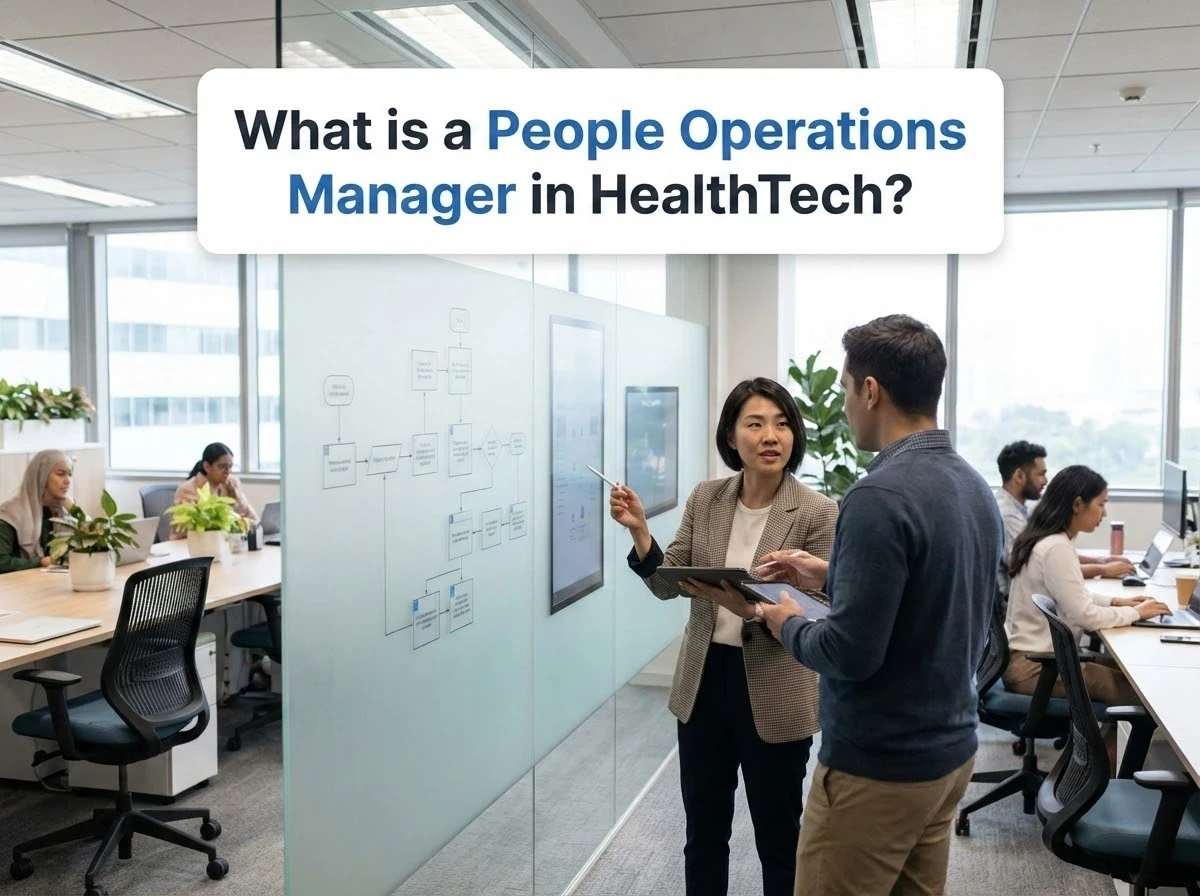
What is a People Operations Manager in HealthTech?
A People Operations Manager in HealthTech owns the day-to-day "engine room" of how people are hired, supported, paid, developed, and treated fairly, at a standard that stands up to scrutiny. They sit at the intersection of employee experience, operational rigour, and risk management, ensuring the organisation can scale without breaking trust: trust with staff, trust with patients and customers, and trust with partners.
This role exists because HealthTech companies grow quickly whilst operating in environments where mistakes carry more than internal consequences. It's not just about running HR processes; it's about being accountable for the reliability of those processes. When onboarding isn't compliant, when data is mishandled, when policies don't match reality, or when managers improvise under pressure, the organisation accumulates risk. The People Operations Manager is the person who prevents that risk from becoming disruption.
At its best, the role is defined less by "HR tasks" and more by ownership: owning the integrity of the employee lifecycle, the consistency of decisions, the quality of people data, and the operational controls that make the company safe and scalable.
🔍 How this role differs in HealthTech
In many tech sectors, People Ops is primarily judged on efficiency and employee experience. In HealthTech, those still matter, but the baseline expectations are higher because the context is higher-stakes. Decisions about access, data handling, training, and conduct often have a closer line-of-sight to real-world outcomes, whether that's clinical workflows, vulnerable users, or essential services.
That changes the role in subtle but important ways. People Operations in HealthTech tends to be more control-oriented: clearer audit trails, tighter handling of personal data, more structured onboarding and training, and less tolerance for "informal" people processes. Even when the role isn't directly responsible for regulatory compliance, it frequently has to make people processes compatible with compliance-heavy environments, without turning the employee experience into bureaucracy.
HealthTech also brings a more complex workforce mix than many software businesses: clinical and non-clinical staff, regulated and non-regulated roles, shift-based teams alongside office-based teams, and a higher likelihood of third-party requirements (customer audits, supplier checks, training expectations). People Operations becomes the translator between operational reality and scalable people standards.
🎯 Core responsibilities in HealthTech
A People Operations Manager typically starts the day by managing flow: hires coming in, contracts going out, a payroll deadline approaching, a policy question from a manager, and a sensitive employee issue that needs a response that is both humane and consistent. The accountability is to keep the organisation moving whilst preventing avoidable risk.
In HealthTech, trade-offs are constant. A hiring manager may want someone to start immediately; People Ops must decide what can be accelerated without creating compliance gaps, access-control mistakes, or incomplete checks. A team may want more flexibility; People Ops must design it so it remains equitable across roles that cannot work remotely or that require specific coverage. A leader may want to "make an exception"; People Ops must assess whether the exception becomes a precedent that undermines fairness or creates legal exposure.
This role often sits close to the practical decisions that shape culture. Not through slogans, but through operational choices: what gets documented, what gets enforced, what gets escalated, what gets automated, and what is handled with discretion. Over time, the role becomes a key internal operator, someone who creates clarity in messy moments and keeps the company's people systems credible as headcount grows.
🧩 Skills and competencies for HealthTech
Core Skill | HealthTech specific requirement | Reason or Impact |
|---|---|---|
Risk judgement | Ability to spot people-process failure modes (access, training, documentation, decision inconsistency) before they surface | Reduces operational disruption and protects trust in environments where errors can carry higher downstream consequences |
Policy ownership | Writing policies that are practical for mixed workforces (clinical/non-clinical, shift/office, multi-site) | Prevents "paper policies" that look compliant but fail in real delivery, which is where risk accumulates |
Data stewardship | Handling employee data with strong privacy instincts and disciplined access controls | People data is sensitive by default; poor handling creates legal, reputational, and internal trust issues |
Operational design | Building repeatable lifecycle processes that hold up under audit and scale pressure | HealthTech growth exposes weak process quickly; scalable ops prevents constant firefighting |
Manager enablement | Coaching managers to make consistent decisions within constraints rather than improvising | Improves fairness and reduces escalation load by making frontline decisions more reliable |
Stakeholder navigation | Working effectively with Finance, Legal, Security/IT, and clinical/regulated teams | People Ops decisions often depend on cross-functional controls (payroll, access, training, approvals) |
Conflict handling | Calm, structured response to sensitive ER situations and conduct concerns | Helps resolve issues without triggering avoidable legal risk, cultural damage, or inconsistent precedent |
Systems ownership mindset | Treating HRIS, payroll inputs, and reporting as critical infrastructure | In HealthTech, weak people data undermines workforce planning, accountability, and confidence in decision-making |
💷 Salary ranges in UK HealthTech
People Operations Manager pay in UK HealthTech is typically shaped by scope and operational risk more than title alone. The biggest drivers are: whether you own payroll and benefits end-to-end, whether you manage ER casework (or only triage/escalate), whether you lead a team, the complexity of the workforce (multi-site, shift patterns, international entities), the degree of process maturity you inherit, and expectations around availability during incidents or critical operational periods. Location still matters, but the gap narrows when roles are national and remote-friendly.
Experience level | Estimated annual salary range | What drives compensation |
Junior | London & South East: £35,000–£45,000 | Size of company, complexity of admin workload, exposure to contracts/payroll/HRIS, and how independent the role is expected to be |
Mid-level | London & South East: £45,000–£58,000 | Ownership of core lifecycle processes, payroll responsibility, HRIS/data quality accountability, and the amount of manager support vs policy ownership |
Senior | London & South East: £58,000–£72,000 | Managing complex ER situations, leading cross-functional improvements, multi-site or regulated workforce complexity, and accountability for operational controls |
Lead | London & South East: £70,000–£85,000 | Team leadership, end-to-end People Ops ownership, multi-entity operations, high volume hiring/onboarding, and measurable improvements to reliability and risk reduction |
Head / Director | London & South East: £85,000–£115,000 | Org-wide accountability (People Ops + broader People function), governance, senior stakeholder management, operating model design, and responsibility for audit-ready processes |
Beyond base pay, packages commonly include a performance bonus (often tied to company and functional goals), pension, and enhanced private medical cover. Equity is more common in venture-backed HealthTech, with larger grants typically tied to seniority and how directly the role affects scale and risk reduction. On-call allowances are not standard for People Ops, but some HealthTechs do expect availability during major operational incidents, workforce-critical events, or high-risk ER situations. This expectation (and the intensity of it) can influence both base and variable compensation.
🚀 Career pathways
Entry points are often through HR administration, People Coordinator roles, payroll/benefits operations, recruitment operations, or office/operations roles that grew into people accountability. HealthTech also attracts people who have worked in healthcare organisations and bring strong operational discipline, especially around process, documentation, and workforce complexity, then adapt that mindset to faster-moving product companies.
Progression tends to follow ownership. Early on, you're trusted with clean execution: accurate contracts, dependable onboarding, reliable payroll inputs, and correct documentation. As you grow, you take on end-to-end responsibility for lifecycle design, then for cross-functional dependencies (Finance, IT/security, Legal), and eventually for operating model decisions: what gets standardised, what can be decentralised to managers, and where controls must be non-negotiable.
The step from Senior to Lead and then to Head/Director is typically marked by your ability to build systems that outlast you: clear decision frameworks, scalable self-service, reliable people data, and a team that delivers consistently under pressure.
❓ FAQ
1) Will I be expected to handle employee relations directly in a HealthTech People Ops Manager role?
Often you'll at least triage and structure ER issues, even if a People Partner or external adviser supports the most complex cases. In smaller HealthTechs, People Ops may own ER day-to-day because there isn't a separate partnering function. In interviews, ask where ER accountability sits and what "escalation" looks like in practice.
2) How do HealthTech employers assess a People Ops Manager's impact beyond "keeping things running"?
They tend to look for reliability and risk reduction: fewer payroll errors, faster but compliant onboarding, cleaner people data, consistent manager decisions, and fewer recurring process failures. Strong candidates can explain a messy lifecycle problem they inherited, the trade-offs they made, and how they made the system more predictable without adding unnecessary friction.
3) Do People Ops Managers in HealthTech ever have on-call expectations?
It's not typical in the same way as engineering or clinical operations, but some businesses expect responsiveness during critical incidents, urgent safeguarding-style concerns, or workforce events that threaten service delivery. The key is whether the expectation is occasional, planned, and compensated, or frequent and informal. Clarify boundaries and escalation routes before accepting.
🔎 Find your next role
Ready to take ownership of the people engine in a HealthTech business? Search People Operations Manager roles on Meeveem.
You might also like