Published Date: January 3, 2026
Updated Date: January 3, 2026
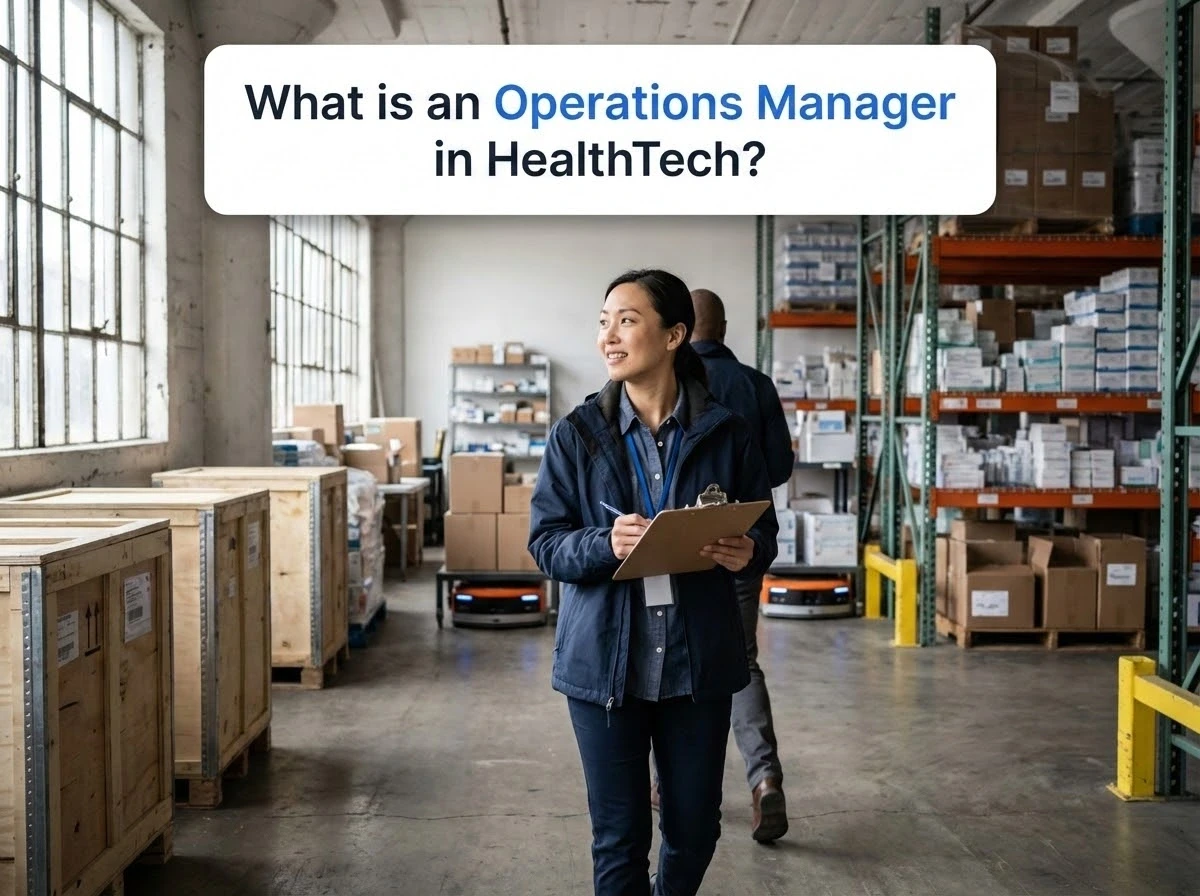
What is an Operations Manager in HealthTech?
An Operations Manager in HealthTech is accountable for turning a health product or service into a reliable, repeatable, safe operation. Product teams decide what the service should do, and clinical teams decide what good care looks like. The Operations Manager owns how the organisation delivers that service day-to-day, at the required quality, within budget, and with the right controls.
This role exists because HealthTech "runs" in the real world. Users don't experience a roadmap; they experience whether onboarding works, whether issues are resolved quickly, whether services are staffed appropriately, and whether delivery is consistent across weeks, partners, and patient cohorts. The Operations Manager is the owner of that operational reality: performance, service continuity, team execution, and the operational risks that come with scaling care- or data-adjacent services.
At its best, this is not a task-driven coordination job. It's a responsibility-driven role: someone must be clearly accountable when service levels slip, when processes create safety or privacy risk, when operational cost drifts, or when growth outpaces capacity.
🔍 How this role differs in HealthTech
In many software industries, operations can be optimised primarily for efficiency and customer experience. In HealthTech, the same decisions are constrained by higher downside risk, sensitive data, and stricter expectations around governance and auditability. "Move fast" still matters, but it has to coexist with traceability, controlled change, and safe escalation paths.
HealthTech operations also tends to be more interdependent. The operation may rely on clinicians, suppliers, external service partners, or public-sector interfaces, and those dependencies introduce failure modes that look very different from pure SaaS. A small operational gap (an unclear handover, an unowned queue, a training lag) can become a patient-impacting delay, a safeguarding concern, or a compliance incident rather than just a support ticket.
As a result, the Operations Manager is often closer to risk ownership than in other tech sectors: designing the operating model so it remains safe under load, not just efficient when everything goes to plan.
🎯 Core responsibilities in HealthTech
Day to day, an Operations Manager in HealthTech is accountable for whether the service is "in control." That means they continuously balance demand, capacity, quality, and cost whilst keeping delivery aligned with clinical expectations and internal governance. They notice where performance is degrading before it becomes visible externally, and they make calls on trade-offs: when to slow growth to protect quality, when to add constraints to reduce risk, and when to escalate because the system is no longer operating safely.
They also tend to be the person who makes operational complexity survivable for everyone else. When a company scales, exceptions multiply: edge-case users, partner-specific workflows, urgent cases, and staffing gaps. The Operations Manager turns those into a coherent operating rhythm (clear ownership, measurable service levels, workable rotas where relevant, and incident patterns that lead to prevention rather than repeated firefighting).
In HealthTech, operational decisions are rarely "best practice" exercises. They are judgement calls under constraints: regulated or contractual commitments, data sensitivity, clinical oversight, limited hiring velocity, and the real human impact of delays or mistakes. The Operations Manager is measured by outcomes: continuity, responsiveness, quality signals, and the organisation's ability to deliver consistently as complexity increases.
🧩 Skills and competencies for HealthTech
Core Skill | HealthTech specific requirement | Reason or Impact |
|---|---|---|
Accountability under risk | Comfort owning outcomes where the cost of failure can be clinical, reputational, or contractual, not just commercial | Drives faster, clearer decisions on escalation, controls, and when to pause change to protect safety and trust |
Operational judgement | Ability to choose "good enough to ship" vs "must be controlled" in services that touch sensitive data or care pathways | Prevents avoidable incidents whilst still allowing the organisation to improve and scale |
Service delivery leadership | Leading teams that may include shift-based coverage, partner-facing roles, or clinically adjacent functions | Improves reliability by clarifying ownership, expectations, and execution discipline across handovers |
Process design with auditability | Creating workflows that are repeatable and explainable, with clear decision points and records where needed | Makes delivery resilient, reduces operational variance, and supports reviews when something goes wrong |
Stakeholder management | Aligning product, clinical, engineering, commercial, and external partners around one operating model | Reduces friction and prevents "gaps between teams" becoming user harm, missed SLAs, or compliance issues |
Data-driven performance management | Using operational signals (queues, cycle times, rework, incidents, quality checks) to run the service | Helps detect deterioration early and prioritise changes that improve safety, timeliness, and cost control |
Incident and escalation handling | Maintaining calm leadership when issues occur, with structured triage and learning loops | Protects continuity, reduces recurrence, and builds organisational trust in the operation |
Change management | Introducing new services, workflows, or tooling without destabilising delivery | Prevents launch-driven chaos and ensures the operation can absorb growth safely |
💷 Salary ranges in UK HealthTech
Operations Manager pay in UK HealthTech tends to track the true scope of operational ownership rather than the title alone. The biggest drivers are: whether you own a "service line" vs a subset of processes, how directly your operation touches time-critical or patient-facing delivery, whether you manage managers, how exposed the business is to audits/contractual commitments, and whether out-of-hours escalation or rota coverage is part of the operating model. Location still matters, but scope and risk typically explain more of the variation than years of experience on a CV.
Experience level | Estimated annual salary range | What drives compensation |
Junior | London & South East: £35,000–£45,000 | Usually supports a defined area (e.g., scheduling, onboarding, partner ops) with limited budget ownership; pay rises with clear ownership of KPIs and complexity |
Mid-level | London & South East: £45,000–£60,000 | Ownership expands to multiple workflows or a full operational "lane"; higher pay when the role carries service-level accountability and cross-team dependency management |
Senior | London & South East: £60,000–£80,000 | Compensation increases when you own service performance end-to-end, manage teams, run supplier/partner relationships, and are accountable for incident response and quality signals |
Lead | London & South East: £80,000–£105,000 | Often manages managers or multiple pods; pay reflects operational strategy, governance, budget influence, and responsibility for scaling without quality or compliance regression |
Head / Director | London & South East: £105,000–£150,000 | Highest ranges align to owning a major function (service delivery, clinical ops, platform ops), multi-site or multi-partner delivery, audit readiness, and high-stakes continuity obligations |
Typical add-ons vary by employer type and operating model. Many HealthTech businesses use annual bonuses tied to company and service performance, whilst some offer equity or share options (more common in venture-backed organisations and more meaningful at senior levels). On-call or out-of-hours allowances are most relevant where the Operations Manager is in an escalation rota for service continuity; total compensation rises when out-of-hours expectations are formal, frequent, and tied to regulated or contractual service levels.
🚀 Career pathways
Common entry points include customer operations, care coordination, NHS or provider operations, clinical administration leadership, service delivery roles in digital health, or operational roles in regulated industries where process control matters. Early on, progression comes from taking ownership of one measurable outcome: reducing backlog, stabilising a queue, improving handovers, or tightening a workflow so it performs reliably week after week.
As responsibility expands, the role shifts from "running processes" to "running systems." You start owning capacity planning, quality signals, escalation pathways, vendor dependencies, and how operations interfaces with product and clinical governance. The strongest progression is usually through breadth of ownership: moving from a single team to multiple teams, from internal execution to cross-partner delivery, and from local optimisation to building an operating model that holds under growth and change.
At Lead and Head/Director levels, the job becomes less about solving today's operational problem and more about making tomorrow's problems unlikely: designing controls, setting performance standards, building management capability, and making service reliability a company-wide discipline.
❓ FAQ
1) Will I be expected to join an out-of-hours rota in HealthTech operations?
Sometimes, but it depends on whether the organisation runs time-critical services or has contractual service levels that require escalation coverage. Ask how incident escalation works, how often it triggers, and whether out-of-hours expectations are formal (rota/allowance) or informal ("always reachable"). Clarity here is often a strong signal of operational maturity.
2) What will interviews actually test for in an Operations Manager role in HealthTech?
Expect to be assessed on judgement: how you handle competing priorities when quality, speed, and cost clash. Strong processes matter, but most teams want evidence you can stabilise delivery, run a team through change, and make decisions that reduce risk without freezing progress. Candidates who can speak in outcomes, not activities, tend to stand out.
3) I'm coming from general tech operations. What's the biggest gap to close for HealthTech?
Usually it's learning how to operate with higher consequence and tighter governance whilst still improving pace. You'll need comfort working alongside clinical stakeholders, handling sensitive data expectations, and designing workflows that are defensible when questioned. Demonstrate that you can build operational control, not just efficiency.
🔎 Find your next role
If you're ready to own outcomes in a mission-critical environment, search Operations Manager roles on Meeveem.
You might also like