Published Date: January 3, 2026
Updated Date: January 3, 2026
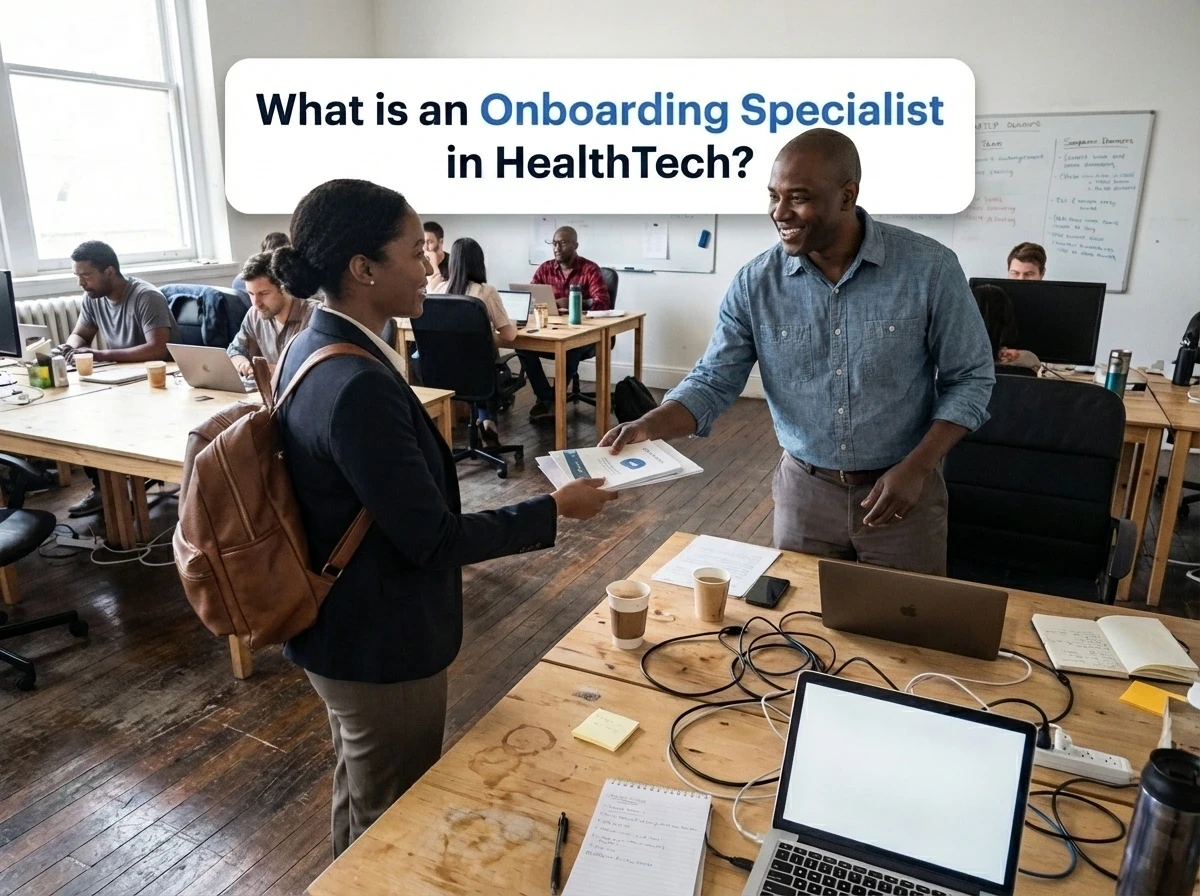
What is an Onboarding Specialist in HealthTech?
An Onboarding Specialist in HealthTech is responsible for getting a new healthcare customer from "signed" to "safely live and meaningfully using the product" with minimal risk, minimal disruption, and clear outcomes. The role exists because HealthTech isn't just shipping software; it's introducing change into clinical, operational, and data environments where errors can impact patient care, compliance, and trust.
At its core, the job is ownership: owning the onboarding plan, the pace, the decisions, and the customer's early success criteria. That means coordinating the right people at the right time, setting expectations that are realistic in healthcare settings, and making sure what's configured, migrated, trained, and launched matches how care is delivered in the real world.
🔍 How this role differs in HealthTech
In many SaaS industries, onboarding optimises for speed-to-value and product adoption. In HealthTech, onboarding must still deliver value quickly, but it also has to protect safety, privacy, and continuity of service. Data is often more sensitive, workflows are more complex, and the "blast radius" of a mistake can be much larger than in consumer tech or many B2B tools.
HealthTech onboarding tends to be more implementation-shaped: longer timelines, more stakeholders, heavier documentation, and more explicit controls around access, data handling, and change management. Decisions that would be "nice-to-have" in other sectors (like how you validate data, how you train end users, how you manage cutover) become central, because the customer's risk tolerance is lower and the cost of disruption is higher.
🎯 Core responsibilities in HealthTech
Day to day, an Onboarding Specialist is accountable for turning a messy, real customer environment into a controlled delivery plan: defining what "done" means, sequencing dependencies, and preventing scope drift that threatens timelines or safety. They spend a lot of time translating between worlds (commercial expectations, product constraints, and frontline realities) then making decisions that keep onboarding moving without compromising quality.
Trade-offs are constant. A customer might want to go live quickly, but data quality, permissions, or local workflow readiness may not support it. The Onboarding Specialist has to decide when to push forward with mitigations, when to pause, and how to communicate that decision so the customer feels supported rather than blocked. In HealthTech, success is rarely a single go-live moment; it's a controlled transition where users can operate confidently, escalation paths are clear, and early usage patterns indicate real adoption, not just logins.
🧩 Skills and competencies for HealthTech
Core Skill | HealthTech specific requirement | Reason or Impact |
|---|---|---|
Accountability for outcomes | Own "safe go-live" and early value, not just training completion or kickoff delivery | Prevents shallow onboarding that looks finished on paper but fails in real clinical or operational use |
Stakeholder leadership | Influence across clinicians, operations, IT, information governance, and vendor partners without formal authority | Healthcare onboarding depends on alignment; misalignment creates delays, risk, and failed adoption |
Risk-based judgement | Assess and document risk, controls, and readiness when timelines clash with safety and data constraints | Enables faster delivery where appropriate, while protecting patients, privacy, and service continuity |
Clear communication under pressure | Explain constraints, decisions, and escalation paths in plain language to mixed audiences | Reduces anxiety during change, keeps decisions transparent, and prevents avoidable rework |
Change management mindset | Anticipate behavioural and workflow change, not only system setup | Improves adoption and reduces workarounds that can create safety, reporting, or compliance issues |
Structured delivery thinking | Run onboarding like a staged programme with gates, dependencies, and acceptance criteria | Makes progress measurable and prevents late surprises at cutover or go-live |
Data handling discipline | Treat data migration, access, and validation as first-class concerns | Protects sensitive health information and reduces downstream clinical and operational errors |
Cross-functional collaboration | Work tightly with Product, Engineering, Support, and Customer Success on issues and improvements | Speeds resolution, ensures feedback loops, and improves onboarding repeatability and quality |
💷 Salary ranges in UK HealthTech
Compensation for Onboarding Specialists in UK HealthTech tracks the scope and risk of what you own: the complexity of the implementation (single site vs multi-site), the sensitivity and volume of data involved, how independently you run projects, and whether you're expected to lead go-lives with high operational criticality. Location remains a factor, particularly for London and South East roles, and pay tends to rise when onboarding is closer to "implementation delivery" than "guided product setup." On-call expectations are less common than in core operations roles, but can appear where go-live support windows are strict or where customers require extended-hours coverage.
Experience level | Estimated annual salary range | What drives compensation |
Junior | London & South East: £28,000–£35,000 | Typically supports onboarding programmes with defined playbooks; pay rises with customer-facing ownership and regulated data exposure |
Mid-level | London & South East: £35,000–£45,000 | Runs end-to-end onboarding for smaller or standardised customers; variation driven by implementation complexity, stakeholder load, and delivery autonomy |
Senior | London & South East: £45,000–£60,000 | Owns complex onboarding, mitigates risk, leads difficult go-lives, and shapes process; higher pay where data migration and change management are central |
Lead | London & South East: £60,000–£75,000 | Leads multiple onboardings or a segment, mentors team members, and is accountable for onboarding performance; higher ranges for multi-site programmes and high criticality |
Head / Director | London & South East: £80,000–£110,000 | Owns onboarding strategy, capacity, quality, and customer outcomes; variation driven by scale of customer base, enterprise complexity, and cross-functional leadership scope |
Beyond base salary, typical add-ons include performance bonus (often tied to onboarding completion, time-to-value, and customer health), and equity in venture-backed organisations. Some roles include go-live or extended-hours allowances when support expectations are explicit, particularly around cutover windows. Total compensation varies most with enterprise complexity, the operational risk profile of deployments, and whether the role is primarily delivery-led (implementation) versus adoption-led (customer success).
🚀 Career pathways
Common entry points include customer support, healthcare operations, training roles, project coordination, or junior customer success positions, especially where you've already learnt how healthcare teams work and how change actually lands on the ground. Early progression comes from moving from "assisting" to owning a defined onboarding slice: a workflow, a customer segment, or a repeatable programme with measurable outcomes.
Over time, responsibility expands through scale and ambiguity: multi-stakeholder implementations, higher-risk go-lives, and customers with stricter governance or more complex data landscapes. From there, paths often split into leadership (owning onboarding capacity, standards, and team performance), or into adjacent domains like implementation leadership, solutions consulting, customer success leadership, or operational excellence, each driven by demonstrated ownership of outcomes, not simply tenure.
❓ FAQ
Do HealthTech onboarding roles usually involve data migration, or is it mostly training and account setup?
Many HealthTech onboarding roles sit closer to implementation than lightweight SaaS onboarding, so data handling and validation often matter. Even when you're not executing migrations yourself, you're frequently accountable for coordinating them and making sure outcomes are safe and usable.
What will I be assessed on in interviews for a HealthTech Onboarding Specialist role?
Expect to be evaluated on judgement: how you handle risk, unclear requirements, and conflicting stakeholder priorities. Strong candidates can explain how they define "ready," how they prevent scope creep, and how they communicate tough decisions without damaging trust.
Will I be on-call or expected to work evenings for go-lives?
Not every role is on-call, but go-live windows can require flexibility, especially when customers can't afford downtime. If extended-hours support is part of the job, it should be clarified up front, and compensation may include an allowance or be reflected in the base salary and bonus.
You might also like