Published Date: December 29, 2025
Updated Date: December 29, 2025
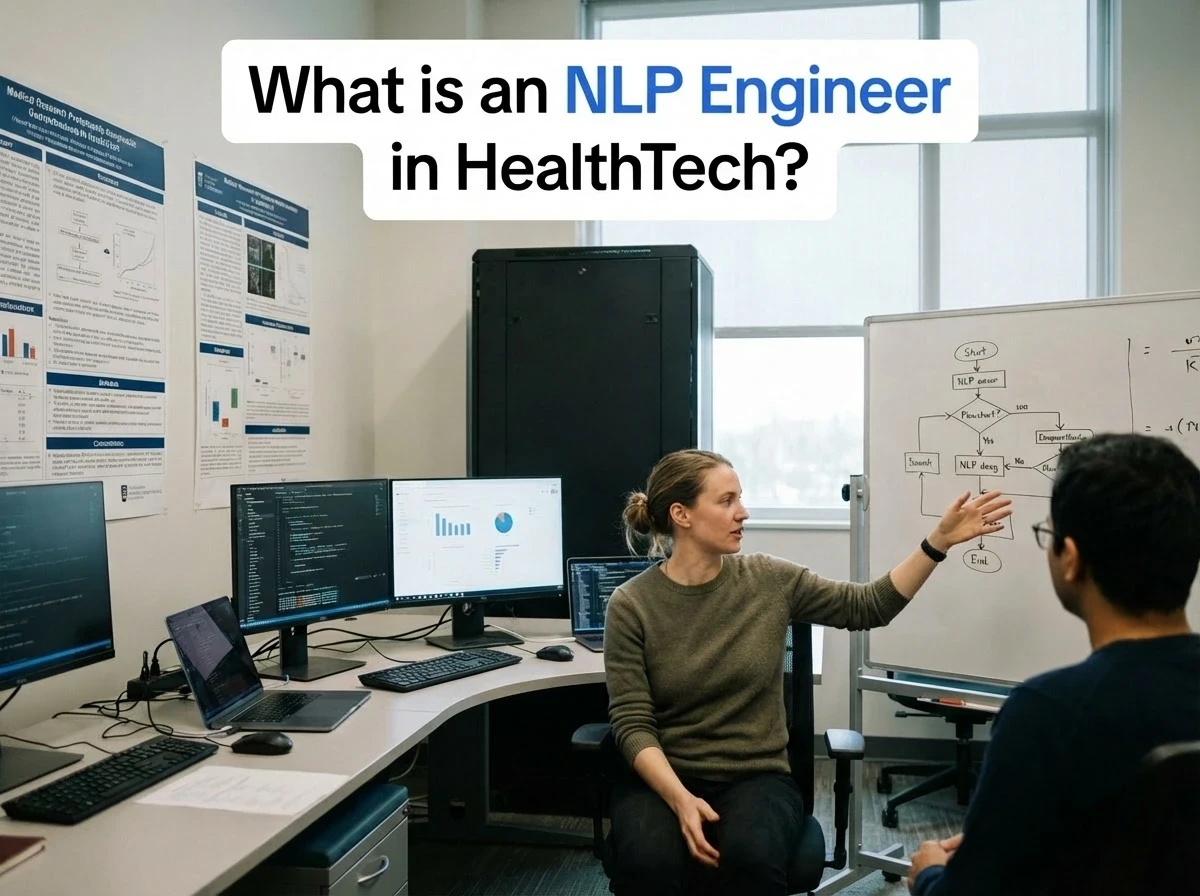
What is an NLP Engineer in HealthTech?
An NLP Engineer in HealthTech is an engineer who owns the delivery of language-driven capabilities inside healthcare products and workflows, turning messy, high-stakes clinical text into reliable signals, outputs, and decisions that real teams can depend on. That might mean extracting clinical entities from notes, powering patient or clinician messaging, structuring referral and triage information, supporting documentation workflows, or enabling search and summarisation in a way that is safe to use.
This role exists because a large proportion of healthcare "data" is language: free-text notes, letters, discharge summaries, care plans, and patient communications. HealthTech organisations need engineers who can turn that language into robust systems that behave predictably, can be audited, and can be improved without creating hidden risk.
In practice, the job is less about "doing NLP" and more about being accountable for outcomes: what the model is allowed to do, where it is allowed to be used, what happens when it fails, how performance is measured in real clinical settings, and how the system is monitored once it's live.
🔍 How this role differs in HealthTech
In many industries, an NLP feature can be treated as an experiment: ship quickly, iterate, and accept occasional odd behaviour if it doesn't create material harm. HealthTech is different because language outputs can influence clinical decisions, patient understanding, operational prioritisation, and data recorded into systems of record.
That changes the bar for evidence, traceability, and operational control. The NLP Engineer must make decisions with tighter constraints around data sensitivity, access patterns, retention, and vendor usage. Even when a system is not formally "clinical decision-making," it may still shape what humans see first, what gets coded, or what gets escalated, so the engineer is routinely managing second-order effects.
HealthTech also tends to have harder real-world interfaces: legacy systems, heterogeneous data formats, ambiguous clinical language, and multiple stakeholder groups (clinical, operations, safety, governance, product). The role often sits at the boundary between product engineering and data/ML, with more cross-functional accountability than in typical consumer NLP work.
🎯 Core responsibilities in HealthTech
Day to day, an NLP Engineer is accountable for converting a clinical or operational need into a language system that holds up in production. That starts with scoping: clarifying what "good" means in context, what failure modes matter, what cannot be automated, and which parts must remain human-reviewed. The work then becomes an ongoing cycle of building, evaluating, deploying, and monitoring, where each step is constrained by privacy, data quality, and the cost of mistakes.
A large part of the role is judgement under uncertainty. You may have to choose between a high-performing approach that is harder to explain and a slightly weaker approach that is safer to operate. You may need to trade model sophistication for deterministic guardrails, or prefer narrower automation with clearer accountability over broader automation that is difficult to validate. In HealthTech, the "right" solution is often the one that can be governed, supported, and defended, not merely the one that performs best on an offline benchmark.
The role also involves making NLP usable by the wider organisation: shaping data contracts, defining evaluation that reflects real clinical text distribution, setting up incident response for model regressions, and creating feedback loops so clinicians and operations teams can flag issues in a structured way. Ownership extends beyond launch into reliability, cost control, and safe evolution of the system.
🧩 Skills and competencies for HealthTech
Core Skill | HealthTech specific requirement | Reason or Impact |
|---|---|---|
Problem framing and scope control | Translate ambiguous clinical or operational needs into bounded, testable NLP outcomes with clear exclusions and escalation paths | Prevents "silent automation" where the system appears to work but creates unsafe edge-case behaviour |
Risk-based evaluation | Define acceptance criteria that reflect harm, workload impact, and downstream decision influence, not just model accuracy | Aligns model success with patient safety, clinician trust, and operational reliability |
Data stewardship | Make conservative choices on access, minimisation, retention, and provenance of sensitive text | Reduces privacy exposure and keeps delivery feasible within governance constraints |
Error analysis with domain context | Separate "model mistakes" from documentation ambiguity, coding conventions, and clinical shorthand | Improves fixes and avoids chasing noise that won't generalise in real environments |
Production ownership | Design monitoring, rollback, and alerting that treats model behaviour as an operational risk | Ensures regressions and drift are detected before they become clinical or operational incidents |
Stakeholder communication | Explain limitations, uncertainty, and safe usage boundaries to non-ML audiences | Enables adoption without overclaiming, and supports informed sign-off and change management |
System design judgement | Balance model complexity with guardrails, auditability, latency, and integration constraints | Produces solutions that are supportable in healthcare settings rather than impressive prototypes |
💷 Salary ranges in UK HealthTech
Salary in UK HealthTech for NLP Engineers is primarily driven by the breadth of ownership: whether you are building a contained feature or owning a production-critical language platform; whether your work touches high-risk workflows; the level of autonomy you have over architecture and governance; and the expectation to support incidents or time-sensitive releases. Location still matters, but the bigger multiplier is responsibility: leading evaluation strategy, setting operating standards, and owning outcomes across teams tends to pay more than narrow model development.
Experience level | Estimated annual salary range | What drives compensation |
Junior | London & South East: £40k–£55k | Close supervision vs. independent delivery; quality of engineering fundamentals; ability to handle sensitive data correctly |
Mid-level | London & South East: £55k–£75k | Owning end-to-end features; shipping to production; handling evaluation and monitoring with minimal support |
Senior | London & South East: £75k–£105k | Ownership of reliability and safety controls; leading trade-offs; mentoring; influence across product, clinical, and engineering stakeholders |
Lead | London & South East: £95k–£125k | Setting technical direction; owning platform-level decisions; accountable for incident posture, cost, and delivery across multiple workstreams |
Head / Director | London & South East: £120k–£170k | Organisation-wide accountability (strategy, risk management, governance readiness, hiring); responsibility for outcomes across teams and products |
Beyond base salary, typical add-ons include performance bonuses (often linked to delivery, reliability, or company outcomes), equity or options (more common in venture-backed HealthTech), and stronger benefits (pension contributions, private healthcare). On-call or out-of-hours allowances can apply when NLP services are production-critical, especially where model outputs feed operational workflows; the size varies based on rota frequency, incident severity, and the maturity of monitoring and rollback controls. Total compensation tends to rise with scope and criticality, not simply with model sophistication.
🚀 Career pathways
Common entry points include software engineering with a focus on data-heavy systems, data science transitioning into production ownership, or research-focused NLP moving into applied delivery. In HealthTech, the strongest early signal is not publishing or novelty. It's demonstrating that you can ship something dependable with clear limits, and improve it safely over time.
Progression typically follows expanding ownership. A mid-level NLP Engineer becomes senior by taking responsibility for end-to-end outcomes: evaluation design that reflects real clinical text, production monitoring, and stakeholder alignment on safe usage. Lead roles usually emerge when you own standards across multiple services: how models are assessed, how incidents are handled, how changes are reviewed, and how the organisation manages risk. Head/Director scope expands again into strategy, governance, and organisational design: building teams, setting operating models, and being accountable for the impact and safety posture of language systems across the product portfolio.
❓ FAQ
Do I need prior healthcare experience to be credible as an NLP Engineer in HealthTech?
Not always, but you do need evidence you can work safely with sensitive data and ambiguous requirements. Hiring teams usually look for signs you can learn domain constraints quickly and communicate limitations clearly. Domain experience becomes more important when the role touches clinical workflows or requires close partnership with clinical stakeholders.
What will interviews actually test for: models, or engineering ownership?
In many HealthTech teams, interviews prioritise production thinking: how you evaluate, how you prevent unsafe failure modes, how you monitor, and how you roll back changes. You may still be assessed on NLP fundamentals, but the differentiator is judgement, especially around trade-offs, governance constraints, and operational reliability.
Will I be expected to do on-call for NLP systems in HealthTech?
Sometimes. If the NLP service supports operationally critical workflows (for example, prioritisation, messaging, documentation support, or search used daily), teams may run an on-call rota or at least require incident support. Mature teams reduce the burden through monitoring, clear fallback paths, and controlled releases, so it's worth asking how incidents are handled and what "failure" looks like in practice.
🔎 Find your next role
If you're ready to take ownership of language systems that matter in the real world, search NLP Engineer roles in HealthTech on Meeveem.
You might also like