Published Date: December 17, 2025
Updated Date: December 17, 2025
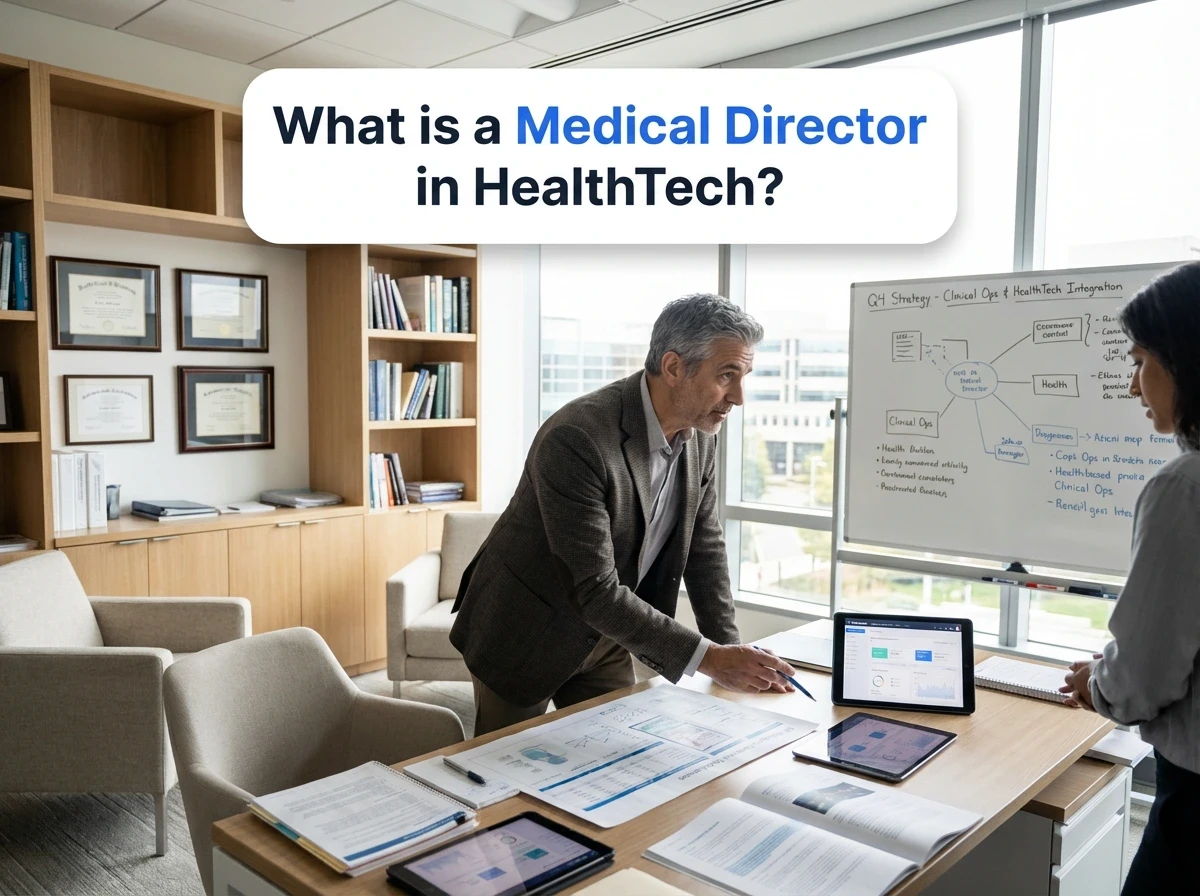
What is a Medical Director in HealthTech?
A Medical Director in HealthTech is the senior clinical leader responsible for how a product, service, or platform affects patient safety, clinical quality, and real-world care delivery. In practice, they translate medical responsibility into organisational decisions: what the product is allowed to do, what it must never do, what evidence is "good enough" to ship, and what risk is unacceptable.
This role exists because HealthTech turns clinical judgement into software behaviour. When you digitise workflows, automate triage, influence prescribing, interpret physiological data, or scale decision support, the organisation needs a clinician who can own the medical consequences, especially when commercial pressure, technical constraints, and regulatory duties collide. The Medical Director is there to carry that ownership, set standards for clinical integrity, and act as a final clinical escalation point when trade-offs get difficult.
More than being a "senior doctor in the building", the Medical Director typically sits as a strategic counterweight to product and engineering leadership. They are accountable for clinical governance, clinical risk framing, and ensuring the company's decisions remain defensible to patients, partners, and regulators.
🔍 How this role differs in HealthTech
In many tech sectors, product risk is mostly commercial: churn, brand damage, or data breaches. In HealthTech, product risk is clinical and operational. A design decision can create harm through missed deterioration, delayed escalation, inappropriate reassurance, or unsafe workflow changes at scale.
That difference changes how a Medical Director operates. They have to treat product roadmaps as clinical interventions, not feature pipelines. They also work in an environment where health data is highly sensitive, clinical workflows are brittle, and partner organisations (often care providers) have their own governance obligations. As a result, the Medical Director's judgement is exercised under stricter constraints: evidence expectations are higher, documentation and auditability matter more, and "move fast" must coexist with patient safety and clinical credibility.
Depending on the company's model, the Medical Director may also need to interface with formal clinical safety processes for digital systems, ensure that clinical risk is managed across the lifecycle (build, deploy, change), and be comfortable with sign-off responsibilities that go beyond normal product approvals.
🎯 Core responsibilities in HealthTech
Day to day, a Medical Director is accountable for the clinical posture of the business: what the product claims, what it actually does in context, and whether the organisation can stand behind those choices when challenged. That means shaping clinical strategy early (before requirements harden) so that safety, equity, and effectiveness are designed in rather than bolted on.
In practice, they spend a lot of time making decisions under constraints: imperfect evidence, limited implementation control in customer environments, variable clinical practice, and ambiguous edge cases. They arbitrate trade-offs such as sensitivity versus specificity in risk flags, usability versus safety friction, speed of iteration versus assurance, and clinical ambition versus what can be responsibly supported with monitoring and governance.
A strong Medical Director also operationalises clinical accountability. They define how clinical input is gathered and recorded, how disagreements are resolved, what "acceptable risk" looks like for each product line, and when the company must slow down, change course, or even stop a deployment. When incidents occur (clinical complaints, near misses, unexpected workflow failures), they lead or direct the clinical component of investigation and ensure learning is translated into product and process change, not just post-hoc explanations.
🧩 Skills and competencies for HealthTech
Core Skill | HealthTech specific requirement | Reason or Impact |
|---|---|---|
Clinical judgement | Ability to apply clinical reasoning to product behaviour across diverse settings, not just within one specialty or local pathway | Prevents "clinically plausible" features that fail under real-world variation and scale |
Risk ownership | Comfort being the accountable clinical escalation point when evidence is incomplete and timelines are tight | Enables defensible decisions and avoids unsafe compromise-by-committee |
Clinical governance leadership | Ability to set governance that fits software delivery (versioning, monitoring, change control) rather than traditional committees | Keeps safety and quality controls effective as the product iterates rapidly |
Evidence literacy | Ability to judge what level of evidence matches the claim and the risk, and to define evaluation approaches that are practical | Stops overclaiming, supports adoption, and reduces downstream regulatory and partner friction |
Cross-functional influence | Ability to lead without relying on hierarchy, aligning product, engineering, commercial, and clinical stakeholders | Ensures clinical constraints shape decisions early, not as late-stage blockers |
Communication under scrutiny | Ability to write and speak clearly about clinical intent, limitations, residual risk, and incident learnings | Builds trust with customers and reduces misunderstandings that can become safety issues |
Ethical reasoning | Ability to anticipate unintended consequences (bias, access, over-reassurance, alert fatigue) and set guardrails | Protects patients and strengthens long-term credibility with providers and users |
Operational pragmatism | Ability to design clinical processes that work in a lean company (availability, escalation, review capacity) | Prevents governance that looks good on paper but fails in day-to-day delivery |
💷 Salary ranges in UK HealthTech
Medical Director pay in HealthTech is driven less by "years qualified" and more by scope of clinical accountability. The biggest levers are: how directly the product can influence clinical outcomes, whether the company needs senior external credibility with providers and partners, the intensity of incident response and clinical availability expectations, and whether the role carries formal sign-off responsibilities across products, claims, and deployments. Location still matters, but breadth of risk ownership and organisational dependence on the Medical Director matter more.
Experience level | Estimated annual salary range | What drives compensation |
Junior | London & South East: £70k–£95k | Usually narrower product scope, more supervised decision-making, and less external-facing accountability; pay rises with exposure to regulated or safety-critical workflows |
Mid-level | London & South East: £90k–£120k | Owning a product area end-to-end, leading clinical input into roadmap decisions, and handling customer clinical escalations with increasing independence |
Senior | London & South East: £115k–£155k | Broader governance ownership across multiple products or high-risk pathways, heavier incident leadership, and greater influence over claims, evidence, and safety posture |
Lead | London & South East: £145k–£185k | Leading company-wide clinical governance, setting standards for evaluation and release decisions, and acting as the key clinical authority with major partners |
Head / Director | London & South East: £170k–£230k | Full clinical accountability across the business, high external scrutiny, board-level advising, and responsibility for how clinical risk is managed at scale; premium for multi-product portfolios and high on-call intensity |
Beyond base salary, total compensation commonly includes a performance bonus (often tied to company and product outcomes), equity (more common in venture-backed firms, with meaningful variation based on stage and seniority), and sometimes allowances where the role has explicit out-of-hours clinical escalation expectations. Total pay tends to increase when the Medical Director is expected to be a visible external clinical figure, when the product has higher potential for harm if misused or misunderstood, and when regulated constraints or customer governance requirements demand heavier sign-off and documentation.
🚀 Career pathways
Most Medical Directors in HealthTech enter from senior clinical practice with a track record of digital transformation, quality improvement, clinical informatics, or clinical leadership roles that required governance and cross-functional influence. Others come via medical affairs, patient safety, or clinical safety work where they've already built the habit of making documented, defensible decisions under scrutiny.
Progression is less about accumulating titles and more about widening the radius of clinical ownership. Early roles might focus on one product area or a subset of clinical claims; over time, responsibility expands to cover multiple workflows, external partnerships, incident leadership, and the clinical standards that govern how teams ship changes. At the most senior levels, the Medical Director becomes accountable for the company's overall clinical credibility: shaping strategy, hiring and developing clinical teams, and ensuring that the organisation can scale without diluting safety, integrity, or trust.
❓ FAQ
Do I need to be on an on-call rota as a Medical Director in HealthTech?
Not always, but many roles include some form of clinical escalation expectation, especially for safety-critical products or deployments. Clarify whether "on-call" means true 24/7 response, a shared rota, or business-hours incident ownership with defined escalation routes.
What will I be judged on in interviews beyond my clinical background?
You'll usually be assessed on how you make trade-offs: when you would block a release, how you define acceptable risk, and how you handle ambiguity without drifting into either over-caution or overconfidence. Hiring teams also look for your ability to influence product and engineering decisions with clear reasoning and pragmatic governance.
How do I transition from NHS leadership or clinical practice into a HealthTech Medical Director role?
Hiring managers typically want evidence you can operate in software delivery cycles and make decisions that scale across users and settings. Concrete examples (owning governance, handling incidents, shaping clinical pathways in digital tools, or leading multidisciplinary change) tend to matter more than having a perfectly linear HealthTech CV.
🔎 Find your next role
Ready to take clinical ownership in product-led healthcare? Search Medical Director roles on Meeveem and find a team building responsibly.
You might also like