Published Date: January 7, 2026
Updated Date: January 7, 2026
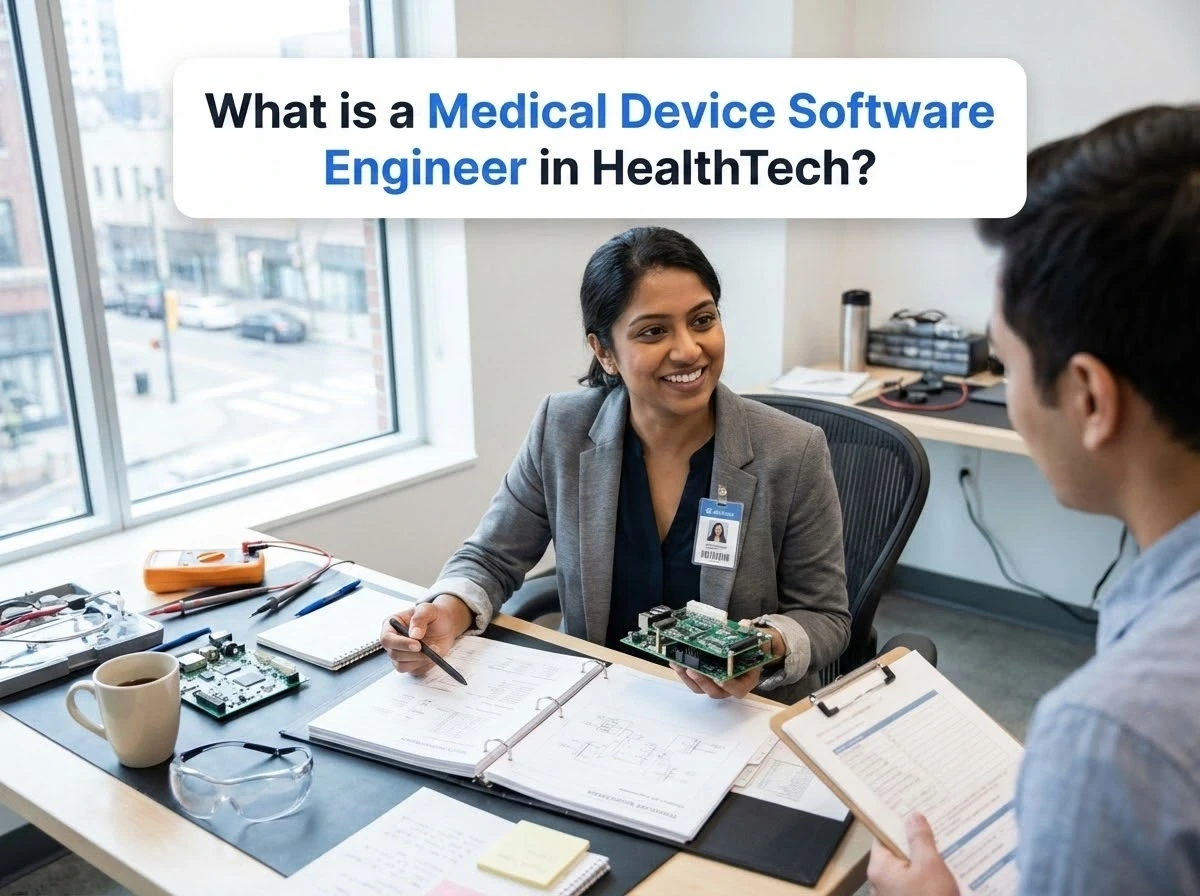
What is a Medical Device Software Engineer in HealthTech?
A Medical Device Software Engineer in HealthTech is a software engineer whose work becomes part of a regulated medical product, either the device itself (embedded software or firmware) or software that is treated as a medical device (often called SaMD). The defining feature isn't the tech stack: it's accountability for software that can influence diagnosis, treatment, monitoring, or clinical decision making, and must remain safe and effective as it evolves.
This role exists because healthcare needs software that behaves predictably under real world conditions: messy environments, edge cases, constrained hardware, imperfect connectivity, human factors, and high consequences when something goes wrong. Unlike general product engineering, medical device software is expected to be auditable, traceable to user needs and risks, and supported by evidence that it performs as intended.
Ownership sits at the centre. A Medical Device Software Engineer is responsible not only for shipping features, but for ensuring those features can be defended (technically and procedurally) through verification and validation, risk management, and release controls. In many organisations, this engineer is a key owner of "what we can safely claim" about the product and "what we can safely change" without introducing unacceptable risk.
🔍 How this role differs in HealthTech
In many SaaS, FinTech, or consumer environments, speed to market and iteration dominate, and "quality" is largely measured through customer experience, uptime, and conversion. HealthTech still values speed, but it is bounded by a different question: what could this change do to a patient, a clinician, or a clinical workflow, and can we prove it won't create harm?
Risk is more concrete and less reversible. A defect can become a safety event, not just a support ticket. Data sensitivity is also different: clinical context, patient identifiers, and downstream consequences of inaccurate outputs raise the bar for privacy, security, and integrity.
Regulated constraints change everyday decision making. You don't just choose the "best" approach; you choose the approach you can justify with evidence, traceability, and repeatability. Even when regulation isn't the headline, the working reality is: more documentation, stricter change control, more rigorous testing expectations, and a closer coupling between engineering, quality, clinical, and regulatory functions than most other industries.
🎯 Core responsibilities in HealthTech
Day to day, the role revolves around turning clinical intent into dependable behaviour. That starts with clarifying what the product must do, under which conditions, and what "unsafe" looks like. A Medical Device Software Engineer constantly navigates ambiguity: clinical needs that are hard to formalise, real world environments that don't match lab assumptions, and product goals that must be reconciled with safety and compliance.
Much of the work is decision making under constraints. You might choose a simpler algorithm because it's more testable and explainable, or split a feature into stages because a full change would expand risk and validation scope. You'll often trade speed for certainty in the areas that matter most, while still finding ways to move quickly by isolating risk, constraining blast radius, and designing for verification.
The engineer also operates within a broader quality system. That means working in a traceable way from requirements to implementation to verification evidence, collaborating tightly with quality, regulatory, clinical, and hardware (where relevant), and treating releases as controlled changes, not just deployments. When issues occur, accountability includes root cause analysis, impact assessment, corrective actions, and ensuring the system (processes as well as code) improves.
🧩 Skills and competencies for HealthTech
Core Skill | HealthTech specific requirement | Reason or Impact |
|---|---|---|
Safety focused judgement | Ability to interpret "risk" as patient/clinical harm pathways, not only technical failure modes | Drives safer design choices and prevents optimising for performance or speed at the expense of real world safety |
Requirements clarity and traceability | Comfort translating clinical and user needs into testable requirements that can be traced through design and evidence | Enables auditability, reduces rework, and makes changes safer because intent and impact are explicit |
Verification mindset | Designing software so it can be convincingly verified, including edge cases and misuse scenarios | Reduces the chance of unknown behaviours and supports defensible release decisions |
Change control discipline | Treating changes as controlled interventions with defined scope, rationale, and rollback/containment thinking | Prevents "small" edits from becoming safety significant drift and keeps releases supportable over time |
Cross functional accountability | Working effectively with quality, regulatory, clinical, product, and (often) hardware teams to converge on what is acceptable | Avoids "throw it over the fence" dynamics and ensures shared understanding of safety, claims, and constraints |
Incident response ownership | Ability to assess severity, clinical impact, and containment actions under time pressure | Improves patient safety outcomes and builds organisational trust in engineering decisions |
Documentation integrity | Writing and maintaining clear, consistent technical and quality artefacts that match reality | Reduces audit risk, speeds onboarding, and prevents gaps between "what we do" and "what we say we do" |
💷 Salary ranges in UK HealthTech
Compensation for Medical Device Software Engineers in the UK is shaped less by languages or frameworks and more by scope and accountability: the safety criticality of the product, the depth of regulated responsibility (traceability, verification, audit readiness), seniority, and whether the role includes operational burden (incident response, release authority, or on call). Location still matters (London and South East often pays more), but specialist domain experience can narrow the regional gap, particularly in established medtech clusters.
Experience level | Estimated annual salary range | What drives compensation |
Junior | London & South East: £40,000–£55,000 | Early career engineers who can contribute safely within an established quality system; higher pay where hiring competition is strongest |
Mid level | London & South East: £55,000–£75,000 | Increasing autonomy across features plus stronger ownership of verification evidence and change control; embedded/firmware and safety critical experience can lift the range |
Senior | London & South East: £75,000–£100,000 | Technical leadership plus accountability for high risk areas, architectural decisions, reviews, and audit ready delivery; compensation rises with product criticality and release responsibility |
Lead | London & South East: £95,000–£125,000 | Ownership across a subsystem or product area, mentoring, delivery governance, and often "final say" on readiness; increases with on call/incident expectations and regulated scope |
Head / Director | London & South East: £120,000–£180,000 | Organisational accountability for software delivery, quality outcomes, audit posture, and cross functional leadership; total comp depends heavily on company stage and risk profile |
Beyond base salary, total compensation commonly includes a performance bonus (often modest in smaller HealthTech companies, stronger in larger corporates), pension and benefits, and (especially in startups/scaleups) equity or options. On call allowances vary widely: some medical device teams avoid out of hours rotations via controlled releases, while others pay allowances or enhanced rates where there is genuine clinical operational support burden. The biggest drivers of total comp variation are regulated accountability (who "owns" evidence and release), product criticality, and whether the role carries incident/field issue responsibility.
🚀 Career pathways
Entry often comes from general software engineering, embedded systems, or test/verification backgrounds, particularly from safety critical industries where traceability and disciplined change control are familiar. Another common route is through quality oriented roles (software QA, verification, validation) that move closer to development as engineers build confidence in design controls and risk based thinking.
Progression is typically marked by expanding ownership. Early on, you may own well scoped components and test evidence under guidance. At mid level and senior, ownership extends to requirements shaping, risk informed design decisions, and leading verification strategy for a feature area. Lead roles usually reflect accountability for a subsystem or product slice (balancing delivery, safety, and audit readiness) while Head/Director roles expand that ownership to organisational systems: how teams build, verify, release, respond to issues, and sustain compliance without freezing innovation.
❓ FAQ
Do I need prior IEC 62304 / ISO 13485 experience to get hired as a Medical Device Software Engineer?
It's helpful but not always mandatory for junior and some mid level roles if you have strong engineering fundamentals and evidence of disciplined delivery. What hiring teams look for is whether you can learn regulated ways of working quickly and take documentation and verification seriously. Senior hiring is more likely to expect prior regulated or safety critical experience.
Will I spend more time writing documents than writing code?
You'll write code, but you'll also produce and maintain evidence that the code does what it should (and that changes are controlled). The balance depends on the company's maturity and product type: some teams have strong support from quality and verification specialists, while others expect engineers to own large parts of traceability and test evidence themselves. Candidates should ask where documentation ownership sits and how it's integrated into normal development flow.
Is on call common for medical device software roles in HealthTech?
It varies. Products that integrate with clinical operations or remote monitoring can require incident response, while others rely on planned releases and controlled support processes that reduce out of hours load. If on call exists, clarify expectations upfront: rotation size, response time, what constitutes an incident, and whether compensation reflects the burden.
🔎 Find your next role
If you want work with real world impact and clear accountability, search Medical Device Software Engineer roles on Meeveem.
You might also like