Published Date: December 30, 2025
Updated Date: December 30, 2025
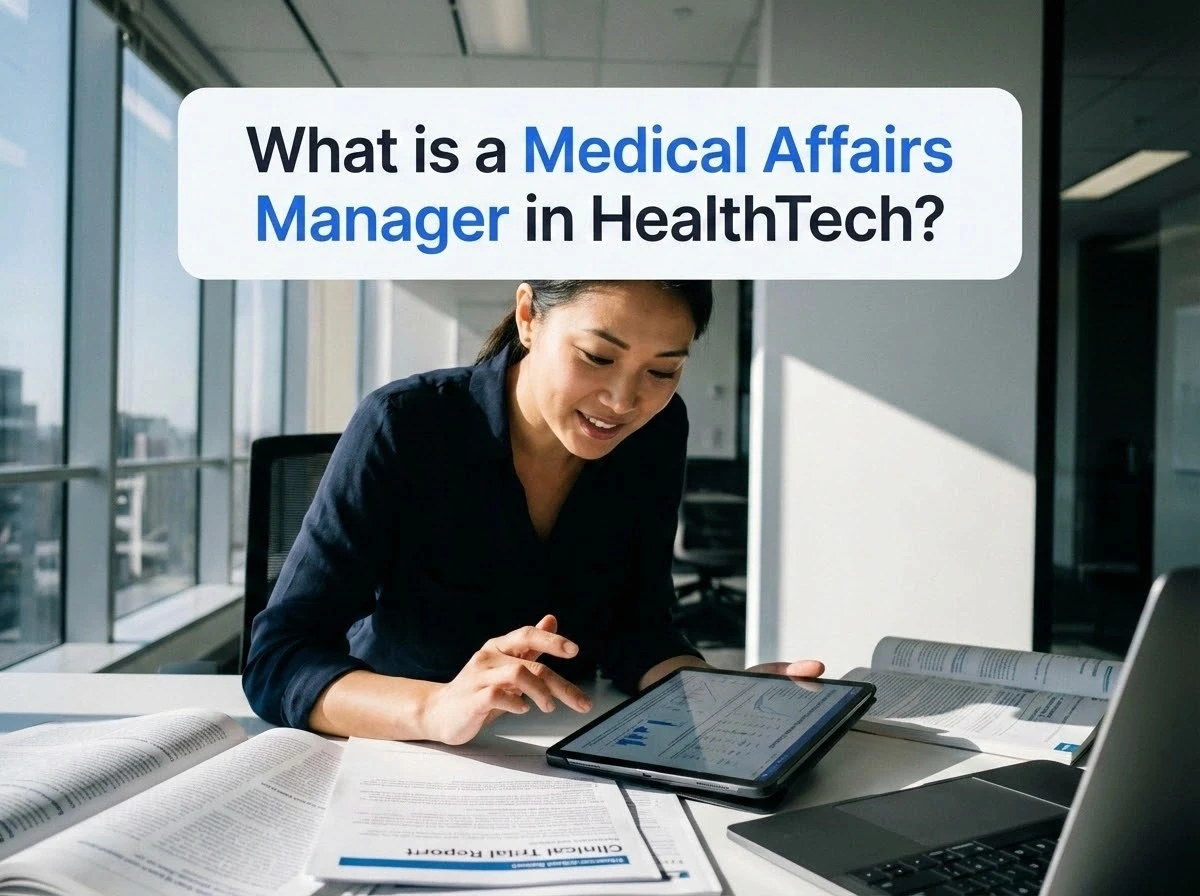
What is a Medical Affairs Manager in HealthTech?
A Medical Affairs Manager in HealthTech is accountable for the clinical and scientific integrity of how a health product is understood, used, and trusted. This applies both internally within the company and externally with clinicians and other healthcare stakeholders. They work at the intersection of product, clinical evidence, compliance, and real-world care pathways, translating medical reality into decisions the business can safely stand behind.
This role exists because HealthTech products can influence diagnosis, treatment choices, workflow, and patient outcomes. Those consequences don't wait for "perfect" product-market fit. A Medical Affairs Manager ensures the company's claims, education, and stakeholder engagement are medically sound, appropriately evidenced, and aligned with the responsibilities that come with operating in healthcare.
Ownership comes first: they own the medical narrative, the medical risk posture, and the quality of scientific exchange. Methods like literature reviews, expert engagement, evidence plans, and materials review are the tools they use to uphold that accountability.
🔍 How this role differs in HealthTech
In many tech industries, it's acceptable to iterate messaging and features quickly, learn from user behaviour, and adjust with minimal external consequence. In HealthTech, the same "move fast" instinct can collide with clinical risk, patient safety expectations, and stricter controls on what can be said, shown, or implied.
A Medical Affairs Manager in HealthTech operates in an environment where data is more sensitive, outcomes are more consequential, and adoption depends on clinical credibility as much as usability. They often balance the pace of product development against the reality that healthcare stakeholders need traceable evidence, clear boundaries, and predictable governance. Even when a product isn't a medicine, decisions still land in clinical contexts. Medical accuracy, appropriate interpretation of evidence, and disciplined communication are non-negotiable.
The role also tends to be closer to the "why should anyone trust this?" question than in other sectors. Medical Affairs is frequently the function that turns product ambition into defensible clinical positioning without overreach.
🎯 Core responsibilities in HealthTech
Day to day, the Medical Affairs Manager is making calls that shape what the organisation can responsibly promise and what it must not. They work with product and clinical teams to interpret evidence, define appropriate use cases, and identify where the current data is strong versus where it is still emerging. When commercial teams want sharper claims, Medical Affairs is the counterweight: they decide what can be supported, what must be qualified, and what needs new evidence before it becomes part of the story.
They spend a meaningful amount of time engaging externally, often with clinicians, clinical leaders, and subject matter experts, to understand how care is delivered in reality, what "good" looks like, and where the product truly fits. That external insight is then translated back into decisions: whether to adjust product direction, how to structure education, where additional clinical validation is needed, and how to handle uncertainty without undermining trust.
Trade-offs are constant. The Medical Affairs Manager may support speed to market, but not at the expense of scientific credibility. They may advocate for broader adoption, but only where the product is appropriate and the risk is understood. They also act as a governance checkpoint, reviewing medical content and ensuring the company's outward-facing materials are accurate, balanced, and consistent with the evidence base and intended use.
🧩 Skills and competencies for HealthTech
Core Skill | HealthTech specific requirement | Reason or Impact |
|---|---|---|
Clinical judgement | Ability to judge what is clinically meaningful versus technically impressive in real care settings | Prevents misalignment between product claims and how clinicians evaluate safety, relevance, and utility |
Evidence interpretation | Comfort working with imperfect, heterogeneous evidence (real-world data, validation studies, literature, usability and workflow studies) | Supports credible positioning without overstating certainty, protecting trust and reducing clinical risk |
Stakeholder credibility | Capability to engage clinicians and experts in genuine scientific exchange rather than "selling" | Drives adoption through trust, and surfaces risks early through honest external feedback |
Governance and boundary-setting | Clear decision-making on what can be said, taught, and implied, and when escalation is required | Reduces the risk of inappropriate claims, inconsistent messaging, and downstream compliance or reputational issues |
Cross-functional leadership | Ability to align product, commercial, regulatory/compliance, and clinical stakeholders around one medically-defensible plan | Avoids fragmented narratives and ensures the organisation acts consistently under healthcare constraints |
Risk-based prioritisation | Focus on the highest-impact patient safety and credibility risks first, not just the loudest internal requests | Ensures limited time is spent where medical oversight most materially affects outcomes and trust |
💷 Salary ranges in UK HealthTech
Medical Affairs compensation in HealthTech is primarily driven by the medical accountability carried by the role: how close the product sits to clinical decision-making, how high the consequence of misuse is, and how much governance responsibility the person owns. Scope also matters (supporting one product versus a portfolio, local versus international remit, and whether the role has line management). Location affects market rates, and expectations around availability can influence packages even when formal on-call is not standard.
Experience level | Estimated annual salary range | What drives compensation |
Junior | London & South East: £45,000–£60,000 | Often scoped to execution with tight supervision; pay moves with scientific complexity, writing responsibility, and degree of external engagement |
Mid-level | London & South East: £60,000–£80,000 | Ownership of a defined area (product/module/therapy area), independent materials review, increasing responsibility for evidence interpretation and stakeholder management |
Senior | London & South East: £80,000–£105,000 | Higher accountability for medical strategy, escalation ownership, influence over roadmap and claims, and broader external footprint with senior clinicians |
Lead | London & South East: £100,000–£130,000 | Portfolio ownership, cross-functional leadership, governance authority, and responsibility for how medical risk is managed across multiple workstreams |
Head / Director | London & South East: £125,000–£180,000 | Organisational accountability: medical governance model, team leadership, executive influence, external reputation, and responsibility across product lines and markets |
Beyond base salary, packages commonly include an annual bonus (often tied to company and individual performance), and equity is more common in venture-backed HealthTech than in large established employers. A formal on-call allowance is not universal for Medical Affairs, but some roles do carry expectations for out-of-hours support for urgent medical queries, safety escalations, or time-critical external requests. Where that expectation is explicit and frequent, it can lift total compensation. Total pay varies most with product risk level, scope of governance authority, leadership responsibility, and whether the role supports multiple markets or high-stakes launches.
🚀 Career pathways
Entry points are typically through clinical or scientific backgrounds, such as healthcare professionals moving into industry, or people coming from clinical research, medical writing, evidence generation, or medical information roles. In HealthTech, candidates also arrive from digital health implementation, clinical consulting, or outcomes/real-world evidence work, especially if they've operated close to clinical decision-making and can translate between clinical and product worlds.
Progression is best understood as expanding ownership. Early on, the focus is on accurate execution: contributing to materials, supporting evidence synthesis, and learning governance expectations. With experience, the role becomes more strategic, owning medical positioning, shaping evidence plans, and acting as a decisive gatekeeper for claims and education. Lead and Head/Director pathways tend to widen scope across products and geographies, formalise governance, and shift the centre of gravity toward organisational risk leadership and external credibility at scale.
❓ FAQ
Do I need to be a doctor to become a Medical Affairs Manager in HealthTech?
Not always. Many roles value a clinical registration, but others prioritise deep therapeutic knowledge, evidence interpretation, and credible engagement with clinicians. What matters most is whether you can take accountable medical decisions and defend them with appropriate evidence and judgement.
How is my performance evaluated if I'm not in a sales role?
You're usually assessed on the quality of medical governance and the impact of your medical strategy: clarity and consistency of claims, robustness of evidence plans, stakeholder feedback, and how effectively you reduce medical risk whilst enabling responsible growth. Strong performance looks like fewer late-stage escalations, higher trust from clinical stakeholders, and fewer avoidable compliance or credibility issues.
Will I be expected to be available out of hours for medical escalations?
It depends on the product, the company's operating model, and how medical queries and safety escalations are handled. Some roles are strictly business hours; others expect responsiveness during launches, incidents, or urgent external requests. If availability is frequent, clarify expectations and whether compensation reflects that responsibility.
🔎 Find your next role
Ready to take ownership of medical credibility in HealthTech? Search Medical Affairs Manager roles on Meeveem and compare scope, risk level, and growth pathways.
You might also like