Published Date: December 30, 2025
Updated Date: December 30, 2025
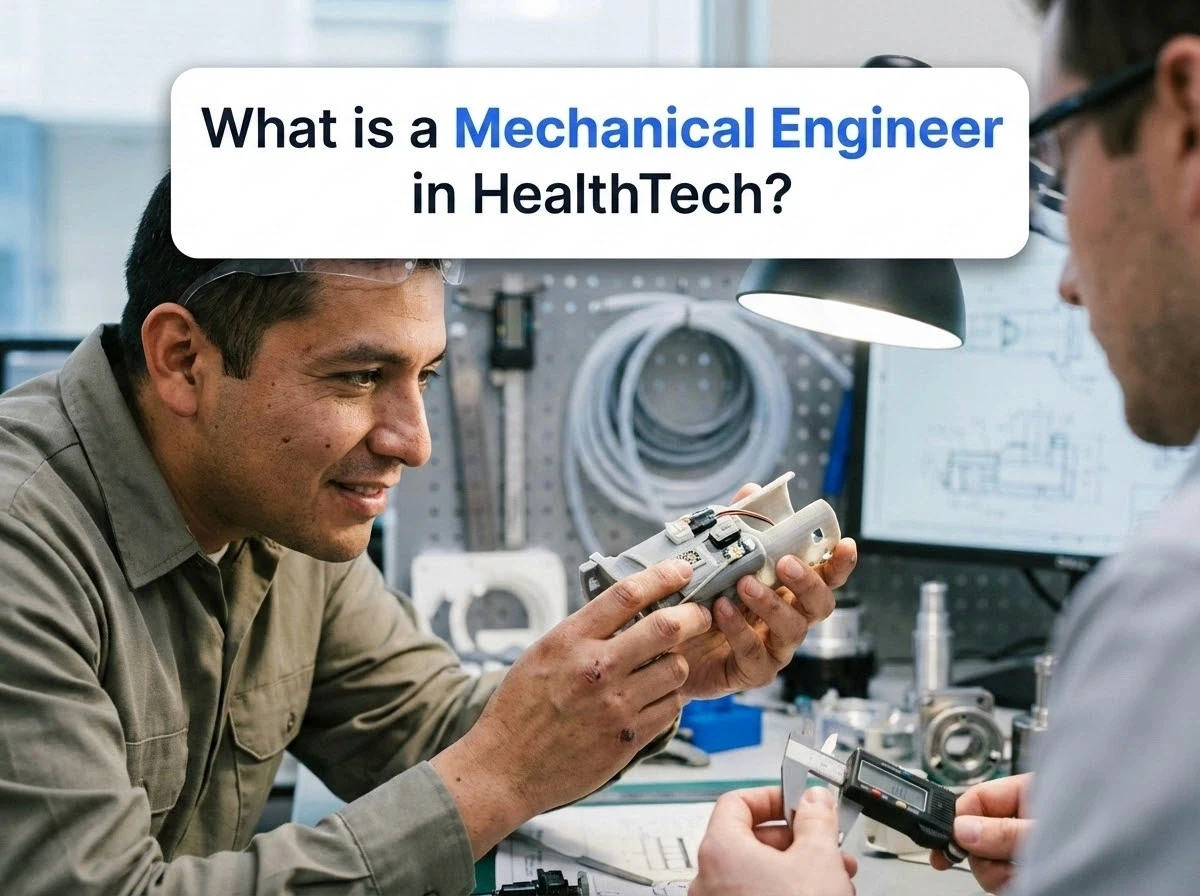
What is a Mechanical Engineer in HealthTech?
A Mechanical Engineer in HealthTech is responsible for turning clinical needs into physical products that are safe, manufacturable, serviceable, and reliable in real healthcare settings. This can mean anything from handheld devices and wearables to larger electromechanical systems used in clinics, labs, or hospitals, often as part of a wider product that includes electronics, firmware, software, and disposable components.
This role exists because healthcare products have to work predictably under real-world constraints: repeated cleaning, long duty cycles, supply variability, tight tolerances, and human use in stressful environments. A Mechanical Engineer owns the mechanical integrity of the solution: how it fits, seals, survives, can be assembled, can be tested, and can be produced consistently, whilst ensuring the design can stand up to formal verification and validation expectations.
More than simply "designing parts," the role is about responsibility: making sure the physical product does what it claims, does not introduce avoidable risk, and can be maintained over its lifecycle without surprises for patients, clinicians, manufacturing, or field service.
🔍 How this role differs in HealthTech
In many tech industries, iteration is primarily constrained by customer experience, uptime, or brand risk. In HealthTech, iteration is constrained by safety, traceability, and the cost of being wrong in the physical world. A mechanical decision isn't just a "performance vs cost" trade-off; it can affect contamination control, patient contact surfaces, electrical safety boundaries, calibration stability, or the likelihood of a rare but serious failure mode.
HealthTech also tends to shift the centre of gravity from "move fast and patch later" to "prove it works as intended, then control change." Mechanical Engineers are expected to make decisions that can be defended with evidence: documented requirements, clear rationale, testability, and disciplined change control. Even when the company culture is startup-fast, the product reality is not purely software-defined. Materials, tolerances, tooling, and supplier capability set hard limits.
Finally, the role is more cross-functional by necessity. Mechanical engineering choices are tightly coupled to quality systems, risk management, usability realities, and manufacturing constraints, so you spend more time aligning stakeholders and closing ambiguity than you would in less regulated, less safety-critical product categories.
🎯 Core responsibilities in HealthTech
Day to day, the Mechanical Engineer is accountable for ensuring the product's physical design is coherent end-to-end: requirements translate into geometry, materials, and assembly methods; the design can be built repeatedly; and it can be verified with objective evidence rather than optimism. Work often starts with ambiguity (what the clinical environment demands, what the user will actually do, what cleaning agents will be used, how maintenance happens) and you are expected to convert that ambiguity into testable mechanical requirements.
A typical week involves making trade-offs under constraint: tightening a tolerance may improve performance but create yield risk; choosing a material may help chemical resistance but complicate supply or biocompatibility evidence; reducing parts count may help reliability but make service more difficult. You balance these trade-offs whilst maintaining traceability: what changed, why it changed, and how you know it didn't introduce new risk.
You also carry accountability through the lifecycle. That includes supporting verification and validation testing, investigating failures found in builds or in the field, and designing fixes that don't create downstream problems in manufacturing, compliance documentation, or user workflows. In mature teams, you're expected to lead the mechanical narrative through design reviews: not just "what we designed," but "why this is safe, robust, and controllable at scale."
🧩 Skills and competencies for HealthTech
Core Skill | HealthTech specific requirement | Reason or Impact |
|---|---|---|
Systems thinking | Understand how mechanical decisions interact with electronics, sensing, sterilisation/cleaning, usability, and service workflows | Prevents "locally optimal" designs that fail in clinical reality or create hidden safety and reliability issues |
Risk-based judgement | Frame design choices around hazard mitigation, severity/likelihood thinking, and defensible rationale | Helps prioritise the right work and supports decisions that must be justified during audits, incidents, or change reviews |
Requirements ownership | Turn user needs and constraints into measurable mechanical requirements with clear acceptance criteria | Reduces rework and makes verification meaningful rather than a box-ticking exercise |
Design for verification and validation | Build testability into the physical design, fixtures, and measurement strategy | Makes evidence-generation practical, repeatable, and credible, especially when timelines compress |
Manufacturing realism | Design for assembly, yield, and supply chain capability, not just prototype performance | Prevents fragile designs that collapse when scaled, where variability becomes a patient-risk or recall-risk problem |
Change control discipline | Treat changes as controlled interventions with impact assessment across documentation, risk, tooling, and service | Protects product integrity over time and avoids "quick fixes" that create compliance or field reliability debt |
Cross-functional leadership | Align engineering, quality, regulatory, clinical, and operations around clear decisions and trade-offs | Keeps the programme moving whilst ensuring the product remains safe, buildable, and supportable |
💷 Salary ranges in UK HealthTech
Mechanical Engineer pay in HealthTech is shaped less by the title and more by the burden of responsibility: clinical criticality, proximity to patient contact, ownership of verification evidence, complexity of electromechanical integration, and the degree to which you're accountable for manufacturing transfer and field reliability. Location still matters, but so does the "blast radius" of your decisions, especially when design changes affect compliance documentation, supplier tooling, and released product performance. On-call is less common than in pure software roles, but some organisations expect incident support for field issues, lab equipment downtime, or urgent manufacturing quality escapes, which can influence pay.
Experience level | Estimated annual salary range | What drives compensation |
Junior | London & South East: £30,000–£38,000 | Exposure to regulated development, pace of learning, and how quickly you can own well-scoped components without increasing risk |
Mid-level | London & South East: £40,000–£55,000 | Ownership of subsystems, ability to run design iterations independently, and contribution to verification plans and manufacturing readiness |
Senior | London & South East: £55,000–£75,000 | Accountability for key product risks, leading design reviews, resolving complex failures, and driving design transfer and supplier alignment |
Lead | London & South East: £75,000–£95,000 | Scope across multiple subsystems or a platform, technical leadership across functions, and responsibility for high-impact trade-offs and release readiness |
Head / Director | London & South East: £95,000–£140,000 | Organisational accountability: strategy, hiring, quality of engineering execution, delivery risk, supplier strategy, and overall lifecycle performance |
Typical add-ons vary by company maturity and product type. You may see annual bonus (often tied to company and delivery milestones), equity (more common in venture-backed HealthTech), and enhanced pension/benefits. On-call allowances are not universal for Mechanical Engineers, but where incident response is expected (field escalations, manufacturing downtime, critical clinical deployments), compensation can increase via allowances, paid standby, or higher base to reflect availability and accountability. Total compensation tends to rise with regulated scope, patient-contact complexity, ownership of verification evidence, and the cost of failure in the field.
🚀 Career pathways
Entry points commonly include mechanical design roles in regulated manufacturing, product development in medical devices, or adjacent industries where reliability and traceability matter (for example, precision manufacturing or safety-critical engineering) followed by a transition into healthcare products. Early progression is usually earned by taking clear ownership of a component or assembly (requirements, design, testing evidence, and handover to manufacturing) rather than by accumulating tools or CAD complexity.
As you move into mid-level and senior scope, responsibility expands from "my part works" to "my subsystem works in the full product, under real use, at scale." You become the person who can anticipate failure modes, design for test and service, and lead trade-offs across cost, schedule, usability, and risk without losing control of the evidence.
At lead level, the step-change is breadth and consequence: you own larger slices of the product or multiple programmes, shape engineering standards, and become accountable for decisions that affect release readiness and field outcomes. At Head/Director level, progression is defined by organisational ownership: building teams, setting development discipline, aligning with quality and operations, and ensuring the company can repeatedly deliver safe physical products without burning time on preventable rework.
❓ FAQ
Do I need direct medical device experience to move into HealthTech as a Mechanical Engineer?
Not always, but you do need to show you can work in a disciplined environment where evidence matters. Candidates often transition successfully if they can demonstrate traceable requirements thinking, risk awareness, and experience delivering designs into production rather than stopping at prototypes.
What will the interview process actually test for in HealthTech mechanical roles?
Expect deeper questioning on how you made trade-offs, what you did when tests failed, and how you prevented problems from recurring. Strong candidates can explain not just the design, but the decisions, constraints, verification approach, and how they managed ambiguity with cross-functional stakeholders.
Will I be on-call as a Mechanical Engineer in HealthTech?
Often no in the traditional "rota" sense, but you may be expected to support urgent investigations for field issues, clinical deployments, or manufacturing escapes. If a role implies frequent incident response, clarify expectations on availability, escalation paths, and whether compensation includes an allowance or standby pay.
🔎 Find your next role
Explore Mechanical Engineer roles in HealthTech by searching on Meeveem and filter by product type, seniority, and location to match the scope you want to own next.
You might also like