Published Date: December 29, 2025
Updated Date: December 29, 2025
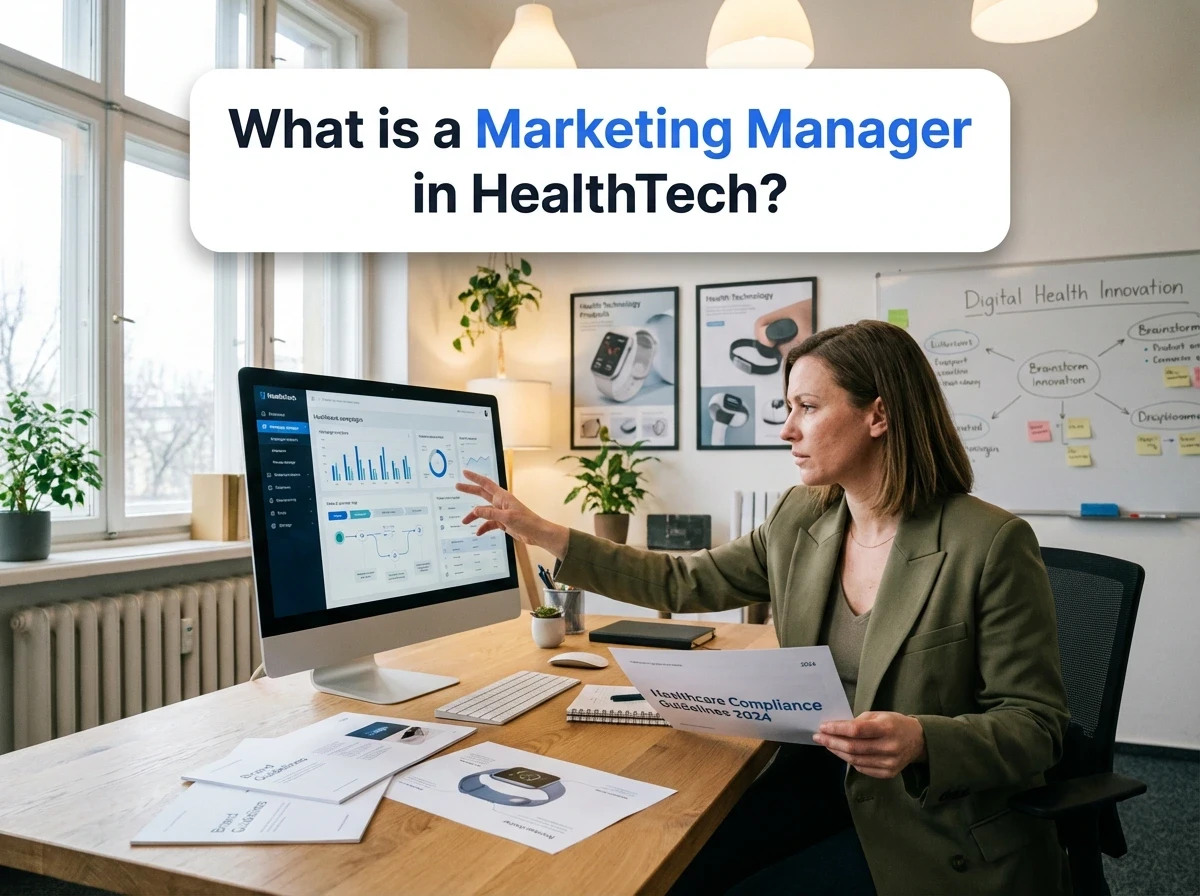
What is a Marketing Manager in HealthTech?
A Marketing Manager in HealthTech is accountable for turning a healthcare technology product or service into a repeatable, trustworthy route to growth. They define what will be said, to whom, through which channels, and how success will be measured. In practice, they own a slice of commercial outcomes (pipeline, revenue influence, adoption, retention, or patient/customer acquisition) and make marketing decisions that stand up to clinical reality, information security expectations, and high scrutiny from buyers.
This role exists because HealthTech companies rarely win on awareness alone. They win when stakeholders believe the product is safe, credible, and usable, and when the business can show evidence, not just claims. A Marketing Manager provides that ownership: shaping positioning, running programmes, and coordinating teams so that growth is achieved without creating compliance risk or damaging trust.
In most organisations, the role sits within the commercial function (often under a Head of Marketing, Growth Lead, or Commercial Director) and works day-to-day with Product, Sales, Customer Success, and clinical or regulatory colleagues. The defining feature is responsibility: the Marketing Manager is expected to deliver outcomes, not just activity.
🔍 How this role differs in HealthTech
In many SaaS or consumer tech environments, marketing can move fast with lighter consequences for getting it wrong. In HealthTech, the same "move fast" instinct is tempered by the reality that marketing messages can influence clinical decisions, patient behaviour, and procurement choices that impact care delivery.
Data sensitivity changes everything. Even when a Marketing Manager isn't handling clinical data directly, they're routinely making decisions about claims, case studies, targeting, CRM hygiene, consent, and how outcomes are presented, all under tighter expectations from buyers and partners. Regulation and internal governance often mean more reviews, more evidence thresholds, and more careful language, especially around outcomes, safety, and comparative statements.
The commercial cycle also tends to be more complex. Marketing is often selling into multi-stakeholder decision-making: clinical champions, operational owners, procurement teams, and information governance. That complexity pushes the role towards cross-functional alignment and disciplined messaging rather than purely creative execution.
🎯 Core responsibilities in HealthTech
Day to day, a Marketing Manager in HealthTech is accountable for making the company legible and credible to the market, then converting that credibility into measurable growth. They translate product capabilities into positioning that resonates with real healthcare workflows, and they decide what evidence is needed to support claims before campaigns go live. This typically means balancing speed against assurance: launching programmes that can scale, while ensuring the business can defend what it says.
They also operate under practical constraints: limited access to reference customers, longer buying cycles, restricted channels in certain contexts, and stakeholders who will challenge assumptions. A strong Marketing Manager manages these trade-offs explicitly, prioritising the segments, messages, and channels that fit the company's maturity and risk profile, and stopping work that creates noise without commercial impact.
In many HealthTech teams, the role becomes a coordination hub. The Marketing Manager is often the person who makes sure Sales has usable materials, Product launches are coherent, case studies are credible, and leadership has honest performance reporting. The work is rarely linear; it's a continuous set of decisions about what to ship now, what to validate, and what to escalate when trust, compliance, or clinical credibility could be compromised.
🧩 Skills and competencies for HealthTech
Core Skill | HealthTech specific requirement | Reason or Impact |
|---|---|---|
Positioning and narrative ownership | Frame value in terms of workflow, outcomes, and operational reality, not just features | HealthTech buyers reward clarity and credibility; weak positioning creates long sales cycles and stalled adoption |
Evidence-based judgement | Know what "proof" looks like in healthcare contexts and when a claim needs stronger support | Overstated messaging can damage trust, trigger objections, or create governance friction that blocks deals |
Stakeholder alignment | Align Product, clinical/regulatory voices, Sales, and leadership into one market story | Conflicting messages are especially costly in HealthTech because buyers cross-check internally and externally |
Risk-aware decision-making | Anticipate reputational, compliance, and patient-safety implications of campaigns | The cost of being wrong is higher; marketing decisions can have downstream real-world impact |
Commercial analytics and accountability | Measure performance against longer cycles, complex attribution, and multi-touch influence | HealthTech growth often requires patience and disciplined measurement to avoid chasing misleading short-term signals |
Customer empathy and domain curiosity | Build practical understanding of care delivery, constraints, and incentives | Without real context, marketing produces generic content that fails to move clinical and operational stakeholders |
Operational excellence | Run repeatable campaign processes with approvals, documentation, and clear handoffs | Governance and cross-functional reviews are common; strong operations keep teams fast without becoming reckless |
💷 Salary ranges in UK HealthTech
Salary in UK HealthTech marketing is shaped less by the job title and more by scope: whether the role owns a segment end-to-end, manages budget and headcount, supports enterprise sales motions, works on regulated products with higher scrutiny, or is expected to drive pipeline in a narrow, high-value market. Location still matters, and so does how close the role is to revenue accountability. On-call expectations are uncommon for Marketing Managers; when they exist, they're usually tied to incident communications or urgent campaign takedowns rather than technical support.
Experience level | Estimated annual salary range | What drives compensation |
Junior | London & South East: £32,000–£40,000 | Breadth of responsibility, independence, and whether you're supporting revenue programmes vs mainly assisting execution |
Mid-level | London & South East: £42,000–£55,000 | Ownership of a channel or segment, campaign complexity, measurable pipeline impact, and cross-functional influence |
Senior | London & South East: £55,000–£70,000 | Accountability for outcomes, budget control, enterprise go-to-market experience, and ability to handle scrutiny on claims and evidence |
Lead | London & South East: £70,000–£90,000 | Leading a function or major programme, strategic ownership, team leadership, and consistent revenue influence in longer sales cycles |
Head / Director | London & South East: £90,000–£130,000 | Org-wide marketing accountability, executive partnering, scaling teams and budget, category positioning, and board-level expectations |
Typical add-ons beyond base include an annual bonus (often linked to company performance and commercial targets), pension and private healthcare, and, more commonly in venture-backed HealthTech, equity options that can meaningfully change total compensation. Variation is driven by company stage (startup vs scale-up), whether marketing is tied directly to revenue targets, the complexity of the buyer environment (enterprise/provider vs SMB/consumer), and the level of governance required for claims, content, and partnerships. On-call allowances are not typical for this role; where they exist, they tend to be modest and tied to comms escalation coverage rather than routine work.
🚀 Career pathways
Entry points into HealthTech Marketing Manager roles commonly come from generalist marketing in B2B SaaS, healthcare services, agencies that serve healthcare clients, or from adjacent commercial roles where you've owned messaging and growth outcomes. Some candidates also move in from customer-facing positions like Customer Success or Partnerships because they already understand stakeholders, objections, and adoption drivers.
Progression is usually earned by expanding ownership. Early on, you're trusted with a channel, a campaign portfolio, or a segment. Over time, you become accountable for a full growth motion: positioning, programmes, performance reporting, and alignment with Sales and Product. The next step is leading, not just managing people, but owning the operating model for how marketing produces results under HealthTech constraints.
The strongest signals for advancement are consistent commercial impact, disciplined judgement under scrutiny, and the ability to keep teams aligned when evidence, governance, or stakeholder complexity would otherwise slow execution to a halt.
❓ FAQ
Do I need a healthcare background to be a Marketing Manager in HealthTech, or can I transition from SaaS?
You don't need a clinical background, but you do need the ability to learn the domain quickly and communicate responsibly. Hiring teams often look for candidates who can show mature judgement on claims, evidence, and stakeholder complexity. A strong transition story includes examples of working in regulated or high-trust contexts, and of influencing cross-functional teams.
What will I be judged on in the first 90 days: pipeline, brand, or product launches?
It depends on the company stage, but most roles expect you to create clarity and traction fast: tighten messaging, prioritise segments, and improve the quality of outbound programmes. Many teams will also assess whether you can build a reliable marketing cadence with clean reporting and credible materials for Sales. Early wins are often about focus and decision-making, not volume of activity.
Will I ever be on-call in this role, and how should I ask about it in interviews?
On-call is uncommon for Marketing Managers, but you may be expected to respond quickly to urgent comms issues, campaign takedowns, or sensitive customer situations. Ask who owns incident communications, what escalation looks like, and whether there's a rota or expectations outside hours. Clear answers are a good proxy for organisational maturity and risk management.
🔎 Find your next role
If you're ready to own growth in a mission-driven, high-trust market, search Marketing Manager roles in HealthTech on Meeveem.
You might also like