Published Date: December 30, 2025
Updated Date: December 30, 2025
What is a Manufacturing Quality Manager in HealthTech?
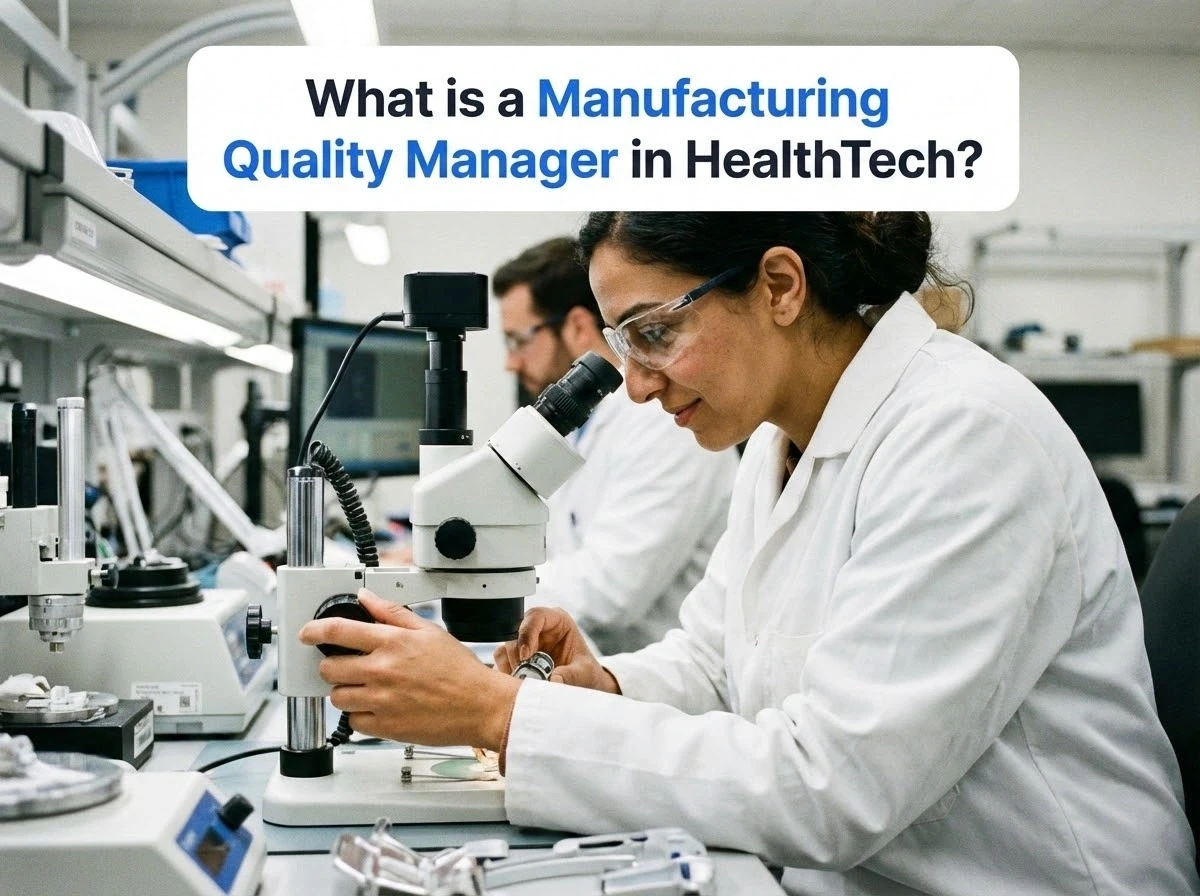
A Manufacturing Quality Manager in HealthTech owns product quality and compliance on the factory floor (and across connected manufacturing sites). They ensure that what is built, tested, released, and shipped consistently meets defined requirements and is safe to use in real clinical or patient-facing settings. They sit at the point where design intent becomes repeatable production reality, and they are accountable for whether the organisation can manufacture at scale without drifting away from what was validated, documented, and approved.
This role exists because "good engineering" isn't the same as "controlled manufacturing." In HealthTech, manufacturing outputs often become part of diagnosis, treatment, monitoring, or clinical decision-making. That means quality is not a best-effort activity; it is a managed system with clear authority to stop, quarantine, reject, escalate, and correct.
The role is fundamentally about ownership: owning the quality management system as it applies to manufacturing, owning the decisions around nonconformance and release readiness, and owning the quality culture that makes issues visible early rather than hidden until customers find them.
🔍 How this role differs in HealthTech
In many tech sectors, quality problems are painful but recoverable: you patch software, roll back a release, or compensate users. In HealthTech manufacturing, defects can turn into field actions, supply disruption, reputational damage, and (most importantly) patient risk. That changes how decisions are made: the Manufacturing Quality Manager is expected to choose control and traceability over speed when the two are in tension.
HealthTech also creates tighter coupling between manufacturing quality, regulatory expectations, and post-market realities. The manufacturing process itself becomes part of the "product" because it determines consistency: environmental controls, validation, inspections, batch/lot traceability, and documented evidence matter as much as the physical build.
Finally, the role typically sits closer to formal governance than in consumer tech. Manufacturing Quality Managers often report into a Quality Director / Senior Director of QA or sit within an Operations quality structure, with explicit authority to challenge production priorities when quality signals suggest drift, weak controls, or incomplete evidence.
🎯 Core responsibilities in HealthTech
Day to day, a Manufacturing Quality Manager is accountable for keeping production inside a controlled system: the right procedures, the right evidence, the right sign-offs, and the right containment when something deviates. They spend much of their time in the middle of real trade-offs (protecting product integrity while keeping manufacturing moving) by deciding what can be released, what must be held, and what requires escalation.
In practice, that means they lead how nonconformances are triaged and investigated, how corrective and preventive actions are shaped, how change is assessed for risk and compliance impact, and how manufacturing teams learn from errors without normalising them. They also act as the manufacturing-facing guardian of audits and inspections, ensuring the organisation can demonstrate not just that it has a system, but that the system is followed and effective.
A strong Manufacturing Quality Manager makes constraints explicit. When production wants speed, they translate risk into concrete options: tighter inspection, additional evidence, temporary containment, rework with documented justification, or stopping the line. Their value is in making the "least risky workable decision" repeatable, documented, and defensible.
🧩 Skills and competencies for HealthTech
Core Skill | HealthTech specific requirement | Reason or Impact |
|---|---|---|
Decision ownership | Willingness to approve, reject, or hold product based on evidence (not optimism or pressure) | Protects patients and the business by preventing avoidable escapes and ensuring release decisions stand up to scrutiny |
Risk-based judgement | Comfort weighting severity, probability, detectability, and downstream clinical impact in everyday calls | Keeps controls proportionate: neither over-engineering everything nor under-controlling critical characteristics |
Systems thinking | Seeing how training, tooling, suppliers, maintenance, validation, and documentation interact as one system | Prevents "local fixes" that move problems around rather than eliminating root causes |
Manufacturing influence | Ability to embed quality into production routines without becoming a blocker or a bystander | Builds a quality culture where issues surface early, reducing scrap, rework, and late-stage surprises |
Investigation discipline | Leading root-cause work that is evidence-driven, time-bound, and linked to sustainable CAPA | Stops repeat defects and avoids superficial actions that fail under audit or recur in the field |
Audit readiness mindset | Maintaining continuous readiness rather than preparing only when an audit is scheduled | Reduces disruption, improves confidence in data integrity, and strengthens operational credibility |
Change control realism | Evaluating change impact across process capability, validation state, traceability, and release evidence | Prevents unintended quality drift and protects the integrity of validated manufacturing conditions |
Cross-functional communication | Translating quality risk into operational and commercial terms for Ops, Engineering, and leadership | Enables faster alignment on containment, prioritisation, resourcing, and escalation thresholds |
💷 Salary ranges in UK HealthTech
Manufacturing Quality Manager compensation in UK HealthTech is shaped less by the job title and more by what the person is truly accountable for: product criticality, complexity of the manufacturing footprint (single site vs multi-site), degree of regulated exposure, maturity of the quality system, and whether the role has formal authority over batch/lot disposition and release. Location also matters, as do leadership scope (team size, QA+QC ownership, supplier oversight) and how often the role is pulled into urgent containment work.
Experience level | Estimated annual salary range | What drives compensation |
Junior | London & South East: £35,000–£45,000 | Often closer to quality engineering/co-ordinator scope; limited sign-off authority; narrower manufacturing surface area |
Mid-level | London & South East: £45,000–£60,000 | Increased ownership of investigations, change control, audit preparation, and shop-floor quality routines; may cover a line or area end-to-end |
Senior | London & South East: £60,000–£80,000 | Clear accountability for manufacturing quality performance and containment decisions; greater exposure to audits, supplier issues, and validation discipline |
Lead | London & South East: £80,000–£100,000 | Multi-site scope or combined QA/QC leadership; owns management review inputs, KPI strategy, and escalations; higher judgement load under pressure |
Head / Director | London & South East: £100,000–£140,000 | Executive accountability for manufacturing quality outcomes, inspection readiness, resource strategy, and business continuity; manages managers and sets policy |
Beyond base salary, total compensation commonly includes a performance bonus (often tied to company and quality/operations goals), pension and benefits, and sometimes equity (more likely in venture-backed HealthTech). On-call is not universal for this role, but urgent escalation expectations can function similarly; where formalised, it may appear as an allowance or as enhanced pay for specific coverage. Variation usually comes from product risk, release/disposition authority, size of the manufacturing footprint, audit exposure, and whether the organisation is stabilising a struggling QMS versus scaling a mature one.
🚀 Career pathways
Many Manufacturing Quality Managers enter HealthTech from quality engineering, quality control supervision, process engineering, or regulated manufacturing roles where documentation discipline and investigation habits are already strong. Others come through supplier quality or complaint/CAPA roles and transition into manufacturing when they can demonstrate practical influence on shop-floor outcomes.
Progression is typically a widening of ownership. Early on, growth looks like moving from supporting investigations to leading them, then to owning the system that prevents them: how training works, how changes are approved, how evidence is captured, and how release decisions are made. Later progression tends to come from managing bigger surfaces (multiple sites, multiple product families, or combined QA/QC scope) and being trusted to make difficult calls when production pressure is high.
The strongest pathway is not "more certificates" or "more tools," but credible decision-making: being the person leadership trusts to protect patients and keep supply moving with defensible, documented judgement.
❓ FAQ
Do Manufacturing Quality Managers in HealthTech usually have "stop-the-line" authority?
In well-run organisations, yes in practice (even if it's not phrased that way). You're expected to quarantine, hold, or reject output when evidence is missing or controls are out of tolerance. In interviews, ask how disposition decisions work and who signs off release readiness.
Will I be evaluated more on audits or on day-to-day manufacturing performance?
Both, but the day-to-day tends to reveal the truth: nonconformance flow, CAPA effectiveness, change control discipline, and whether issues are escalated early. Audits then test whether that daily reality is documented and repeatable. Strong candidates can explain how they build routine controls that make audit readiness a by-product.
Is this role compatible with coming from "pure software" quality?
It can be, but you'll need to show comfort with manufacturing evidence, traceability, and disposition decisions (where you can't simply patch in the field). The most successful transitions happen when candidates can demonstrate risk-based judgement and disciplined investigations, and can learn the manufacturing control mindset quickly.
You might also like