Published Date: January 7, 2026
Updated Date: January 7, 2026
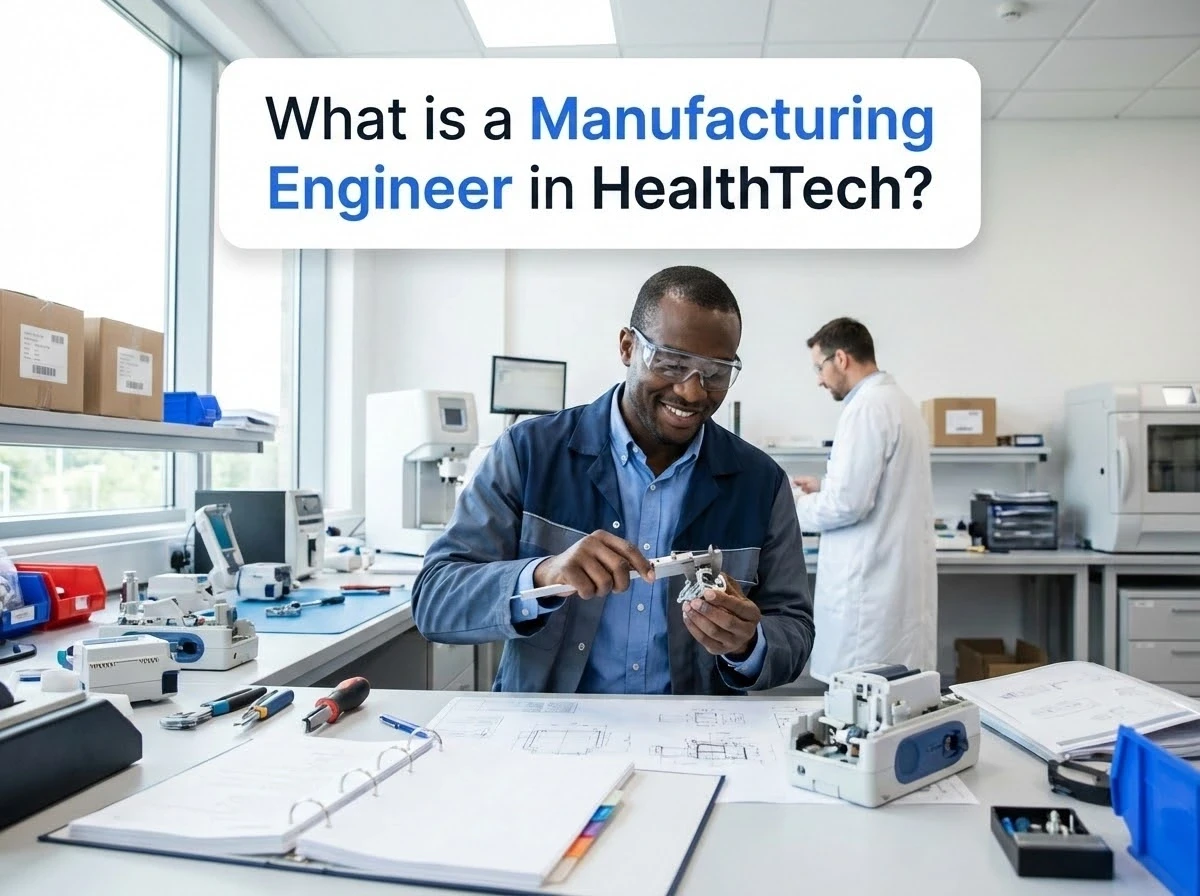
What is a Manufacturing Engineer in HealthTech?
This role exists because HealthTech products must work outside a demo environment. They need to meet defined specifications every time, withstand real-world use, and remain compliant as suppliers, volumes, and designs evolve. A Manufacturing Engineer ensures the organisation can build what it sells: consistently, traceably, and with appropriate risk control.
Ownership comes first. They are responsible for process capability, manufacturing readiness, the integrity of the production route, and the consequences of changes. Tools, methods, and improvement programmes matter, but they come second to accountability for outcomes.
🔍 How this role differs in HealthTech
In many software-first industries, manufacturing either doesn't exist or is abstracted away behind contract vendors with limited regulatory consequence. In HealthTech, manufacturing is part of the product. The way a device is assembled, calibrated, cleaned, packaged, labelled, or tested can be as safety-critical as the design itself.
That shifts decision-making. A Manufacturing Engineer in HealthTech operates in an environment where traceability, documentation discipline, and controlled change are not process theatre. They are the evidence that the product you ship is the product you validated. The acceptable risk posture is different: you optimise, but you do it within constraints that protect patients, users, and the company's licence to operate.
Organisationally, this role often sits close to Operations and Quality, with strong interfaces into R&D, Supply Chain, and Regulatory. In smaller HealthTech companies, it may be the bridge that connects design teams to external manufacturing partners. In larger organisations, it can be a specialist function embedded in a broader manufacturing or industrialisation group.
🎯 Core responsibilities in HealthTech
Day to day, a Manufacturing Engineer in HealthTech is accountable for whether the manufacturing process can repeatedly deliver conforming product. That means translating design intent into work instructions, test methods, and process parameters that are realistic on the shop floor and defensible in audits. They investigate why yields move, why defects appear, and why a line that worked last week is now producing variation. Then they drive corrective actions that fix the system rather than the symptom.
Much of the role is decision-making under constraints. A supplier component change might improve availability but introduce a new failure mode. A process tweak might reduce cycle time but weaken detection of latent defects. A redesign could simplify assembly but trigger a wider revalidation burden. Manufacturing Engineers weigh these trade-offs with Quality and R&D, choosing options that protect patient safety, maintain compliance, and still move the business forward.
They also act as the operational owner for introduction and change: making sure new products (or new versions) are manufacturable, testable, and supportable at target volumes; ensuring production issues feed back into design and risk management; and maintaining a controlled, well-documented manufacturing baseline as the company scales.
🧩 Skills and competencies for HealthTech
Core Skill | HealthTech specific requirement | Reason or Impact |
|---|---|---|
Accountability for process outcomes | Owning build quality and repeatability across shifts, sites, and suppliers, not just "engineering support" | Prevents quality drift that can translate into field failures, complaints, or recalls |
Risk-based judgement | Making changes only when risk is understood, mitigations are in place, and evidence is proportionate | Protects patient safety while avoiding unnecessary rework or validation overhead |
Quality system fluency | Working comfortably within controlled documents, deviations, CAPA, and change control | Ensures manufacturing decisions are auditable and defensible, not just technically correct |
Industrialisation thinking | Designing processes that scale (fixtures, test strategies, training, takt time) without sacrificing controls | Enables growth without a spike in defects, rework, or regulatory exposure |
Cross-functional influence | Aligning R&D, Quality, Supply Chain, and production when incentives conflict | Reduces delays caused by unclear ownership and prevents "handoff" failures at product launch |
Supplier and outsourcing management | Translating requirements into measurable manufacturing expectations for partners | Improves consistency and reduces hidden variation when manufacturing is not in-house |
Structured problem solving | Investigating issues with evidence, containment, root cause, and verified effectiveness | Shortens downtime and prevents recurring defects that erode reliability and margin |
Documentation discipline | Writing clear instructions and rationales that work on the floor and stand up to scrutiny | Minimises human error and supports traceability when issues must be reconstructed later |
Pragmatic systems thinking | Seeing interactions between tooling, people, materials, environment, and test | Prevents "local optimisations" that create bigger downstream quality or throughput problems |
💷 Salary ranges in UK HealthTech
Manufacturing Engineer pay in UK HealthTech is primarily driven by how much regulated manufacturing accountability you carry. The biggest levers are: product criticality and risk, whether you own validation or industrialisation end-to-end, the complexity of the supply chain (in-house vs outsourced), the intensity of change and launch activity, leadership scope (people and/or multi-line responsibility), and location. On-call expectations are less standard than in software roles, but can apply where production support or urgent nonconformance containment is required.
Experience level | Estimated annual salary range | What drives compensation |
Junior | London & South East: £28k–£38k | Exposure to regulated documentation, hands-on line support, and how quickly you can take ownership of a defined process area |
Mid-level | London & South East: £38k–£52k | Independent ownership of process changes, investigations, and manufacturing readiness for product updates or variants |
Senior | London & South East: £52k–£70k | Leading complex change, stabilising yield/quality, supplier/process validation accountability, and influencing cross-functional decisions |
Lead | London & South East: £70k–£90k | End-to-end industrialisation ownership (often across multiple products/lines), technical leadership, and escalation ownership during quality or throughput events |
Head / Director | London & South East: £90k–£125k | Strategic accountability for manufacturing performance, compliance posture, budgets, staffing, partner strategy, and multi-site or multi-product governance |
Beyond base salary, typical add-ons include annual bonus (more common in larger manufacturers), pension and benefits, and (particularly in venture-backed HealthTech) equity options. Where manufacturing support requires availability outside standard hours, some employers use shift premiums, call-out pay, or an on-call allowance. This varies widely based on whether production runs continuously, how often issues require engineering escalation, and whether manufacturing is in-house or primarily at a partner site.
🚀 Career pathways
Many people enter HealthTech manufacturing engineering from mechanical, manufacturing, industrial, or biomedical engineering routes, often starting in production support, NPI (new product introduction), or process engineering. Others transition from quality engineering, supplier engineering, or test engineering after building strong documentation and investigation skills.
Progression typically follows ownership. Early on, you own a workstation, process step, or test stage and learn how to keep it stable. At the next stage, you own change: driving improvements and managing the evidence trail so changes are safe, controlled, and scalable. Senior roles expand to owning whole value streams: launch readiness, validation strategy, supplier capability, and the system of manufacturing performance (yield, scrap, reliability, complaints feedback loops). Lead and Head/Director progression is defined by accountability for outcomes across multiple products or sites and the ability to make trade-offs that protect both patients and business continuity.
❓ FAQ
Do I need medical device experience to get hired as a Manufacturing Engineer in HealthTech? It helps, but it's not always required. Hiring managers often prioritise evidence that you can work in controlled environments, write clear documentation, and manage change without breaking quality. If you come from automotive, aerospace, or other regulated manufacturing, translate your experience into risk, traceability, and validation language.
What will I be assessed on in a HealthTech Manufacturing Engineer interview? Expect scenario questions about real production problems: how you contain risk, investigate root cause, and decide whether a change is acceptable. You may be asked to talk through a process change, a nonconformance, or how you'd improve yield without weakening detection. Clear judgement and ownership usually matter more than naming tools.
Will I be on-call, and what does "on-call" look like in manufacturing? It depends on whether the company runs high-throughput production and how critical downtime is. In some environments, on-call means being available for urgent quality containment decisions or line stoppages. In others, it's minimal because shifts have on-site engineering coverage. If it's a requirement, clarify frequency, escalation expectations, and whether there is a formal allowance or call-out pay.
🔎 Find your next role
Ready to take ownership of how HealthTech products get built in the real world? Search Manufacturing Engineer roles on Meeveem.
You might also like