Published Date: December 17, 2025
Updated Date: December 17, 2025
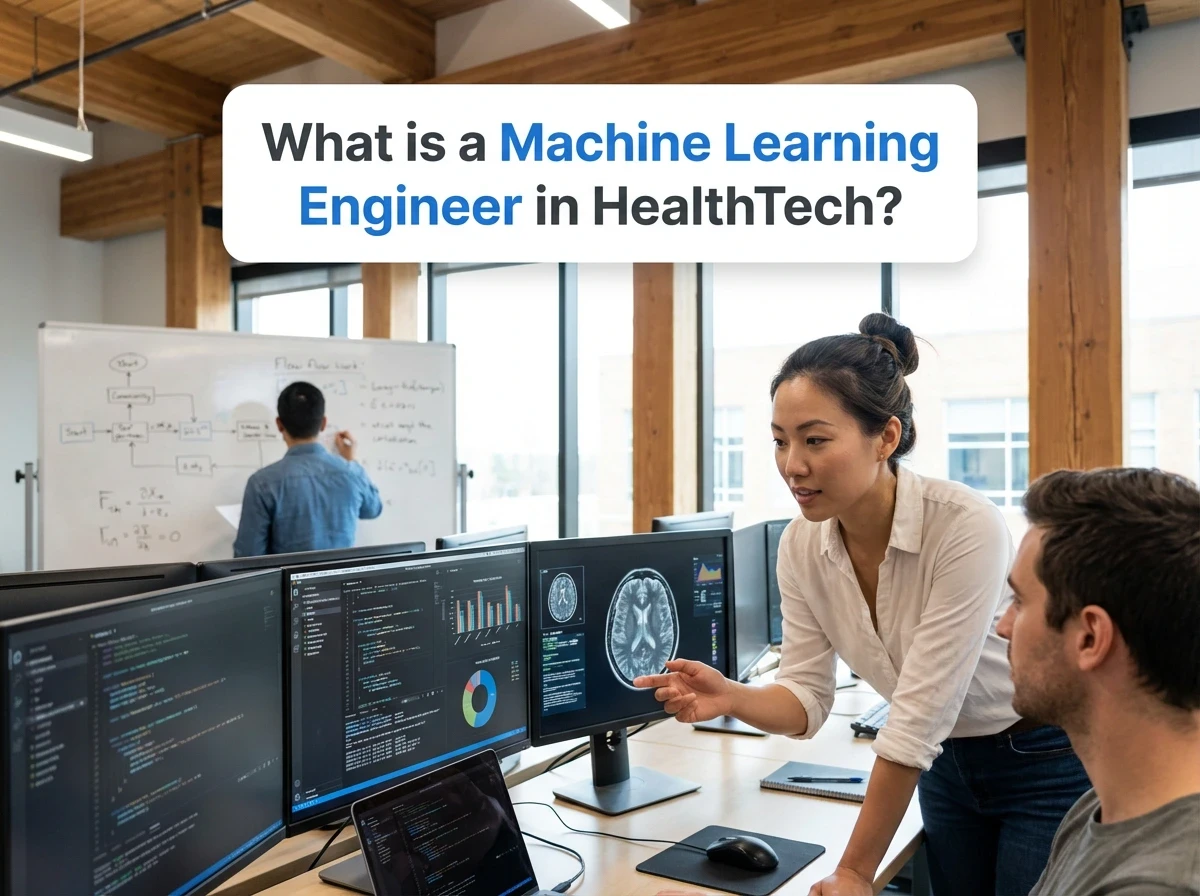
What is a Machine Learning Engineer in HealthTech?
A Machine Learning Engineer in HealthTech is an engineer who owns the delivery and ongoing safe operation of machine-learning-driven functionality in health and care products. They take responsibility for how models behave in the real world, not just how they perform in a notebook. They build systems where predictions, rankings, risk scores, summarisation, or automation meaningfully influence patient-facing experiences, clinician workflow, operational decisions, or clinical and safety outcomes.
This role exists because HealthTech organisations need someone accountable for turning data and research into dependable product behaviour under real constraints: sensitive data, messy real-world signals, changing populations, and a higher cost of mistakes. In practice, the job is to make sure machine learning is not "a project", but a maintained capability that is versioned, monitored, auditable, and integrated into software that people can trust.
In many teams, the Machine Learning Engineer sits between product engineering, data engineering, and applied science. They are often the person held responsible when a model silently degrades, a feature's behaviour can't be explained to stakeholders, or a deployment creates downstream risk that wasn't obvious during experimentation.
🔍 How this role differs in HealthTech
In other industries, machine learning can be judged primarily on conversion lift, engagement, or operational efficiency. In HealthTech, the same techniques are shaped by a different set of realities: the data is more sensitive, the context is higher stakes, and the consequences of failure can be clinical, ethical, or reputational rather than purely commercial.
A HealthTech Machine Learning Engineer is expected to work in an environment where "can we build it?" is often less important than "should we ship it like this?" and "how do we keep it safe over time?" Decisions are influenced by privacy expectations, stricter governance, and the need to defend model behaviour to non-technical stakeholders. Even when a solution is not formally regulated, customers and partners often demand evidence, traceability, and clear operational controls.
The practical result is that HealthTech ML Engineering tends to be more conservative in rollout, heavier on monitoring and change control, and more focussed on how humans interact with model outputs. The model is rarely the only decision-maker, but it can still shape outcomes.
🎯 Core responsibilities in HealthTech
Day to day, the Machine Learning Engineer is accountable for making ML features reliable in production: shaping the training data and labels into something fit for purpose, selecting evaluation methods that reflect real-world harm and benefit, and designing deployment paths that reduce risk. They spend as much time negotiating constraints as they do writing code. This means balancing speed against evidence quality, accuracy against interpretability, automation against human oversight, and model freshness against stability.
A typical week might include investigating a performance drop that turns out to be a data pipeline change, aligning with clinical or domain experts on what a "good" outcome actually means, and tightening monitoring so you can detect drift before it becomes a user-facing incident. They also tend to own the "edge cases" others avoid: missingness patterns in clinical-like data, distribution shifts when a partner site changes workflow, or brittle behaviour when text inputs evolve.
Trade-offs are constant. Sometimes the right decision is to ship a simpler model with clearer failure modes. Sometimes it's to delay a release until you can prove the feature won't systematically disadvantage a subgroup. Sometimes it's to add product guardrails (thresholding, deferrals, abstention logic, or human review) because the ML output is not safe to act on autonomously. The defining responsibility is not model building; it's being answerable for the feature's behaviour after launch.
🧩 Skills and competencies for HealthTech
Core Skill | HealthTech specific requirement | Reason or Impact |
|---|---|---|
Production ownership | Treat ML as a running service with uptime, incident response, and clear rollback paths | HealthTech organisations need predictable behaviour under pressure; "we'll retrain later" is not an acceptable operating model when outcomes and trust are at stake |
Risk-based decision-making | Evaluate changes through failure modes, impact severity, and operational safeguards | The most important metric is often "what happens when we're wrong?", which shapes thresholds, UX design, and escalation routes |
Data stewardship | Work effectively with constrained, sensitive, and access-controlled data environments | Practical progress depends on respecting privacy and governance whilst still delivering, which requires careful design of pipelines, logs, and permissions |
Evidence-minded evaluation | Align model evaluation with real-world benefit, not just offline scores | HealthTech stakeholders often need clear evidence narratives; a small metric gain is meaningless if it doesn't translate to safer or better outcomes |
Monitoring and drift management | Detect distribution shift, performance decay, and upstream data changes early | Health data and workflows change; without drift strategy, systems quietly degrade and produce confident but wrong outputs |
Cross-functional communication | Explain model behaviour, limitations, and safeguards to non-ML stakeholders | Adoption depends on trust; you need to make constraints legible to product, clinical/domain, security, and leadership audiences |
Change control discipline | Version data, models, features, and evaluation artefacts with clear release notes | HealthTech environments often require traceability; when questions arise, "what changed?" must be answerable quickly and accurately |
Human-in-the-loop design judgement | Decide where ML should advise, defer, or automate, and how feedback is captured | Many HealthTech use cases require calibrated reliance; design choices determine whether ML improves workflows or creates new safety risks |
💷 Salary ranges in UK HealthTech
Compensation for Machine Learning Engineers in UK HealthTech is driven less by "ML in general" and more by the scope of ownership and the risk profile of what you're running. The biggest levers are: whether the ML feature is safety-critical or heavily governed, the maturity of the production platform, how independently you can own end-to-end delivery, and whether you carry operational responsibility (including on-call) for ML services. Location still matters, but in HealthTech the premium is often highest where accountability is highest: regulated constraints, complex integrations, and real-world monitoring expectations.
Experience level | Estimated annual salary range | What drives compensation |
|---|---|---|
Junior | London & South East: £45,000–£60,000 Rest of UK: £40,000–£55,000 | Limited end-to-end ownership; compensation rises quickly if you can run reliable pipelines, ship safely behind guardrails, and contribute to monitoring and incident hygiene |
Mid-level | London & South East: £60,000–£85,000 Rest of UK: £55,000–£75,000 | Ability to deliver production ML with minimal supervision, handle data quality constraints, and make sensible trade-offs around model complexity and maintainability |
Senior | London & South East: £85,000–£120,000 Rest of UK: £75,000–£105,000 | Ownership of critical ML components, strong judgement on safety and evaluation, mentoring, and responsibility for reliability, drift response, and cross-team alignment |
Lead | London & South East: £110,000–£150,000 Rest of UK: £95,000–£130,000 | Technical leadership across multiple ML services or a platform, setting standards for governance and release discipline, and being accountable for outcomes across teams |
Head / Director | London & South East: £135,000–£200,000 Rest of UK: £115,000–£170,000 | Organisation-level accountability: strategy, risk posture, hiring, stakeholder management, and ensuring ML delivery is safe, auditable, and aligned with business and care priorities |
Beyond base salary, typical add-ons include annual bonus (often tied to company and personal performance), equity (more common in venture-backed HealthTech, less common in some established environments), and benefits such as pension and private medical cover. On-call compensation varies: some roles have no on-call at all, whilst others include a standby allowance and/or time-off-in-lieu when ML services are considered production-critical. Total compensation moves most when the role includes production accountability, high-impact ML features, and meaningful leadership scope.
🚀 Career pathways
Entry points into HealthTech ML Engineering are varied. Some people come through data engineering or backend engineering and move into ML once they can reliably ship services and handle operational responsibility. Others start in data science or research-heavy roles and transition when they demonstrate they can productionise models, manage drift, and own the lifecycle rather than just analysis.
Progression is typically a widening of ownership. Early on, you're trusted with a defined model or pipeline. At mid-level, you own a feature end-to-end and can explain its behaviour to stakeholders. At senior level, you become the person who can run a critical ML capability safely over time (handling monitoring, incidents, and change control without drama). Lead roles expand into setting standards and enabling other teams: shaping platform choices, governance patterns, and release practices. Head/Director responsibility is less about being the best modeller and more about ensuring the organisation can repeatedly deliver ML safely, predictably, and with clear accountability.
❓ FAQ
Do I need healthcare experience to get hired as a Machine Learning Engineer in HealthTech?
Not always, but you do need to show you can operate under constraints: sensitive data, messy real-world signals, and high expectations for reliability. Candidates without HealthTech background typically do best when they can demonstrate strong production ownership, careful evaluation thinking, and an ability to communicate limitations clearly.
What will interviews focus on beyond "model accuracy"?
Expect assessment of end-to-end judgement: how you'd validate a feature, manage drift, respond to incidents, and design guardrails for failure modes. Many teams will probe how you handle trade-offs when data is incomplete, labels are imperfect, or stakeholders need understandable behaviour rather than maximum complexity.
Is on-call common for Machine Learning Engineers in HealthTech?
It depends on whether ML is treated as a core production service and how directly it affects operations or care pathways. Where on-call exists, it's often about data pipeline failures, model serving issues, or monitoring alerts rather than "fixing the model" in real time; understanding how you'd triage and roll back safely is important.
🔎 Find your next role
Ready to apply your ML engineering skills to real-world health impact? Search Machine Learning Engineer roles on Meeveem.
You might also like