Published Date: December 29, 2025
Updated Date: December 29, 2025
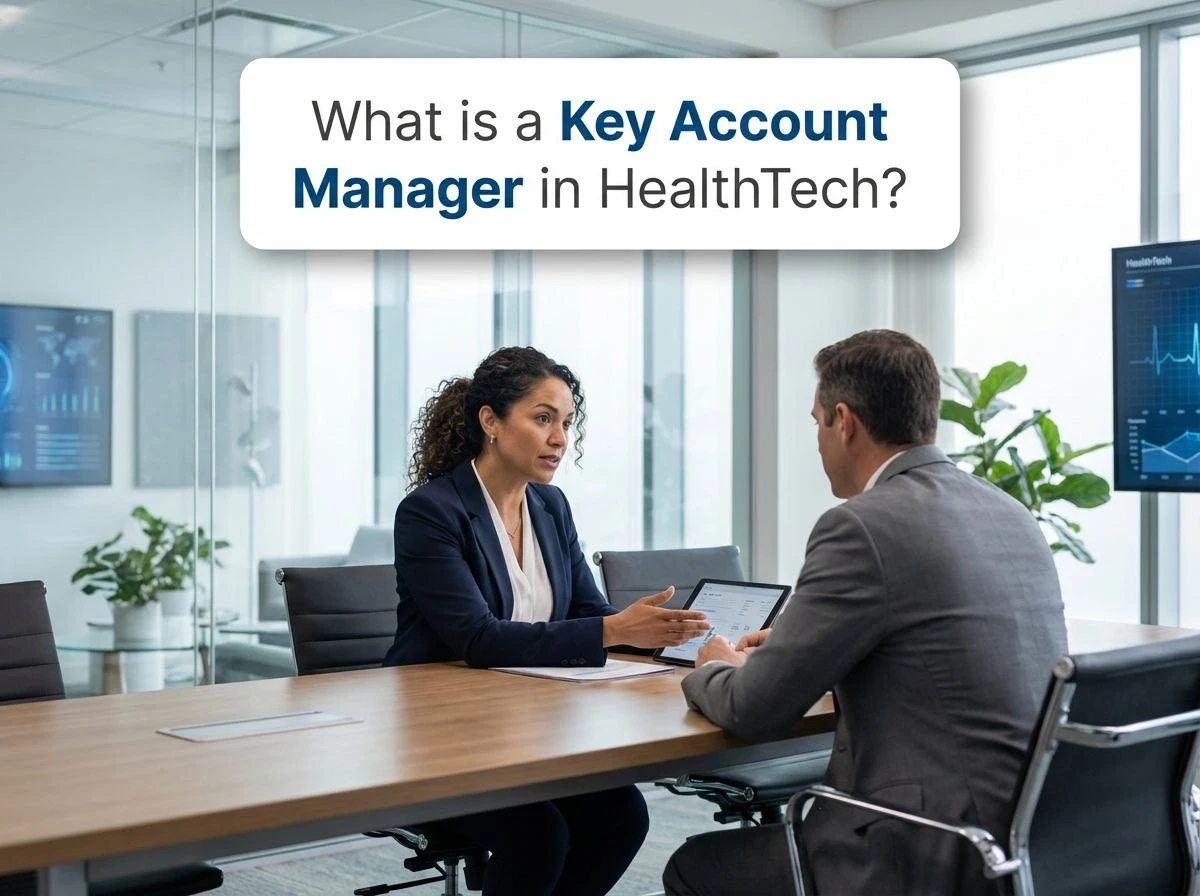
What is a Key Account Manager in HealthTech?
A Key Account Manager (KAM) in HealthTech is the commercial owner of a small number of high-value, high-dependency customer relationships. These are typically healthcare providers, payers, or enterprise partners where continuity, trust, and delivery reliability directly affect revenue and often patient-facing services. Unlike broader account management, the "key" in Key Account Manager signals that these customers are strategically important: they are large, influential, complex to serve, or difficult to replace.
This role exists because HealthTech companies need a single accountable person to hold the full relationship: commercial outcomes (renewal, expansion, margin), operational outcomes (adoption, service continuity), and stakeholder outcomes (executive alignment and satisfaction). In practice, KAMs sit at the intersection of sales, customer success, delivery/implementation, and product, bringing those functions together around one clear goal: keep critical accounts healthy, contracted, and growing.
In many HealthTech organisations, the KAM reports into Commercial, Revenue, or Customer (often under a Commercial Director, Head of Account Management, or Head of Customer Success). The job is not "support with better manners"; it's ownership of the relationship risk and the commercial plan, with the authority to escalate internally and the responsibility to prevent avoidable customer failure.
🔍 How this role differs in HealthTech
In most tech sectors, a Key Account Manager can optimise for speed: rapid rollout, fast iteration, and aggressive expansion. In HealthTech, the same instincts need to be balanced against environments where change is slower, stakeholder maps are wider, and the consequences of missteps are higher.
HealthTech accounts commonly involve sensitive data, clinical workflows, and operational dependencies that can't be casually disrupted. A decision that would be a standard "process tweak" in consumer tech may become a governance issue in healthcare, requiring careful communication, documented rationale, and more conservative rollout planning. The KAM becomes a risk manager as much as a growth driver: protecting patient-facing continuity, ensuring commitments are realistic, and preventing internal teams from over-promising under pressure.
Where FinTech often concentrates risk around financial loss and regulatory compliance, HealthTech adds a distinct layer: real-world service impact. That shifts how KAMs negotiate timelines, manage incidents, and agree success metrics because "value" is frequently measured not just in ROI, but in service stability, clinician confidence, and operational readiness.
🎯 Core responsibilities in HealthTech
Day to day, a HealthTech Key Account Manager is accountable for keeping strategically important customers on track: commercially, operationally, and politically. That starts with owning the narrative of the account: what outcomes the customer is trying to achieve, what blocks progress, what "good" looks like in the next quarter, and what risks could derail it. They translate that narrative into internal priorities: which product requests deserve escalation, what implementation issues must be resolved first, and what needs executive attention.
Because healthcare environments can be multi-stakeholder, KAMs often make decisions under competing constraints. A customer may want faster delivery, while internal teams need safer rollout windows; the commercial team may want expansion, while the customer needs stability and proof of value. The KAM's job is to make those trade-offs explicit, negotiate a path that protects trust, and document commitments in a way that survives staff turnover on both sides.
They also carry accountability through friction: managing renewal risk when adoption is uneven, handling escalations when incidents occur, and maintaining credibility when the customer asks for commitments that aren't feasible. In well-run HealthTech companies, KAMs are expected to be commercially fluent (renewals, pricing, forecasting) and operationally grounded (implementation realities, change management, governance), not merely relationship-oriented.
🧩 Skills and competencies for HealthTech
Core Skill | HealthTech specific requirement | Reason or Impact |
|---|---|---|
Stakeholder leadership | Comfort leading across clinical, operational, digital, and procurement audiences without relying on hierarchy | HealthTech accounts often require alignment across groups with different incentives; the KAM must create shared direction to prevent stalled delivery and renewal risk |
Commercial judgement | Ability to balance revenue goals with service continuity, delivery capacity, and customer readiness | Over-selling in HealthTech can damage trust and trigger churn if delivery impacts frontline operations; sound judgement protects long-term revenue |
Risk management | Proactively identifying relationship, delivery, and reputational risks and setting mitigation plans | A small issue can escalate quickly when services are patient-facing; disciplined risk handling reduces escalations and protects account stability |
Outcome framing | Turning "feature requests" into measurable outcomes that match healthcare reality | HealthTech value is often multi-dimensional; clear outcome framing helps secure renewals, supports adoption, and reduces scope creep |
Governance and accountability | Operating confidently in structured decision-making environments (steering groups, formal escalation paths, documented decisions) | Healthcare customers often need clarity, auditability, and predictable process; governance competence shortens decision cycles and improves credibility |
Cross-functional influence | Driving priority internally across Product, Engineering, Implementation, Support, and Sales | Key accounts demand coordinated delivery; influence prevents internal fragmentation and ensures the customer experiences "one company," not competing teams |
Communication under pressure | Calm, precise incident and escalation communication that protects trust while being honest about constraints | HealthTech customers expect transparency when things go wrong; strong communication can prevent a service issue turning into a commercial failure |
💷 Salary ranges in UK HealthTech
In UK HealthTech, salary is driven less by the label "Key Account Manager" and more by the scope of accountability: size and strategic importance of the portfolio, renewal/expansion ownership, complexity of stakeholders, and how close the product sits to patient-facing operations. Location still matters (especially London and South East), but the biggest swings come from whether the role is closer to enterprise relationship ownership (renewals, forecasting, commercial negotiation) or more like scaled account coverage with limited commercial authority. On-call expectations are not universal for KAMs, but some HealthTech organisations expect escalation availability for priority accounts during incidents, which can influence pay.
Experience level | Estimated annual salary range | What drives compensation |
Junior | London & South East: £35,000–£45,000 | Support-to-ownership transition, smaller portfolio scope, lighter negotiation responsibility, less exposure to executive stakeholders |
Mid-level | London & South East: £45,000–£60,000 | Owning renewals/retention for a defined portfolio, greater autonomy, stronger forecasting expectations, more complex stakeholder environments |
Senior | London & South East: £60,000–£80,000 | Enterprise/strategic accounts, high renewal risk, expansion ownership, complex delivery dependencies, frequent executive engagement and escalations |
Lead | London & South East: £75,000–£95,000 | Leading the most critical accounts and/or mentoring others, shaping account strategy and playbooks, influencing product and delivery prioritisation |
Head / Director | London & South East: £95,000–£140,000 | Team and revenue ownership, multi-segment portfolio strategy, senior stakeholder relationships, forecasting discipline, performance management, and strategic partnerships |
Typical add-ons include an annual bonus (often tied to renewals, retention, net revenue retention, or expansion), commission/OTE structures for commercially focused KAM roles, and equity or options in growth-stage HealthTech companies. Total compensation varies most when the role carries explicit quota/OTE, manages a very small number of high-stakes enterprise accounts, or includes regular out-of-hours escalation ownership during incidents affecting critical customers.
🚀 Career pathways
Many HealthTech KAMs enter from adjacent roles where they've already demonstrated ownership: customer success, account management, implementation, clinical partnership roles, or healthcare sales. The common thread is credibility with customers and the ability to coordinate internally, especially when outcomes depend on multiple teams.
Progression usually follows an expansion of responsibility rather than a sudden title jump. Early on, the focus is learning to stabilise accounts and run reliable renewals. With experience, the KAM becomes the person trusted to handle the highest-risk relationships: accounts with complex governance, heavy stakeholder maps, or delivery dependencies. From there, growth can move in two directions: deeper strategic ownership (enterprise/strategic accounts, partnerships, complex negotiations) or leadership (building the function, setting standards, managing a team, and owning forecasting and performance).
❓ FAQ
Do HealthTech Key Account Managers typically own renewals, or is that handled by Sales?
It varies by company, but many HealthTech KAM roles own renewals end-to-end for their portfolio, especially where retention depends on adoption and service stability. In more sales-led organisations, Sales may lead renewal negotiation while the KAM owns account health, stakeholder alignment, and risk mitigation.
What will I be judged on in the first six months as a HealthTech KAM?
Expect to be evaluated on whether you can build credible relationships quickly, surface risks early, and create a clear account plan that internal teams can execute. Hiring managers also look for evidence that you can handle escalations calmly and keep commercial forecasting realistic rather than optimistic.
Is on-call common for Key Account Managers in HealthTech?
Formal on-call rotas are more common in Support or Engineering, but KAMs can be expected to be available for priority-customer escalations when incidents occur. Where this expectation is explicit and frequent, it can affect compensation and should be clarified during interviews.
🔎 Find your next role
Ready to take ownership of strategic HealthTech relationships? Search Key Account Manager roles on Meeveem and find a position that matches your scope, sector, and growth goals.
You might also like