Published Date: January 5, 2026
Updated Date: January 5, 2026
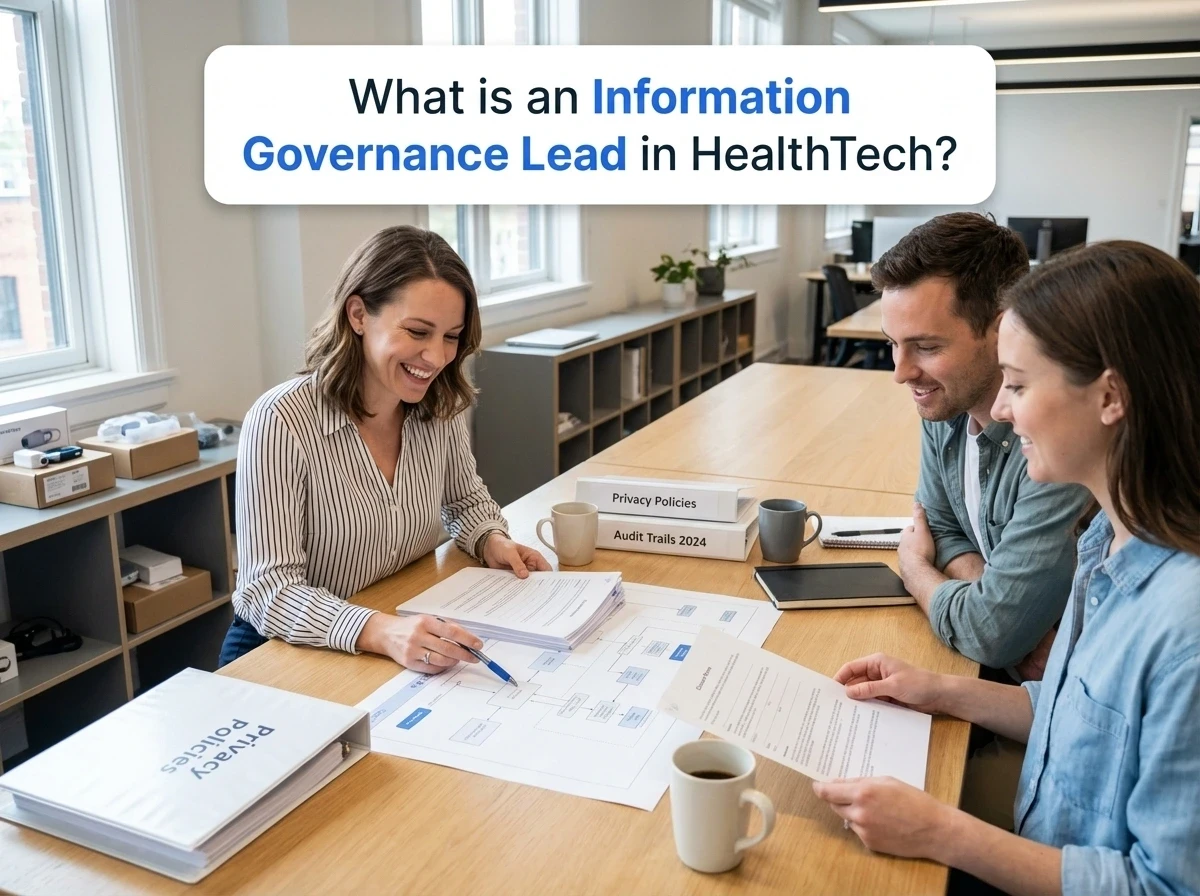
What is an Information Governance Lead in HealthTech?
An Information Governance Lead in HealthTech is the person accountable for how an organisation uses, shares, protects, retains, and proves control over sensitive information, especially patient, user, and clinical-operational data, so that the business can operate lawfully, safely, and credibly. It's a governance role, but not "paper governance": it exists to make real decisions about risk, data use, and acceptable controls so products and services can ship without creating avoidable harm or regulatory exposure.
This role exists because HealthTech sits in a high-trust, high-sensitivity environment where data is both an asset and a potential source of clinical, legal, and reputational damage. As organisations scale, "everyone being careful" stops working; teams need a clear owner who can set boundaries, unblock responsible delivery, and take responsibility when trade-offs are hard.
Before any framework or process, the defining feature of the role is ownership: owning the organisation's posture on privacy, confidentiality, records, information rights, and data sharing; owning how decisions are documented; and owning escalation when risks can't be reduced further without changing product scope or operational design.
🔍 How this role differs in HealthTech
In many tech sectors, information governance can lean heavily toward efficiency: standard retention schedules, broad internal access for analytics, or faster vendor onboarding. In HealthTech, the default posture is different. The data is more intimate, the consequences of misuse are more concrete, and the tolerance for "we'll fix it later" is much lower.
HealthTech information governance is shaped by real-world impact. A permissioning mistake can expose clinical notes. A poorly structured sharing agreement can break a partnership. An unclear legal basis can halt a product roll-out. And even when something is technically legal, it may not be acceptable to patients, clinicians, or commissioners, so the IG Lead must navigate not just compliance, but legitimacy.
You'll also see the role sit closer to delivery than in many other industries. It commonly partners tightly with security, clinical safety, product, legal, and operations because governance decisions must survive contact with live services, incident response, audits, and procurement due diligence.
🎯 Core responsibilities in HealthTech
Day to day, an Information Governance Lead holds the line on what the organisation will and won't do with sensitive data, and makes that practical for teams building and operating systems. That means translating law, contracts, and sector expectations into decisions that product and engineering can implement, without turning governance into a blocker.
Much of the work is decision-making under constraints: a customer wants a new data feed, but consent and purpose limitation are unclear; an ML team wants a richer dataset, but minimisation and transparency are not yet defensible; an operations team needs rapid access to resolve a patient issue, but access controls must remain proportionate. The IG Lead is expected to arbitrate these moments, document rationale, and escalate when the "safe" option requires changing timelines, scope, or commercial terms.
The role also carries accountability for information rights and incident handling readiness. In practice, this means ensuring the business can respond credibly to requests, questions, and failures, whether that's a subject access request, a partner's audit, a commissioner's assurance requirement, or an information incident that demands coordinated triage across security, legal, and operations.
🧩 Skills and competencies for HealthTech
Core Skill | HealthTech specific requirement | Reason or Impact |
|---|---|---|
Accountability under regulatory ambiguity | Comfort making defensible calls when product reality doesn't map neatly to guidance | Prevents paralysis and reduces the risk of shipping something that later becomes indefensible under scrutiny |
Risk-based judgement | Ability to weigh privacy, confidentiality, clinical context, operational urgency, and patient trust together | Produces decisions that are safe enough to operate, not merely "compliant on paper" |
Cross-functional authority | Influence across product, engineering, security, legal, and clinical stakeholders without relying on hierarchy | Enables consistent governance decisions across squads and prevents "local exceptions" becoming systemic risk |
Contract and assurance literacy | Confidence translating information governance needs into procurement answers, partner commitments, and audit-ready evidence | Shortens sales and onboarding cycles while avoiding commitments the organisation can't realistically keep |
Information lifecycle thinking | Designing retention, access, sharing, and deletion around clinical and operational reality rather than generic IT patterns | Reduces long-term risk and cost by preventing uncontrolled data sprawl and unclear ownership |
Incident and escalation leadership | Calm, structured decision-making during breaches, near misses, and high-pressure stakeholder moments | Improves response quality, reduces harm, and protects organisational credibility when it matters most |
Pragmatic communication | Explaining constraints and options in plain language to non-specialists, including clinicians and ops teams | Increases adoption of controls and reduces workarounds that silently undermine governance |
💷 Salary ranges in UK HealthTech
Compensation for Information Governance roles in UK HealthTech is driven less by "years of experience" alone and more by risk exposure and operational responsibility: whether the role is the named owner for IG (or deputises for a DPO/Head of IG), whether it supports clinical systems and cross-organisation data sharing, the volume/complexity of information rights work, and how often the person is needed for urgent decisions. Location still matters, especially in London & the South East, but regulated scope and stakeholder pressure can outweigh geography.
Experience level | Estimated annual salary range | What drives compensation |
Junior | London & South East: £32,000–£40,000 | Early-career IG delivery, supporting DPIAs, information rights administration, basic policy and records support, limited independent sign-off |
Mid-level | London & South East: £40,000–£52,000 | Owning parts of the IG programme, advising teams directly, handling more complex information rights and incidents with supervision, stronger stakeholder management |
Senior | London & South East: £52,000–£68,000 | Independent decision-making on risk, leading DPIAs/data sharing workstreams, influencing product delivery, supporting audits and external assurance, mentoring others |
Lead | London & South East: £65,000–£85,000 | Organisation-wide ownership for IG outcomes, shaping policy and operating model, leading cross-functional escalation, high-trust partner/customer engagement, potential deputising for DPO/Head of IG |
Head / Director | London & South East: £85,000–£120,000 | Strategic accountability, budgeting and team leadership, senior leadership influence, regulator/commissioner-grade assurance, responsibility for high-impact incidents and governance posture across products and services |
Beyond base salary, total compensation commonly includes pension contributions and standard benefits, some employers add performance bonus, private healthcare, and (in venture-backed firms) equity or options. On-call is not universal for IG, but an "incident escalation" expectation can show up in senior/lead roles, sometimes paired with an allowance, sometimes folded into base; variation is typically driven by incident frequency, customer assurance demands, and whether the IG Lead is a key decision-maker during live service issues.
🚀 Career pathways
People often enter HealthTech information governance from privacy, records management, information rights (FOI/SAR work), clinical operations, healthcare IT, compliance, or security-adjacent roles where they've had to translate rules into operational reality. A realistic starting point is being the person who reliably closes the loop on governance work: getting DPIAs completed properly, making information sharing agreements workable, and ensuring responses and evidence stand up to scrutiny.
Progression tends to follow ownership. At first, you own delivery of a defined slice of IG. Then you own decisions: sign-off, risk acceptance recommendations, and the practical guardrails product teams work within. Later, you own the organisation's IG posture, how it shows up in partnerships, procurement, audits, and incident response, and your scope expands from "doing the work" to building a system that keeps working as teams, products, and data flows multiply.
The strongest career moves usually come from demonstrating credible judgement in high-stakes moments: a difficult data sharing negotiation, a serious incident, a product launch with uncomfortable constraints, or a rapid scaling phase where governance must mature without stopping delivery.
❓ FAQ
Do HealthTech employers expect an Information Governance Lead to act as the Data Protection Officer?
Not always. Some organisations have a separate DPO (internal or external), while the IG Lead owns day-to-day governance decisions and evidence, and escalates complex points for formal DPO input. In interviews, clarify who signs off risk, who interfaces with regulators, and whether you'll be deputising.
How will I be assessed if the product is still evolving and data flows keep changing?
You'll be judged on whether you can create governance that survives change: clear decision logs, proportionate controls, and practical guidance teams actually follow. Employers also look for how you handle trade-offs, what you push back on, what you allow with mitigations, and how you document why.
Will I be "on-call" for incidents, and what does that mean in practice?
Many roles won't have formal on-call, but senior IG roles often carry an expectation of availability for high-severity incidents or urgent customer escalations. It may involve advising on containment, communications input, and ensuring decision-making is documented. Ask directly how often escalations happen, who leads incident response, and whether there's any allowance or time-off-in-lieu.
🔎 Find your next role
If you're ready to take ownership of information risk in a sector where decisions genuinely matter, search Information Governance roles on Meeveem.
You might also like