Published Date: December 17, 2025
Updated Date: December 17, 2025
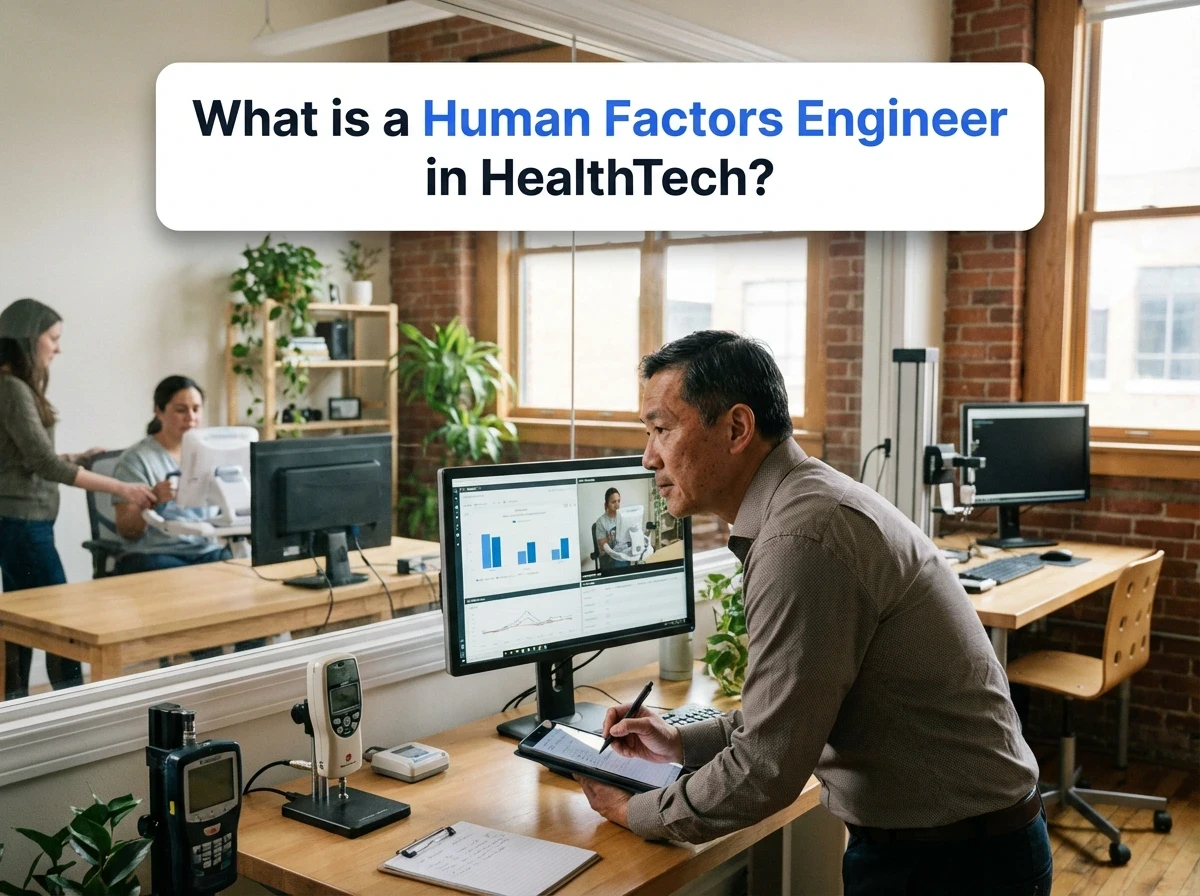
What is a Human Factors Engineer in HealthTech?
A Human Factors Engineer in HealthTech ensures that health products can be used safely and effectively by their intended users in real-world environments. This includes patients at home, clinicians working under time pressure, carers with limited training, and support staff navigating busy systems. The role exists because "works as designed" is not the same as "works safely in real life." In healthcare, the gap between the two is measured in harm, missed diagnoses, delayed treatment, or unsafe dosing.
This job is not owned by research or design alone. It is a risk-and-outcomes role that involves owning use-related safety risks, making defensible decisions about interface and workflow design, and ensuring that what ships aligns with clinical reality, data sensitivity, and the expectations surrounding health products. In many teams, the Human Factors Engineer is the person who can say, with evidence, whether the product is ready to be used by intended users without unacceptable use error, and what must change if it is not.
🔍 How this role differs in HealthTech
In many tech industries, usability problems are costly because they reduce conversion, retention, or efficiency. In HealthTech, usability problems can become safety risks, regulatory blockers, or sources of clinical burden. This shifts the centre of gravity of the role. Human Factors is less about preference and more about whether the product supports safe decisions, correct actions, and reliable outcomes under real-world constraints.
Health data sensitivity also changes the trade-offs. Authentication, consent, audit trails, and privacy controls can add friction, but the Human Factors Engineer is expected to help teams land designs that remain usable under pressure. The work is also shaped by the reality that health products often operate in mixed ecosystems: devices, apps, clinical systems, and physical environments. In these contexts, the "interface" includes alarms, labels, instructions, training, and handovers, not just screens.
Where other sectors can iterate freely after launch, HealthTech frequently requires higher confidence before release, with stronger expectations for documented rationale, traceability, and post-market learning when issues are discovered in real clinical use.
🎯 Core responsibilities in HealthTech
Day to day, a Human Factors Engineer carries the accountability of translating real-world use into product decisions that hold up under scrutiny. That starts by establishing who the users truly are (including edge cases), what tasks matter most, and what "failure" looks like in practice: wrong selection, misinterpretation, missed alerts, incorrect device setup, or unsafe workarounds. They then steer the team towards designs that reduce the likelihood and severity of those failures, whilst acknowledging that time, cost, technical constraints, and clinical workflows are not optional.
A large part of the work is making trade-offs explicit and defensible: deciding when training is acceptable versus when the design must change, when a safety control is essential versus when it creates new error paths, and how to balance speed and simplicity against necessary clinical detail. In product reviews, this role often becomes the person who frames disagreements as risk decisions rather than opinion debates, and who sets the standard for evidence over intuition.
In many HealthTech organisations, Human Factors sits at the intersection of product, design, engineering, clinical, and quality/regulatory. The function may report into R&D, product, or quality depending on whether the organisation is more device-led, software-led, or highly regulated. Regardless of reporting line, the practical expectation is the same: own the use-related risk story, drive the evaluation plan, and ensure conclusions are reflected in what the team builds and ships.
🧩 Skills and competencies for HealthTech
Core Skill | HealthTech specific requirement | Reason or Impact |
|---|---|---|
Safety-centred judgement | Ability to distinguish inconvenience from clinically meaningful risk, and to prioritise hazards that could plausibly lead to harm | Keeps the team focused on real safety outcomes rather than "polish," and prevents critical risks being diluted among minor UX issues |
Context-of-use reasoning | Comfort working with messy environments: interruptions, shared devices, low-light settings, gloves, stress, multilingual users, variable health literacy | Ensures decisions reflect reality, reducing the chance of predictable use errors emerging only after rollout |
Evidence-based decision ownership | Ability to set what evidence is "enough" for a decision, and to stand behind it in cross-functional forums | Enables progress without false certainty, whilst maintaining a defensible rationale when outcomes are questioned |
Risk communication | Turning findings into clear, action-oriented risk statements that product, engineering, and clinical stakeholders can act on | Prevents research outputs becoming "interesting insights" that don't change the build or the release decision |
Systems thinking across product + service | Seeing the user experience as device/app + labelling + training + support + monitoring + workflow integration | Reduces harm caused by gaps between components (for example, a safe UI undermined by unclear instructions or a brittle workflow) |
Stakeholder leadership without formal authority | Ability to align strong opinions across product, design, clinical, and quality by framing trade-offs in shared terms | Human Factors often cannot "approve" work unilaterally, so influence and clarity are essential to avoid unsafe compromises |
Regulated documentation discipline | Producing clear, traceable artefacts that connect user needs, known hazards, evaluation results, and final design decisions | Supports smoother internal governance and external scrutiny, and reduces rework when questions arise late in delivery |
💷 Salary ranges in UK HealthTech
Compensation for Human Factors Engineers in UK HealthTech is most strongly driven by product risk and regulatory burden (for example, higher-risk devices and complex clinical workflows), the scope of ownership (single feature vs whole product line), and whether the role is embedded in a quality/regulatory operating model. Location matters, but so does the ability to lead cross-functional decisions, run studies end-to-end, and represent the use-related risk position with confidence. On-call is uncommon for this role, but total compensation can still vary meaningfully through bonus and equity, especially in venture-backed firms.
Experience level | Estimated annual salary range | What drives compensation |
|---|---|---|
Junior | London & South East: £35,000–£45,000 | Assisted ownership of studies and documentation; narrower problem space; closer supervision; less responsibility for release-critical decisions |
Mid-level | London & South East: £45,000–£60,000 | Running evaluations end-to-end, shaping design changes, and contributing materially to use-related risk arguments; complexity of user groups and workflows |
Senior | London & South East: £60,000–£80,000 | Accountability for safety-critical decisions, mentoring, and influencing product direction; higher scrutiny environments; greater independence and cross-team leadership |
Lead | London & South East: £80,000–£100,000 | Owning the function for a product line, setting standards and governance, handling contentious trade-offs, and representing Human Factors in senior forums |
Head / Director | London & South East: £100,000–£140,000 | Org-level accountability, portfolio prioritisation, team building, budget ownership, and external-facing risk posture; breadth across multiple products and markets |
Beyond base pay, typical add-ons include annual bonus (often modest in established firms, more variable in growth-stage companies) and equity in venture-backed HealthTech. On-call allowance is not typically a standard component for Human Factors Engineers. Where it appears, it is usually tied to broader operational responsibilities rather than pure human factors work. Total compensation moves most with seniority, regulated criticality (and the documentation burden that comes with it), leadership scope (single product vs portfolio), and the organisation's maturity and funding model.
🚀 Career pathways
Common entry points include human factors, ergonomics, psychology, industrial design, biomedical engineering, or UX research backgrounds, often with early exposure to safety, clinical environments, or complex hardware-software systems. Many people start by supporting study execution and documentation, then grow into ownership of end-to-end evaluation plans and the authority to recommend design changes that affect delivery schedules.
Progression is usually not about "doing more tests." It is about taking responsibility for harder decisions: defining what "safe enough to ship" means in a given context, aligning stakeholders when evidence is imperfect, and building mechanisms that prevent repeated use-related failures. At higher levels, the role expands into setting organisational standards, coaching teams to make safer decisions without constant oversight, and ensuring post-market signals feed back into design improvements rather than being treated as isolated incidents.
❓ FAQ
Do I need a clinical background to be credible as a Human Factors Engineer in HealthTech?
No, but you do need comfort working with clinicians, patients, and real workflows. Credibility usually comes from how well you understand context-of-use, how you reason about risk, and how you translate findings into product decisions that respect clinical realities.
What will interviewers look for beyond "I can run usability tests"?
They will probe how you make trade-offs when usability conflicts with safety controls, privacy constraints, or engineering limitations. Strong candidates can explain how they decide what evidence is sufficient, how they handle disagreement, and how they connect findings to design changes and risk rationale.
Is this role likely to include on-call work in HealthTech?
It is uncommon for Human Factors Engineers to be on a formal on-call rota. If a role mentions on-call, clarify whether it is for incident response, post-market safety monitoring, or broader operational coverage, and how decisions are made when issues are discovered out of hours.
🔎 Find your next role
If you are ready to work on products where usability is inseparable from safety, search Human Factors Engineer roles on Meeveem.
You might also like