Published Date: January 7, 2026
Updated Date: January 7, 2026
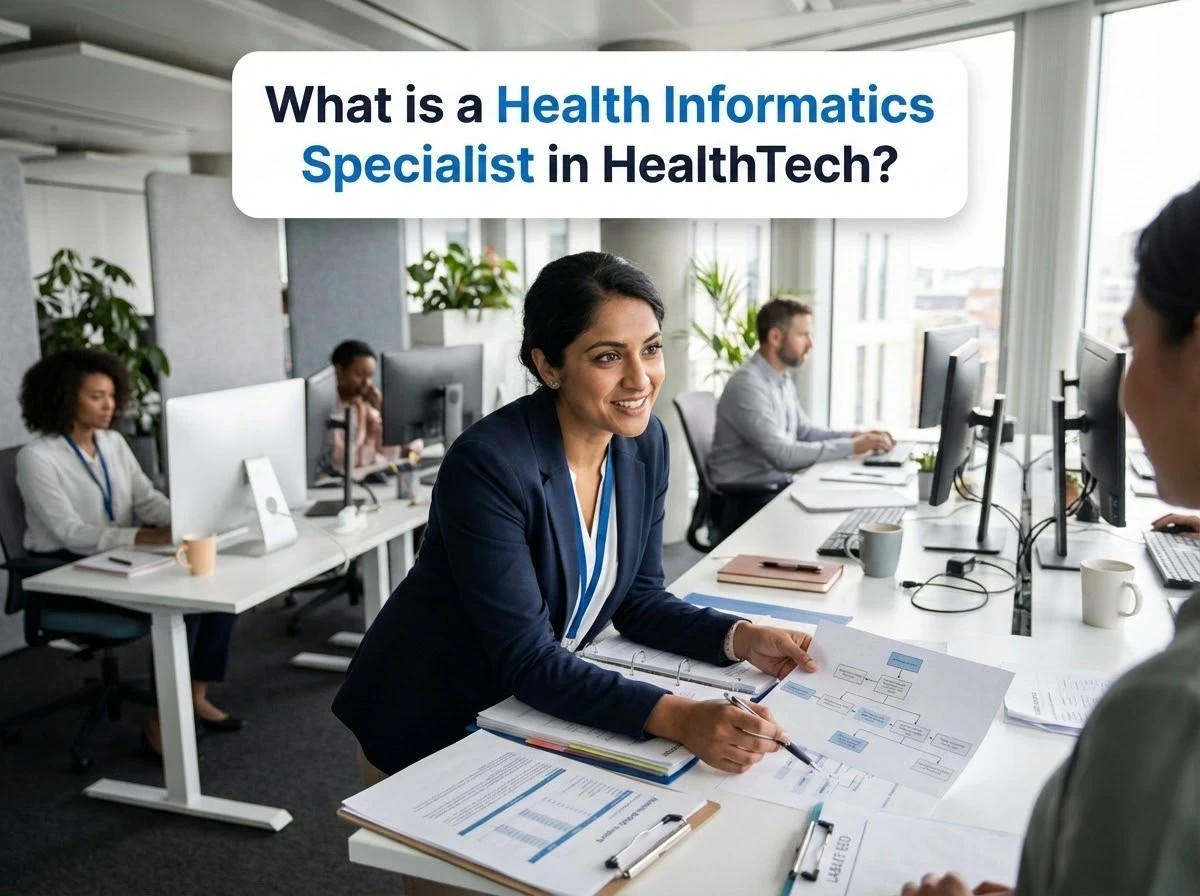
What is a Health Informatics Specialist in HealthTech?
A Health Informatics Specialist in HealthTech is the person accountable for turning clinical and operational reality into safe, usable, high-integrity health data and workflows inside digital products. They sit between clinical users, product teams, and data/engineering, owning how information is captured, structured, interpreted, and governed so that a tool can be trusted in real care settings.
This role exists because "health data" isn't just another dataset. Definitions vary by service line, clinical context changes meaning, and small design decisions can create downstream safety, compliance, and operational risks. A Health Informatics Specialist reduces that risk by owning the translation layer: making sure the product's data model and workflows reflect real-world care, support decision-making appropriately, and remain auditable.
The core of the job is responsibility: for data semantics, workflow integrity, safe change, and stakeholder alignment. Methods (requirements, standards, testing, training) matter, but they're secondary to ownership. Being the person who can say what's true, what's safe enough to ship, what must be escalated, and what cannot be compromised.
🔍 How this role differs in HealthTech
In many tech sectors, the cost of ambiguity is mostly commercial: churn, inefficiency, or a poor user experience. In HealthTech, ambiguity can become clinical risk, operational failure, or loss of trust in the system. That changes how a Health Informatics Specialist works: decisions are more constrained, trade-offs are explicit, and documentation and traceability carry real weight.
Data sensitivity also changes the job. It's not only about "protecting data", but about ensuring that access, provenance, and interpretation are appropriate for clinical and operational contexts. HealthTech organisations also tend to have more complex stakeholder environments (clinical leadership, frontline users, safety and governance functions, delivery teams, and external partners), so the role often includes navigating competing definitions of "correct".
Organisationally, the role commonly sits in product or delivery teams but maintains strong ties to clinical leadership, data governance, and implementation. In some HealthTech companies it's a dedicated informatics function; in others it's embedded, with a specialist assigned to a product area (for example, EHR adjacent tooling, digital triage, population health, or interoperability-focused products).
🎯 Core responsibilities in HealthTech
A Health Informatics Specialist is accountable for making sure the product behaves like the service it claims to support. Day to day, that means interrogating requirements until they become clinically and operationally precise, then shaping how they show up in data structures, workflows, user interactions, and reporting. They are often the person who spots when a "simple" feature request actually changes clinical meaning, alters downstream coding/reporting, or creates a safety or governance gap.
The work is constraint-heavy. You're routinely balancing speed-to-delivery against the need for safety assurance, auditability, and consistent definitions across environments. You may need to align multiple teams on what a concept means (for example, "episode", "triage outcome", "referral accepted", "medication changed") and then ensure those meanings remain stable through releases, migrations, and integrations.
Trade-offs are handled by being explicit: clarifying what is safe to automate versus what must remain user-confirmed, what can be configurable versus what should be standardised, and what must be logged for accountability. When there's uncertainty, the role is expected to escalate with a clear articulation of risk, impact, and decision options, not simply to block delivery, but to enable safe progress.
🧩 Skills and competencies for HealthTech
Core Skill | HealthTech specific requirement | Reason or Impact |
|---|---|---|
Clinical–technical translation | Convert clinical intent into unambiguous workflow and data definitions that engineers and analysts can implement consistently | Prevents "works in demos" features that fail in real care settings or produce misleading outputs |
Data semantics and information modelling judgement | Define what each field means, when it should be captured, who can change it, and how it evolves over time | Ensures reports, decision support, and audit trails reflect reality rather than artefacts of implementation |
Risk ownership and escalation | Recognise where product decisions create patient safety, operational, or governance risk and drive a documented decision | Reduces harm and protects the organisation by making trade-offs visible and accountable |
Stakeholder alignment under pressure | Facilitate agreement across clinical, product, engineering, data, and delivery when incentives conflict | Avoids fragmentation (multiple "truths") that break interoperability, analytics, and frontline trust |
Change control and traceability | Maintain continuity of meaning across releases, configurations, and integrations, including documenting rationale | Protects safety and compliance by ensuring people can explain what changed, why, and with what effect |
Implementation realism | Understand that adoption depends on training, workflow fit, local variation, and support models, not just features | Improves outcomes by designing for the real operating environment rather than idealised processes |
Communication for assurance | Write and present clear narratives that connect user need, constraints, risk, and design choices | Speeds decision-making and reduces rework, especially where approvals and governance are required |
💷 Salary ranges in UK HealthTech
Compensation for a Health Informatics Specialist is driven less by tools and more by scope and risk: whether you own a single workflow or a multi-service product area, how close your work sits to clinical decision-making, the complexity of integrations and data governance, and whether you're expected to provide assurance, sign-off, or out-of-hours support. Location matters, but so does seniority in accountability, especially when you're the person expected to say "this is safe enough" or "this definition will hold across partners".
Experience level | Estimated annual salary range | What drives compensation |
Junior | London & South East: £35,000–£45,000 | Supervision level, narrow vs broad domain exposure, and whether the role is closer to analysis/support or product-facing delivery |
Mid-level | London & South East: £45,000–£60,000 | Ownership of a workflow or module, stakeholder complexity, and responsibility for consistent definitions across teams |
Senior | London & South East: £60,000–£80,000 | Accountability for cross-product data semantics, leading governance decisions, and navigating higher-risk change with limited ambiguity |
Lead | London & South East: £80,000–£105,000 | Owning informatics strategy for a product area, influencing roadmap trade-offs, and being a primary escalation point for risk and assurance |
Head / Director | London & South East: £105,000–£140,000 | Organisational accountability (teams, budgets, external relationships), enterprise-wide data/workflow governance, and responsibility for safe scaling |
Typical add-ons vary by employer and operating model. Some roles include on-call or out-of-hours allowances when supporting clinical operations, incident response, go-lives, or high-availability services; these can materially lift total pay in teams with frequent releases or critical pathways. Bonus is more common in venture-backed or commercial HealthTech than in public-sector aligned structures, and equity is most typical in startups and scaleups, usually increasing with seniority and the breadth of ownership. Total compensation also shifts with domain criticality (patient-facing decision support vs back-office optimisation), integration footprint, and how much assurance responsibility sits with the role.
🚀 Career pathways
Entry routes are typically from healthcare operations, clinical backgrounds moving into digital roles, health data/BI roles that become increasingly workflow-aware, or implementation and customer delivery roles that deepen into governance and product accountability. Early progression usually comes from moving beyond "reporting what users want" to owning what the system should mean, and being able to defend those definitions under scrutiny.
Over time, responsibility expands from supporting a team to owning a domain: aligning stakeholders, controlling change, and ensuring that data and workflows remain safe and consistent across releases and partners. The strongest progression is marked by increasing decision rights, becoming the person trusted to set guardrails, arbitrate trade-offs, and represent clinical and operational reality inside product strategy.
At Lead and Head / Director levels, the pathway becomes less about individual contribution and more about building operating systems: informatics standards, governance forums, training models, assurance practices, and the org design that allows multiple product teams to ship safely without reinventing definitions each time.
❓ FAQ
Do I need to be a clinician to become a Health Informatics Specialist in HealthTech?
Not always. Many HealthTech teams hire non-clinicians who have strong workflow understanding and can translate real-world service delivery into reliable data and product behaviour. What matters is credibility with clinical and operational stakeholders and the ability to own definitions, risk, and change control.
What will interviews actually test for in this role?
Expect scenario-based questions: ambiguous requirements, conflicting stakeholder needs, and how you'd define "correct" data and workflow behaviour. You'll often be evaluated on how you reason about risk, traceability, and trade-offs, not on naming tools or standards from memory.
Will I be on call, and what does that look like in practice?
Some HealthTech roles include on-call or out-of-hours support, especially where products are operationally critical or used in time-sensitive pathways. The intensity varies widely: it may be incident triage and governance input, or it may include active support during releases and go-lives. Clarify expectations early, including rota frequency and how allowances are structured.
🔎 Find your next role
If you're ready to move into (or level up within) HealthTech informatics, search open Health Informatics Specialist roles on Meeveem.
You might also like