Published Date: December 18, 2025
Updated Date: December 18, 2025
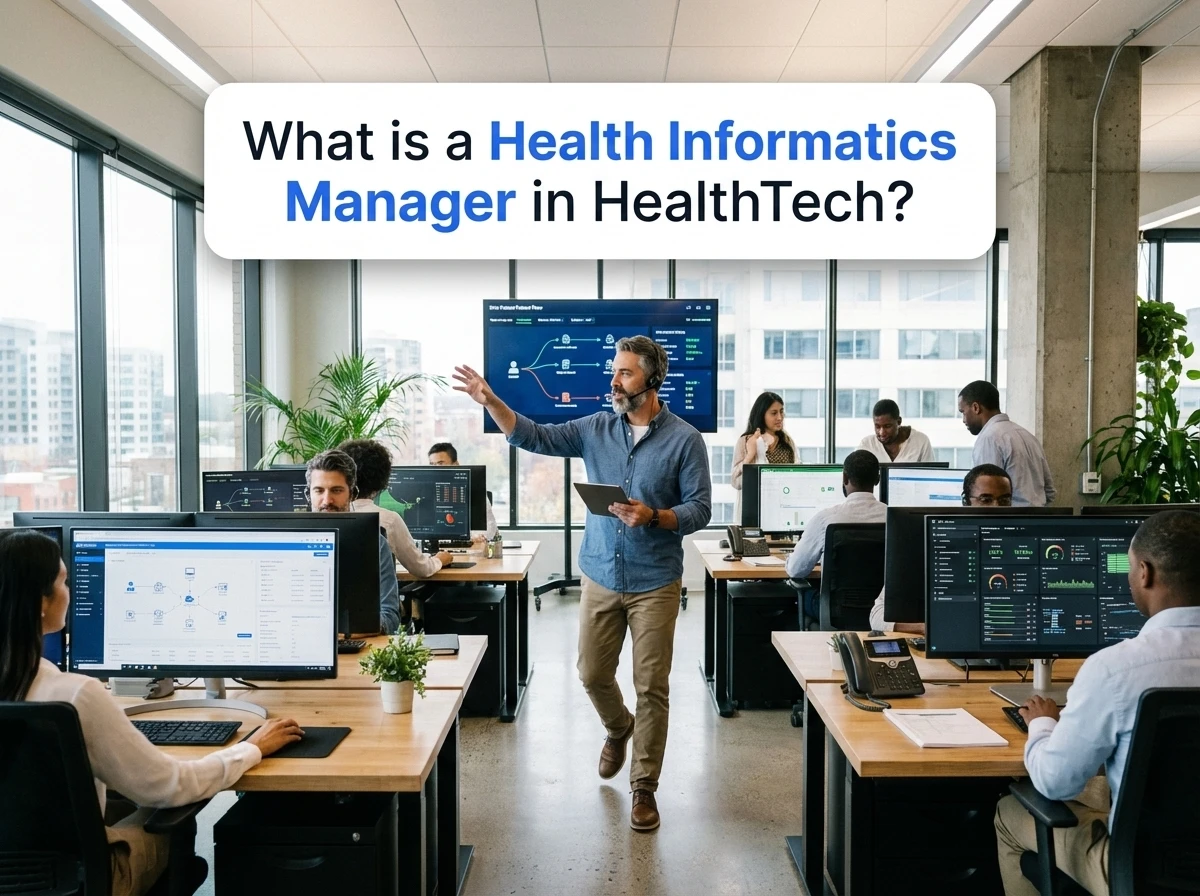
What is a Health Informatics Manager in HealthTech?
A Health Informatics Manager in HealthTech is the person accountable for how health data is captured, governed, interpreted, and operationalised inside a digital health product or service so that the organisation can safely deliver care, support clinical decision-making, and meet the expectations that come with handling sensitive patient information. They sit at the intersection of clinical reality, operational constraints, and technology delivery, translating "what must be true for safe care" into "what we will build, measure, and maintain."
This role exists because in healthcare, information isn't just a business asset. It becomes part of the care pathway. A single definition, workflow change, or data quality assumption can alter triage decisions, safety reporting, or outcomes measurement. HealthTech companies need someone who owns the rules of the data (meaning, provenance, quality, and permissible use), and who can make hard calls when product speed, clinical usability, and regulatory obligations collide.
More than anything, the job is ownership: owning data credibility, owning the informatics operating model, and owning the risk trade-offs that come with deploying technology into real clinical environments.
🔍 How this role differs in HealthTech
In many tech sectors, "data correctness" is often framed as analytics hygiene or product insight maturity. In HealthTech, correctness can become a safety issue, a contractual issue, and a trust issue simultaneously. The Health Informatics Manager is therefore closer to an accountable "clinical-data operator" than a pure delivery manager: they are expected to protect clinical meaning, ensure data supports decisions, and keep systems defensible under scrutiny.
Risk and sensitivity change the tone of everyday work. You're not only optimising dashboards or pipeline reliability. You're managing how patient data is interpreted, how clinical users experience workflows under pressure, and how evidence is generated from the product. That typically means tighter governance, more stakeholder alignment, more auditability, and more care with terminology, coding, and downstream consequences than you'd see in consumer tech or even heavily regulated FinTech.
The real-world impact also changes prioritisation. A Health Informatics Manager may accept slower release cycles or stricter change control when the alternative is destabilising clinical workflows, distorting outcomes reporting, or weakening the organisation's ability to respond to incidents.
🎯 Core responsibilities in HealthTech
Day to day, a Health Informatics Manager is accountable for keeping the "informational layer" of the organisation coherent: defining what key clinical and operational measures mean, ensuring data collection reflects real workflows, and making sure reporting is trusted by clinicians, customers, and internal leadership. They spend significant time clarifying ambiguity. When two teams use the same metric differently, when a data field is populated inconsistently, or when a new product feature could change how events are recorded and therefore how safety or performance is interpreted.
They also own decision-making under constraint. For example, when clinical stakeholders ask for richer data capture, they weigh benefit against clinician burden and adoption risk. When engineering wants to simplify a workflow, they assess whether that simplification breaks clinical validity. When commercial teams want comparability across customers, they handle the uncomfortable truth that healthcare delivery is heterogeneous, and that "standardisation" often requires careful governance, mapping, and clear documentation rather than forcing uniformity.
In many HealthTech organisations, this role sits between product, engineering, clinical leadership, and data teams, and is expected to create a workable operating model: how changes are requested, validated, approved, released, and monitored, especially when those changes affect clinical content, reporting, or externally shared datasets.
🧩 Skills and competencies for HealthTech
Core Skill | HealthTech specific requirement | Reason or Impact |
|---|---|---|
Accountability for data meaning | Maintain consistent clinical definitions across product features, reporting, and customer implementations | Prevents "valid-looking" metrics that are clinically misleading and avoids downstream safety and contractual disputes |
Stakeholder leadership | Align clinicians, product, engineering, analytics, and customer teams around what is safe, feasible, and defensible | Reduces rework and prevents late-stage escalations when clinical risk or governance issues surface |
Risk-based judgement | Make trade-offs with explicit risk framing when evidence is incomplete or operational realities differ by site | Keeps delivery moving without normalising unsafe shortcuts, whilst maintaining auditability of decisions |
Change control and governance | Run predictable, transparent processes for modifying data capture, clinical workflows, and reporting logic | Protects clinical operations from "silent" changes that alter outcomes, quality reporting, or user behaviour |
Clinical workflow literacy | Understand how care is actually delivered, including variability, handovers, and documentation pressure | Ensures informatics design reflects reality rather than idealised pathways, improving adoption and data quality |
Data quality ownership | Set pragmatic standards for completeness, timeliness, and provenance, and decide what "good enough" is by use case | Enables reliable reporting and decision support whilst avoiding unrealistic requirements that stall delivery |
Communication under scrutiny | Produce clear, defensible explanations of metrics, limitations, and changes for internal and external audiences | Builds trust with customers and clinical users, and supports incident response and assurance processes |
💷 Salary ranges in UK HealthTech
Health Informatics Manager pay in UK HealthTech is primarily driven by scope (single product vs multi-product), proximity to patient safety or clinical decision-making, ownership of governance, the scale and complexity of customer deployments, and whether the role carries operational responsibility (including out-of-hours support for clinical systems, incident participation, or release cutovers). Location still matters, but variation is often more about accountability than about specific tools.
Experience level | Estimated annual salary range | What drives compensation |
|---|---|---|
Junior | London & South East: £35,000–£45,000 | Usually scoped to a defined domain (one pathway, one dataset, one service line) with close supervision; pay rises with demonstrated ownership of definitions and reliable delivery in live environments |
Mid-level | London & South East: £45,000–£60,000 | Compensation increases when you own cross-team delivery (product + data + clinical stakeholders), manage change control, and are accountable for reporting integrity and customer-facing data commitments |
Senior | London & South East: £60,000–£78,000 | Higher pay reflects broader governance ownership, complex implementations, risk management, and being the escalation point when clinical meaning, measurement, or safety concerns are disputed |
Lead | London & South East: £78,000–£95,000 | Driven by multi-stream ownership (multiple products/customers), leading other informaticists/analysts, setting operating standards, and carrying significant accountability for incidents, audits, and executive reporting |
Head / Director | London & South East: £95,000–£125,000 | Pay reflects organisational accountability: informatics strategy, governance model, customer assurance posture, hiring and budget ownership, and high-stakes decision-making when trade-offs affect clinical risk or external commitments |
Typical add-ons vary by company maturity and how "operational" the role is. Some roles include an on-call or out-of-hours allowance when supporting clinical services, releases, or incident response; others do not if the organisation has a separate operations function. Bonus is more common in larger or later-stage HealthTech firms and tends to track company performance and role scope. Equity is most common in venture-backed companies and can materially change total compensation at Lead and Head/Director level, especially where the role is central to delivery in regulated or safety-sensitive contexts.
🚀 Career pathways
Entry points are usually practical rather than linear: clinicians who moved into digital delivery, analysts who became owners of clinical definitions, implementation specialists who learned the governance "why" behind customer configuration, or health information staff who gained product-facing responsibility. What matters early is building credibility with both clinical and technical teams, being the person whose interpretation is trusted and whose changes don't destabilise live services.
Progression tends to follow expanding ownership. You start by owning a dataset or workflow area, then move to owning cross-functional change, then to setting standards for how the organisation defines measures, manages clinical content, and assures data quality across customers. The most meaningful step-up is when you stop being the "translator" and become the accountable decision-maker: establishing governance, defining risk tolerances, and owning how informatics choices impact safety, outcomes evidence, and customer trust.
At senior levels, career growth often branches: towards leadership (Head/Director of Informatics, Clinical Data Governance, Digital Clinical Safety leadership alignment), towards product (clinical product leadership), or towards strategic data roles focused on outcomes measurement, interoperability, and large-scale partnerships. Each still anchored in ownership rather than title.
❓ FAQ
1) Will I be judged more on clinical knowledge or on technical delivery?
In HealthTech, you're judged on whether the organisation can rely on your decisions under pressure: do your definitions hold up, do your changes land safely, and can you align stakeholders to a defensible outcome. Clinical context matters, but so does delivery discipline, especially change control, incident awareness, and the ability to explain limitations clearly.
2) What should I expect in interviews that's specific to this role?
Expect scenario-based questions about ambiguous metrics, conflicting stakeholder needs, or changes that could affect clinical workflow and reporting. Strong candidates describe how they frame risk, document assumptions, validate changes with users, and prevent silent shifts in meaning across releases.
3) Does a Health Informatics Manager typically take on-call in HealthTech?
It depends on whether the company runs a live clinical service, supports time-critical customer operations, or has strict release windows tied to care delivery. Some roles include structured on-call for incidents or cutovers; others expect occasional out-of-hours support without a formal rota. Clarify expectations early because it can materially change workload and total compensation.
You might also like