Published Date: January 1, 2026
Updated Date: January 1, 2026
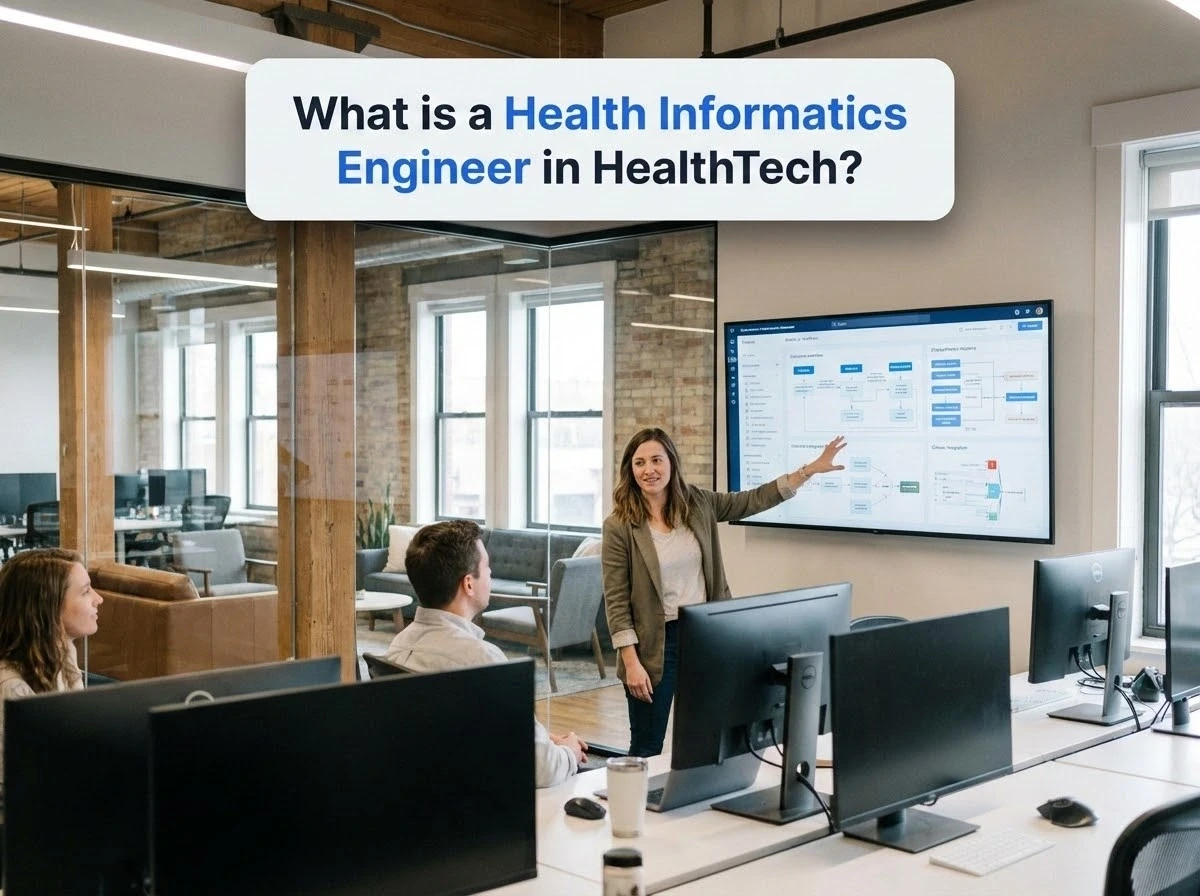
What is a Health Informatics Engineer in HealthTech?
A Health Informatics Engineer in HealthTech is an engineer responsible for ensuring clinical and operational data moves safely, correctly, and usefully between systems so that care teams, patients, and services can rely on it in real time. In practice, this often means owning interoperability: how events like admissions, orders, results, medications, documents, and appointments are represented, transmitted, validated, stored, and observed across multiple products and partners.
This role exists because healthcare data is not just information. It is part of care delivery. When data is late, duplicated, mis-mapped, or misrouted, the impact is felt as missed follow-ups, clinical risk, operational disruption, and loss of trust. A Health Informatics Engineer is therefore measured less by how many integrations they build, and more by whether the data exchange is dependable under pressure: during outages, partial deployments, vendor changes, and high-stakes incidents.
Ownership comes first. A strong Health Informatics Engineer takes responsibility for the end-to-end behaviour of data flows: what goes in, what comes out, and what users experience when something goes wrong. Methods, standards, and tooling matter, but they are secondary to accountability for correctness, safety, and service reliability.
🔍 How this role differs in HealthTech
In many tech sectors, integration work is primarily about speed, convenience, and product breadth. Ship the API, automate the workflow, optimise the funnel. In HealthTech, the same technical decisions carry a different weight because they sit closer to clinical decision-making, regulated environments, and data that cannot be "approximately right".
Data sensitivity changes the engineering posture. You typically have stricter expectations around access control, traceability, and separation of duties, and you may need to design for constrained customer environments (locked-down networks, legacy clinical systems, and rigid change windows). Reliability also means something different: a degraded integration can create hidden harm long before it becomes an obvious outage, because the surface symptom may be a clinician not seeing a result, not receiving an alert, or trusting a stale record.
Finally, the "customer" is rarely a single stakeholder. HealthTech integrations cut across clinical, operational, information governance, security, and vendor teams, each with legitimate constraints. The role is as much about engineering judgement under multi-party constraints as it is about building connectors.
🎯 Core responsibilities in HealthTech
Day to day, a Health Informatics Engineer is accountable for making interoperability predictable. That starts with clarifying what "correct" means in a healthcare context: which system is the source of truth for a demographic field, how identifiers are matched, what constitutes an update versus a new record, and how to represent clinical nuance without inventing semantics the receiving side cannot safely interpret.
Much of the work is decision-making under constraints. You may be designing message flows that must work across multiple sites with different local configurations, while keeping latency low and auditability high. You will frequently trade off between fidelity and operability: choosing, for example, whether to preserve complex clinical structure that downstream systems cannot safely consume, versus simplifying in a way that maintains clinical intent but avoids misinterpretation.
When things break (and they will), the role becomes explicitly operational. You are expected to diagnose quickly, communicate clearly to mixed audiences, contain risk, and restore service without creating downstream data corruption. The best Health Informatics Engineers do not just "fix the interface"; they harden the system: better observability, clearer runbooks, safer retry behaviour, improved validation, and tighter governance over changes so the same failure mode does not recur.
🧩 Skills and competencies for HealthTech
Core Skill | HealthTech specific requirement | Reason or Impact |
|---|---|---|
Data correctness and semantic judgement | Ability to reason about clinical meaning, not just data types, and to validate whether mappings preserve intent across systems | Prevents subtle clinical and operational errors that look "technically successful" but are unsafe or misleading |
Interoperability ownership | Comfort owning end-to-end flows across multiple organisations, including what happens during partial failures and downstream constraints | Improves reliability and reduces the "it's not our system" gap that causes prolonged incidents |
Risk-based decision-making | Knowing when to block a release, constrain a feature, or introduce manual controls because the risk profile demands it | Protects patient safety, reduces regulatory exposure, and preserves customer trust during change |
Operational discipline | Designing for monitoring, traceability, and fast diagnosis, with an emphasis on safe recovery and data reconciliation | Shortens time-to-restore whilst reducing the chance of silent data loss or duplicated clinical events |
Stakeholder communication under pressure | Ability to explain issues and trade-offs to clinical, operational, governance, and vendor audiences without oversimplifying | Enables faster incident coordination and better decisions about containment, downtime processes, and remediation |
Security and privacy judgement | Applying least-privilege access, defensible audit trails, and careful handling of identifiers and sensitive attributes | Reduces breach risk and supports contractual and governance requirements common in HealthTech deployments |
Change management in constrained environments | Planning rollouts that respect limited maintenance windows, varied site configurations, and strict approval processes | Minimises service disruption and avoids "works in staging" failures that are costly in live care settings |
💷 Salary ranges in UK HealthTech
Compensation for Health Informatics Engineers in UK HealthTech is driven less by "coding ability" in isolation and more by scope of ownership: the number of integrations and customers you support, whether you own incident response, how safety-critical the workflows are, and how much ambiguity you are expected to resolve without escalation. Location still matters, but the gap narrows when roles are remote and when the role includes on-call expectations, high customer exposure, or niche interoperability expertise.
Experience level | Estimated annual salary range | What drives compensation |
Junior | London & South East: £35,000–£45,000 | Supervised delivery, narrower integration scope, limited on-call, and lower expectation of independent incident ownership |
Mid-level | London & South East: £45,000–£60,000 | Owning integrations end-to-end for key pathways, stronger production support responsibility, and ability to work across teams without heavy guidance |
Senior | London & South East: £60,000–£80,000 | Technical authority on interoperability design, higher incident accountability, complex partner/vendor coordination, and governance-aware delivery |
Lead | London & South East: £80,000–£105,000 | Ownership across multiple products/customers, setting standards and review quality, mentoring, and being a primary escalation point for high-impact incidents |
Head / Director | London & South East: £105,000–£150,000 | Organisational accountability for interoperability outcomes, customer risk management, resourcing and operating model design, and executive-level decision-making during critical events |
Typical add-ons beyond base include performance bonus (often tied to company and delivery outcomes), equity in venture-backed firms, and on-call compensation where the role supports production integrations. On-call can range from modest allowances for low-frequency escalation to more meaningful uplifts when coverage is frequent, incidents are high-impact, or the engineer is a primary resolver. Total compensation varies most with the criticality of the workflows supported, the breadth of customer environments owned, and whether you are expected to lead incident response and remediation across organisational boundaries.
🚀 Career pathways
Common entry points include software engineering with a focus on integrations, data engineering with healthcare exposure, or roles in clinical systems support where you have developed strong operational instincts and domain understanding. Some people also enter from implementation or interoperability consultancy, then move in-house once they have proven they can own production outcomes rather than just deliver projects.
Progression is usually a widening of responsibility. Early on, you will be trusted to implement and support defined interfaces with clear requirements. At mid and senior levels, you are expected to resolve ambiguity: agreeing semantics with stakeholders, designing safer failure behaviour, and making calls that balance clinical risk, customer constraints, and product priorities.
Lead and Head/Director progression is defined by ownership at scale: setting the interoperability strategy, establishing governance and operating rhythms, and ensuring the organisation can run safely through incidents, vendor changes, and growth. Titles matter less than whether you are accountable for outcomes across multiple systems, multiple customers, and multiple teams.
❓ FAQ
Do I need to be a clinician to become a Health Informatics Engineer?
No, but you do need genuine comfort with clinical context and the humility to validate assumptions. Hiring teams typically look for evidence you can preserve clinical meaning in data flows and communicate well with non-technical stakeholders. Domain knowledge can be learned; poor judgement under healthcare constraints is harder to fix.
What does interview assessment usually focus on for this role?
Expect scenario-based evaluation: diagnosing broken integrations, reasoning about identifiers and data correctness, and explaining safe rollout and recovery plans. Strong candidates show they can balance speed with risk, and that they think operationally (monitoring, alerting, auditing, and incident handling), not just implementation.
How common is on-call for Health Informatics Engineers in HealthTech?
It is common when you support production interoperability for multiple customers or safety-critical pathways, especially where your team is the escalation point. The intensity varies widely: some organisations have infrequent escalations with clear runbooks, whilst others expect deeper involvement in incident resolution and post-incident remediation. You should ask explicitly about rota frequency, first/second-line split, and what "out of hours" actually entails.
🔎 Find your next role
If you are ready to own real-world data flows that directly affect care delivery, search Health Informatics Engineer roles on Meeveem.
You might also like