Published Date: December 30, 2025
Updated Date: December 30, 2025
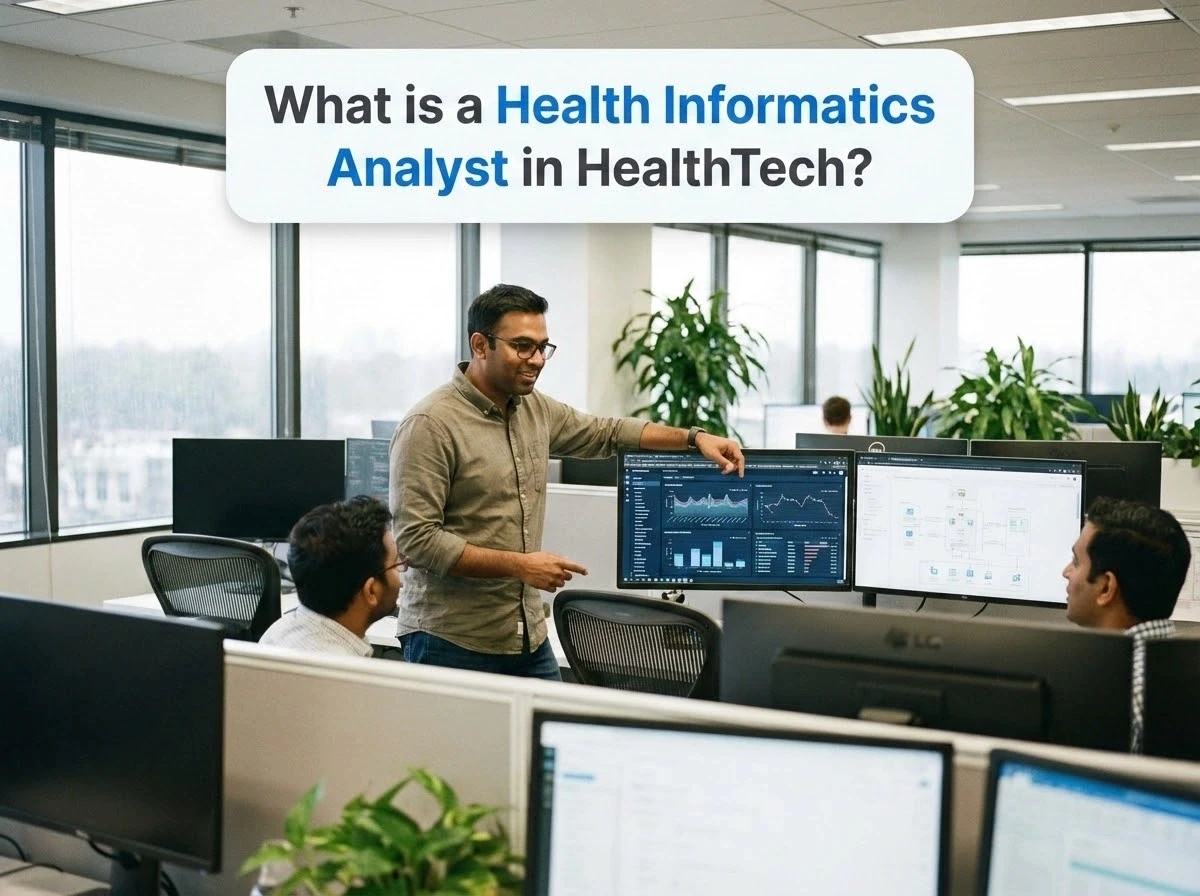
What is a Health Informatics Analyst in HealthTech?
A Health Informatics Analyst in HealthTech is the person accountable for turning clinical and operational data into decisions the business can safely act on, without breaking trust, compromising care, or misrepresenting outcomes. They sit at the intersection of product, clinical operations, data, and engineering, and they own the integrity of "what the numbers mean" in contexts where those numbers can affect real patients, regulated reporting, and funding.
This role exists because healthcare data is uniquely messy, consequential, and context-dependent. The same field can be captured differently across services, a coding change can alter apparent outcomes overnight, and an "improvement" in one metric can conceal harm elsewhere. HealthTech organisations need someone who can take responsibility for interpretation, not just extraction: defining what should be measured, validating what is true, and making sure insights are safe to operationalise.
In practice, the Health Informatics Analyst is often the steward of clinical truth inside a technical organisation. They align stakeholders on definitions, surface risk, and ensure decisions remain defensible when challenged by clinicians, auditors, or partners.
🔍 How this role differs in HealthTech
In many tech industries, analysts can optimise for growth, revenue, or engagement with relatively clean feedback loops. If a dashboard is slightly wrong, the impact is usually commercial and reversible. In HealthTech, incorrect interpretation can drive clinical workflow changes, mislead care teams, distort reported quality, or create downstream safety issues. That changes the threshold for evidence, documentation, and how confidently a recommendation can be rolled out.
HealthTech also raises the bar on data handling. Analysts are expected to operate fluently within privacy, governance, and consent constraints, and to assume that any dataset may be incomplete, biased, or contextually wrong. "What is measurable" is often limited by system interoperability, clinical coding variation, and operational reality, so the work becomes as much about negotiating safe approximations as it is about analysis.
Finally, the role is shaped by a strong partnership model. Health Informatics Analysts spend substantial time translating between clinical language and technical implementation, because a technically correct metric that isn't clinically meaningful is functionally incorrect.
🎯 Core responsibilities in HealthTech
Day to day, a Health Informatics Analyst is accountable for making health data usable for decisions while protecting clinical meaning and patient safety. They are often the person who has to say "this number isn't reliable yet" and explain why, whether it's missingness in key fields, a change in coding practice, a workflow shift, or a system migration that quietly altered definitions.
A typical week includes working with product and clinical stakeholders to agree success measures, shaping data capture so that future analysis is valid, and validating reporting outputs so that teams don't build features or processes on shaky assumptions. They routinely balance speed against assurance. Shipping insight quickly is valuable, but in HealthTech it must be coupled with clear caveats, confidence levels, and an understanding of how the insight will be used in real settings.
Trade-offs are constant. You may accept a proxy metric because it's the only feasible option, but only after testing it against clinical reality, documenting limitations, and designing monitoring so errors are caught early. You may simplify a model because transparency is essential for clinical adoption. And you often have to choose between a "perfect" dataset and a "timely enough" dataset that supports safe operational decisions now.
🧩 Skills and competencies for HealthTech
Core Skill | HealthTech specific requirement | Reason or Impact |
|---|---|---|
Clinical-context translation | Convert clinical workflows, pathways, and coding behaviours into measurable, testable definitions without losing meaning | Prevents analytics that look valid technically but are clinically misleading, which can drive unsafe decisions |
Data integrity ownership | Treat data quality as a product risk, not a hygiene task: define validity checks, lineage expectations, and sign-off standards | Protects reporting credibility with partners and avoids "dashboard truth" diverging from clinical reality |
Risk-based judgement | Calibrate confidence, caveats, and rollout recommendations based on patient impact and operational criticality | Ensures decisions are proportional: stricter assurance for safety-critical insights, faster iteration for low-risk areas |
Stakeholder governance | Run alignment on definitions, metric ownership, and change control across product, clinical ops, and engineering | Reduces metric churn and prevents silent definition drift that invalidates trend analysis |
Ethical and privacy-aware analysis | Work within confidentiality and access constraints whilst still producing actionable insight | Minimises exposure risk and supports compliant use of sensitive data without paralysing decision-making |
Communication under scrutiny | Explain assumptions, limitations, and implications in plain language that withstands challenge | Builds trust with clinicians and leaders and reduces the chance of overconfident interpretation becoming policy |
💷 Salary ranges in UK HealthTech
Health Informatics Analyst pay in HealthTech is primarily a function of decision risk and accountability: whether you're shaping clinical workflows versus reporting them, owning metric governance versus producing one-off analyses, and whether your outputs influence regulated reporting, contractual outcomes, or safety-critical operations. Location still matters, but seniority is often defined less by years and more by ownership: who signs off definitions, who defends the numbers externally, and who is responsible when insight is wrong.
Experience level | Estimated annual salary range | What drives compensation |
Junior | London & South East: £32,000–£42,000 | Supervised delivery, smaller scopes, lower-risk reporting, limited responsibility for metric governance |
Mid-level | London & South East: £42,000–£55,000 | Independent analysis ownership, stakeholder management, reliable reporting pipelines, stronger validation standards |
Senior | London & South East: £55,000–£72,000 | Ownership of definitions and data quality strategy, cross-team influence, higher scrutiny, leading complex ambiguity |
Lead | London & South East: £70,000–£90,000 | Accountability for analytics direction, governance, and prioritisation; mentoring; partnering closely with clinical/product leadership |
Head / Director | London & South East: £90,000–£125,000 | Organisational accountability, external credibility, risk management, budget ownership, and oversight of regulated/partner reporting |
Typical add-ons vary by company maturity and operating model. Some HealthTech employers offer bonuses tied to company performance or delivery goals. Equity is more common in venture-backed organisations and tends to increase with seniority and breadth of responsibility. On-call is less universal than in core infrastructure roles, but can appear where the analyst function supports time-critical clinical operations, incident response for reporting pipelines, or partner commitments. Where it exists, allowances and compensatory time can materially change total compensation. Variation is also driven by domain complexity (acute versus community versus social care), proximity to regulated reporting, and how directly the role influences clinical workflow decisions.
🚀 Career pathways
Common entry points include data analysis roles in healthcare settings, clinical coding or information roles, operational reporting roles, or analytics positions in adjacent regulated domains. Some candidates arrive via clinical or life-science backgrounds and build technical depth. Others come from analytics and develop clinical context and governance muscle. What matters early is learning how healthcare data is created, and how easily it can be misinterpreted if you ignore workflow reality.
Progression typically expands through ownership. You move from producing accurate outputs to defining what should exist, then to governing definitions across teams, and finally to shaping how the organisation makes decisions with data. As responsibility grows, the work becomes less about creating reports and more about setting standards, managing risk, influencing product direction, and building systems and teams that keep insight trustworthy at scale.
❓ FAQ
Do I need clinical experience to become a Health Informatics Analyst in HealthTech?
Not always, but you do need the ability to learn clinical workflows fast and to work credibly with clinicians. Employers typically look for evidence you can translate domain ambiguity into defensible definitions and communicate limitations clearly. Clinical experience can accelerate trust, but strong governance and analytical judgement can compensate.
What will I be evaluated on in interviews: tools or decision-making?
In strong HealthTech teams, you'll be assessed on how you validate data, handle definition disputes, and choose safe trade-offs under constraints. Expect scenario questions about missing data, coding changes, conflicting stakeholder expectations, and how you'd prevent metric drift over time. Tools matter, but judgement and accountability are usually the differentiator.
Is on-call common for Health Informatics Analysts in HealthTech?
It depends on whether the company runs time-critical reporting or supports operational services that can't wait for business hours. Some roles are strictly office-hours, whilst others include incident support when pipelines fail or partner reporting deadlines are at risk. If on-call exists, clarify frequency, response expectations, and whether the rota is shared across analytics/engineering.
🔎 Find your next role
Ready to apply your analytical judgement where it materially affects care? Search Health Informatics Analyst roles on Meeveem.
You might also like